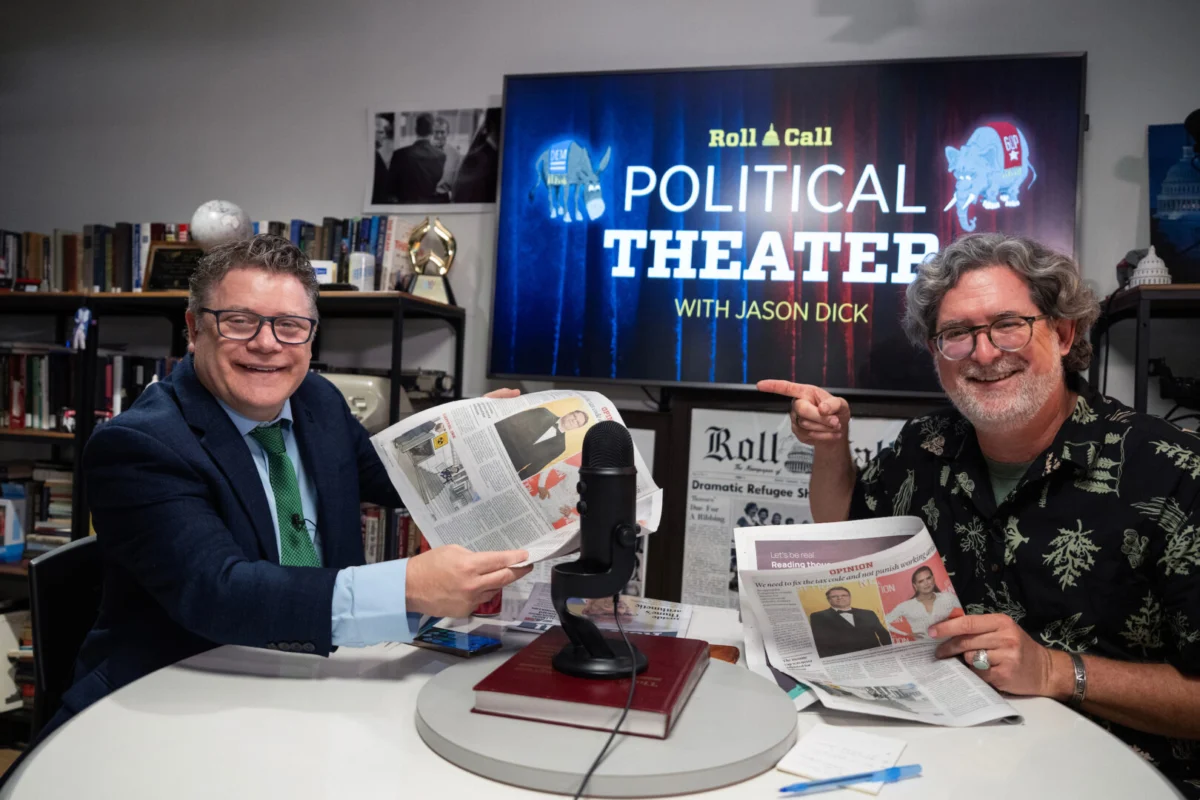
WASHINGTON D.C. – July 1, 2026 – The intersection of entertainment, labor, and national politics took center stage in Washington this Wednesday, as Sean Astin, the widely recognized president of the Screen Actors Guild-American Federation of Television and Radio Artists (SAG-AFTRA), visited the CQ Roll Call newsroom. Astin, a veteran actor known for iconic roles in "The Goonies," "Rudy," and "The Lord of the Rings" trilogy, engaged in a robust discussion on the "Political Theater" podcast, shedding light on his extensive work and advocacy at the helm of one of Hollywood’s most influential unions.
Pictured alongside Jason Dick, Editor-in-Chief of CQ Roll Call, Astin’s presence underscored the growing importance of entertainment industry labor issues within the broader national dialogue. His appearance signals a proactive approach by SAG-AFTRA to amplify its concerns and policy objectives directly to Washington’s political and journalistic elite, moving beyond the traditional confines of Hollywood. The conversation delved into the complex challenges facing performers and media professionals in an era defined by rapid technological shifts, evolving media consumption, and persistent calls for fair compensation and robust worker protections.
Main Facts: A Union Leader’s D.C. Outreach
Sean Astin’s visit to CQ Roll Call for the "Political Theater" podcast was far more than a casual media appearance; it was a strategic engagement designed to bridge the gap between the creative industries and the nation’s capital. As President of SAG-AFTRA, Astin represents over 160,000 actors, broadcasters, recording artists, and other media professionals, navigating a landscape increasingly reshaped by streaming services, artificial intelligence, and global production models. His discussion with Jason Dick focused intensely on his advocacy efforts, highlighting the union’s ongoing fight for equitable contracts, intellectual property rights, and the future viability of careers in entertainment and media.
The podcast, a staple for those tracking the nuances of Washington policy and politics, offered Astin a unique platform to articulate SAG-AFTRA’s legislative priorities. These likely included issues such as the regulation of AI in creative content, the protection of performers’ likenesses and voices, and ensuring sustainable residual structures in a streaming-dominated world. His presence in the capital’s journalistic heart signifies a concerted effort to ensure that the voices and concerns of Hollywood’s workforce resonate beyond the studios and into the halls of power where critical decisions are made. Astin’s dual identity as a celebrated performer and a formidable labor leader lends significant weight to his message, making him a compelling advocate for a workforce often misunderstood by those outside the industry.
Chronology: Astin’s Path to Advocacy and SAG-AFTRA’s Recent History
Sean Astin’s journey to the presidency of SAG-AFTRA is a testament to a deep-seated commitment to his fellow performers and the industry that shaped his life. While many know him for his on-screen charisma, Astin has a long history of involvement in union affairs, predating his ascension to the top office. His activism grew from a firsthand understanding of the evolving challenges faced by working actors, from the unpredictable nature of employment to the shifting paradigms of compensation.
Astin’s leadership comes at a pivotal moment for SAG-AFTRA, following a period of unprecedented labor action that reverberated across Hollywood and beyond. The year 2023 marked a historic turning point, with both the Writers Guild of America (WGA) and SAG-AFTRA launching simultaneous strikes against the Alliance of Motion Picture and Television Producers (AMPTP). These strikes, lasting for months, brought the entertainment industry to a near standstill, drawing international attention to critical issues such as residuals from streaming content, the existential threat of generative artificial intelligence, and fair working conditions.
Astin, who was elected to his first term as President in 2021 and subsequently re-elected, played a crucial role in navigating these tumultuous negotiations. He emerged as a vocal proponent for stronger protections against AI exploitation, a champion for improved minimums and benefits, and a fierce advocate for a more equitable share of streaming revenues for performers. His presidency has been defined by a proactive stance, pushing for legislative solutions in Washington and fostering solidarity among union members. The aftermath of the 2023 strikes saw some gains, but many issues, particularly concerning the rapid advancement of AI and the long-term sustainability of creative careers, remain front and center on SAG-AFTRA’s agenda. Astin’s current outreach in Washington is a direct continuation of these efforts, aiming to solidify legislative support and maintain momentum on these critical fronts.
The "Political Theater" podcast, hosted by CQ Roll Call, has historically served as a platform for political figures, policy experts, and influential leaders to dissect current events and policy implications. Astin’s invitation signifies the podcast’s recognition of the entertainment industry’s increasingly significant role in national economic and social policy discussions. It allows a detailed exploration of how Hollywood’s labor dynamics intersect with broader American labor movements, technological innovation policies, and even intellectual property law, bringing these nuanced discussions to a politically engaged audience.
Supporting Data: The Shifting Sands of the Entertainment Economy
The issues Astin champions are not abstract; they are rooted in tangible data reflecting profound changes within the entertainment and media landscape. SAG-AFTRA, with its formidable membership exceeding 160,000 individuals, encompasses a diverse array of professionals, from background actors and stunt performers to leading stars, voice artists, and broadcast journalists. This vast membership contributes billions annually to the U.S. economy, not just through direct production but also through ancillary services and cultural impact.
However, the economic realities for many of these members have become increasingly precarious. Studies and internal union data have repeatedly highlighted a significant decline in residual payments – the long-standing bedrock of income stability for performers – in the streaming era. While traditional broadcast and cable models offered a clear, if diminishing, stream of income from reruns, streaming platforms’ opaque viewership metrics and flat buyout deals have drastically reduced these payments. For many working actors, whose income is often sporadic, residuals historically provided a crucial safety net between projects. The erosion of this system has pushed many closer to the poverty line, struggling to maintain health insurance and basic living standards.
The advent of artificial intelligence presents another layer of complexity and concern. Surveys conducted by SAG-AFTRA and other industry groups reveal widespread anxiety among members regarding AI’s potential to replicate voices, likenesses, and performances without fair compensation or consent. Performers fear that studios could use AI to generate "digital doubles" or synthesized voices, effectively sidelining human talent and devaluing creative work. This isn’t a futuristic dystopia but a present-day challenge, with instances of AI being used in various production capacities already emerging. The union’s push for robust legislative frameworks to govern AI’s use in creative industries is backed by these palpable fears and the potential for massive job displacement.
Furthermore, the economic disparity within the union is stark. While a handful of stars command exorbitant fees, the vast majority of SAG-AFTRA members struggle to reach the minimum earnings threshold required to qualify for union health and pension benefits. This disparity underscores the union’s focus on improving minimum rates and strengthening the overall economic security for its broad membership, not just its most visible figures. By engaging with platforms like "Political Theater," Astin aims to translate these internal economic struggles into compelling arguments for policy intervention, highlighting how the health of the creative workforce impacts the broader cultural and economic fabric of the nation.
Official Responses: Astin’s Vision and Washington’s Ear
During his podcast appearance, Astin likely articulated a clear and compelling vision for the future of creative labor. He would have emphasized the fundamental importance of collective bargaining as the most effective tool to ensure fair treatment and equitable compensation for performers and media professionals. His message would undoubtedly have underscored that the entertainment industry, while glamorous, is fundamentally an industry of workers who deserve the same protections and benefits as any other labor force.
"The creative spirit is the engine of our industry, but it cannot thrive on passion alone," Astin might have stated, echoing sentiments he’s expressed previously. "Our members are skilled professionals, and they deserve to be compensated fairly for their talent and contributions, especially as technology transforms how content is created and consumed. We cannot allow innovation to come at the expense of human artistry and livelihoods." He would have stressed the need for a collaborative approach with studios and streaming platforms, but one grounded in mutual respect and a commitment to shared prosperity.
Jason Dick, CQ Roll Call’s Editor-in-Chief, likely guided the conversation to delve into the specifics of SAG-AFTRA’s legislative agenda. His questions would have aimed to unpack the complexities of AI regulation, the union’s stance on intellectual property in the digital age, and the broader implications of Hollywood labor disputes for federal labor policy. Dick’s decision to host Astin reflects a recognition that these issues are no longer niche industry concerns but critical elements of the national economic and regulatory discourse.
Beyond the podcast, Astin’s visit to Washington would undoubtedly include meetings with key lawmakers and congressional staff. While specific "official responses" from legislators wouldn’t be public immediately, the purpose of such outreach is to educate, advocate, and build bipartisan support for SAG-AFTRA’s objectives. Lawmakers are increasingly aware of the political and economic power of the entertainment industry, and listening to a prominent figure like Astin, who embodies both the creative and labor aspects, is crucial for crafting informed policy. The conversations would likely touch upon the need for federal legislation to establish clear guidelines for AI’s use in creative works, strengthen copyright protections, and potentially explore new models for worker classification in the gig economy that now permeates many creative fields.
Implications: The Future of Creative Labor and Hollywood’s Political Clout
Sean Astin’s proactive engagement in Washington carries significant implications for the future of the entertainment industry and the broader landscape of American labor. His advocacy signifies a deepening commitment by SAG-AFTRA to ensure that the unique challenges faced by creative professionals are addressed not just at the bargaining table, but also through federal policy and legislation. This strategic outreach acknowledges that the digital revolution and the rise of AI demand a legislative response that traditional collective bargaining alone may not fully encompass.
The ongoing dialogue between Hollywood’s labor leaders and Washington could pave the way for landmark legislation concerning intellectual property in the age of AI. Such laws might establish frameworks for consent and compensation when AI is used to replicate human performance, potentially setting precedents for other industries grappling with similar technological disruptions. Furthermore, Astin’s efforts aim to ensure that the economic models of streaming platforms are scrutinized, pushing for greater transparency and more equitable distribution of revenue to the content creators who drive their success. This could lead to congressional hearings, new regulatory proposals, and a re-evaluation of existing copyright and labor laws.
Beyond specific legislative outcomes, Astin’s visit reinforces the growing political clout of Hollywood’s unions. The 2023 strikes demonstrated the industry’s capacity for collective action and its ability to capture national attention. By consistently engaging with policymakers, SAG-AFTRA, under Astin’s leadership, is solidifying its position as a formidable voice in Washington, capable of influencing policy decisions that affect not only its members but also the broader creative economy. This could inspire other labor unions facing similar challenges from automation and changing work models to intensify their own federal advocacy efforts.
Ultimately, Astin’s appearance on "Political Theater" is a powerful reminder that the stories told on screen, the music we listen to, and the news we consume are all products of human labor. As technology continues to evolve at an unprecedented pace, the fight for fair compensation, ethical AI practices, and robust worker protections will define the future of these industries. Sean Astin, the actor turned union president, is firmly positioned at the forefront of this critical battle, ensuring that the voice of the creative worker is heard loud and clear in the nation’s capital. His continued efforts will shape not just the careers of thousands of performers, but the very nature of creative work in the 21st century.