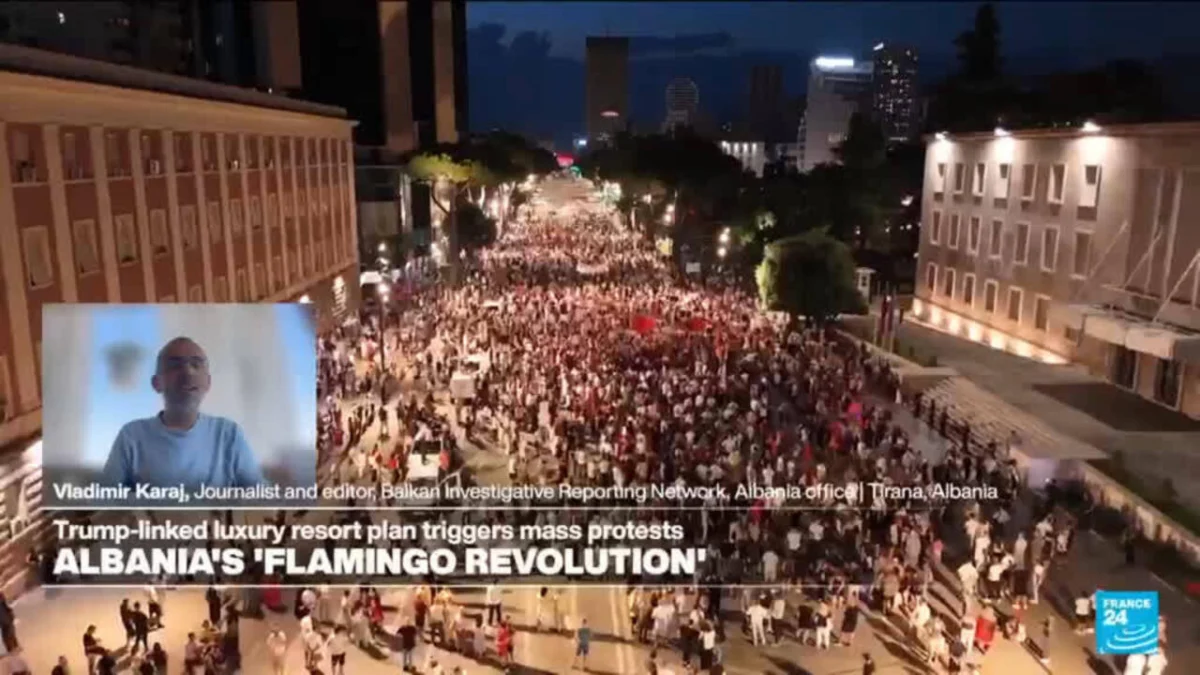
TIRANA – The rugged, sun-drenched coastline of Albania, long touted as Europe’s “last hidden gem,” has become the epicenter of a fierce socio-political firestorm. What began as a government-sanctioned proposal for a luxury resort project—linked to Jared Kushner and the Trump family—has ignited what locals are now calling the “Flamingo Revolution.”
The protests, which have paralyzed key thoroughfares in the capital of Tirana and drawn thousands to the Sazan Island archipelago, represent a critical junction in Albania’s post-communist history. At the heart of the conflict lies a clash between the country’s aggressive push for high-end tourism and the preservation of its ecological and sovereign integrity.
I. Main Facts: The Genesis of the Conflict
The controversy centers on a multi-billion dollar development deal involving Affinity Partners, the investment firm led by Jared Kushner, former advisor to Donald Trump. The proposed development is slated for the Zvërnec region and Sazan Island—a former military fortress turned protected nature reserve.
The project, which has been dubbed “The Flamingo” by local activists due to the sensitive wetland habitats it threatens, promises a luxury oasis complete with high-end villas, a marina, and a boutique hotel complex. Proponents, including the Albanian government, argue that the development will inject much-needed capital into the economy, create thousands of jobs, and elevate Albania’s profile as a premier destination for global elites.
However, the opposition views the deal as a “fire sale” of national heritage. Critics allege that the legal framework was fast-tracked to bypass environmental impact assessments, and that the concessions granted to foreign developers prioritize private profit over the public’s right to access coastal land.
II. Chronology of the “Flamingo Revolution”
The escalation of the crisis can be tracked through a series of rapid developments that have pushed the Balkan nation to the brink:
- January 2026: Initial reports emerge of high-level meetings between the Albanian Ministry of Tourism and international investors, including representatives from the Trump-linked Affinity Partners.
- March 2026: The Albanian Parliament passes a controversial amendment to the "Law on Protected Areas," loosening restrictions on construction within national parks and protected coastal zones.
- April 2026: Environmental NGOs and local civil society groups file an injunction, claiming the law change violates the Aarhus Convention. The courts, citing “economic urgency,” dismiss the motion.
- May 15, 2026: The first "Flamingo" protest is held in Tirana, drawing a modest crowd of 500 activists.
- June 10, 2026: Images of heavy machinery being offloaded onto the Sazan Island ferry port go viral. The images spark national outrage, as the area is designated as a protected biosphere reserve.
- June 22, 2026: A massive general strike is called. Protesters occupy the Ministry of Environment, leading to violent clashes with riot police.
- June 28, 2026: As of today, the protests have entered their sixth day of sustained occupation, with international observers expressing concern over potential escalation.
III. Supporting Data: The Ecological and Economic Stakes
To understand the intensity of the resistance, one must look at the data surrounding the disputed regions.
Ecological Impact
The Zvërnec wetlands are home to the Dalmatian Pelican and the Greater Flamingo, species protected under both Albanian law and the Mediterranean Action Plan. Ornithologists warn that the dredging required for the proposed luxury marina would permanently destroy the brackish water ecosystem, leading to the collapse of local biodiversity.
- Biodiversity Index: Environmental audits indicate that the Sazan-Karaburun Marine Park houses over 40 endangered species of Mediterranean flora and fauna.
- Soil Erosion: Construction experts have noted that the limestone-heavy terrain of the proposed site is highly susceptible to erosion, and large-scale infrastructure could trigger irreparable geological instability.
Economic Context
Albania’s economy is heavily reliant on tourism, which accounts for roughly 20% of the GDP. The government argues that high-end tourism is the only way to avoid the “low-cost, low-quality” trap.
- Investment Figures: The Kushner-linked project is valued at approximately $1.2 billion, representing one of the largest single foreign direct investments in Albania’s history.
- Job Creation Claims: The government claims the project will generate 3,500 permanent jobs. However, labor unions argue that these roles will be restricted to low-wage service positions, while high-level management will be imported, leaving the local workforce marginalized.
IV. Official Responses: A Nation Divided
The response from the Albanian government has been one of staunch defiance. Prime Minister Edi Rama has publicly labeled the protesters as “reactionary forces” attempting to sabotage Albania’s modernization.

“We are not selling our country,” the Prime Minister stated in a televised address on June 25th. “We are inviting the world to see the transformation of a nation that was once isolated and is now a hub for international investment. Those who oppose this are opposing the prosperity of their children.”
Conversely, the opposition parties and civil society leaders, led by the "Coalition for the Coast," argue that the deal was negotiated behind closed doors with zero transparency.
“This is not an investment; it is an enclave,” says Dr. Elena Hoxha, an environmental sociologist at the University of Tirana. “When you hand over public land to a private entity with ties to foreign political figures, you aren’t building a national economy; you are creating a colonial-style outpost where local laws and local people are treated as obstacles to be removed.”
V. Implications: Regional Stability and Global Optics
The “Flamingo Revolution” has implications that extend far beyond Albania’s borders.
The Trump Connection
The involvement of the Trump-linked Affinity Partners has turned a local zoning dispute into an international geopolitical event. Critics of the former U.S. President see this as a test case for how his business network interacts with foreign governments. If the project proceeds, it could set a precedent for “political capitalism” in the Western Balkans, where international political influence is traded for massive real estate concessions.
Democratic Backsliding
Observers from the European Union have expressed unease. While the EU generally supports economic integration, the blatant disregard for environmental regulations and public dissent has raised questions about Albania’s commitment to the rule of law.
“The health of a democracy is measured by its ability to protect the common good against the interests of the powerful,” said a spokesperson for the European Environmental Bureau. “The situation in Albania is a canary in the coal mine for the region.”
The Future of the Coast
If the protests succeed, it could mark a turning point for Mediterranean environmentalism, signaling to developers that coastal protection is no longer an optional hurdle, but a fundamental pillar of national identity. If they fail, the “Flamingo” project will likely become a permanent monument to the tension between the globalized desire for luxury and the local necessity for ecological and political self-determination.
As the standoff continues into the heat of the summer, the world is watching. Albania, a nation that has struggled for decades to find its place in the modern world, now finds itself the stage for a fundamental question: Is the price of development worth the soul of the land?
For now, the protesters on the front lines remain resolute. They are not merely fighting against a resort; they are fighting for the right to define the future of their own coast, one flamingo at a time.