By Daniela Altimari (with additional reporting and analysis by CQ Roll Call Campaign Team)
Welcome to a special edition of At the Races! Throughout the 2026 primary season, watch for these updates from the CQ Roll Call campaign team on what you need to know for Election Day. Know someone who’d like to get this newsletter? They can subscribe here.
BATON ROUGE, La. – The political landscape of Louisiana is poised for a significant shift this Saturday as Republican voters head to the polls for a pivotal Senate primary runoff. This contest, which follows the stunning ouster of two-term GOP incumbent Bill Cassidy in last month’s initial primary, has quickly become a national bellwether, scrutinizing the enduring influence of former President Donald Trump’s endorsements in deep-red states.
At the heart of the Republican runoff is a high-stakes battle between Rep. Julia Letlow, who entered the race with the coveted endorsement of President Trump, and state Treasurer and former Rep. John Fleming. The outcome will not only determine the Republican standard-bearer for the general election but will also serve as a potent indicator of the GOP’s internal ideological currents as the 2026 midterm cycle gains momentum.
Letlow, a former university administrator whose political career began under tragic circumstances, secured a commanding first-place finish in the initial primary round, capturing 45 percent of the vote. Her closest competitor, Fleming, garnered 28 percent. While Letlow’s lead appeared substantial, recent analyses and on-the-ground reports from Louisiana suggest that the runoff could be tightening considerably, setting the stage for a dramatic photo finish.
This Saturday’s vote is more than just a local election; it’s another critical test of the power and efficacy of a Trump endorsement in Republican primaries. While the former president has enjoyed a mixed record in gubernatorial races this cycle, his Senate picks, including Texas Attorney General Ken Paxton and Georgia Rep. Mike Collins, have largely prevailed, reinforcing his sway over a significant portion of the Republican base. The Louisiana Senate race will add another chapter to this ongoing narrative, with national implications for party unity and future election strategies.
Adding to the complexity, Louisiana Democrats are also holding their Senate primary runoff on Saturday. Farmer Jamie Davis and Navy veteran Gary Crockett are vying for their party’s nomination. Davis led Crockett 47 percent to 26 percent in the initial round. However, in a state that Trump carried by a commanding 22 points in 2024, the Democratic winner will face an uphill battle, entering the general election as a heavy underdog. Democrats have not won a Senate election in Louisiana since Mary L. Landrieu secured her third and final term in 2008, underscoring the deep-seated conservative leanings of the Pelican State.
The Republican Showdown: A Clash of Endorsements and Experience
The race between Julia Letlow and John Fleming encapsulates a broader struggle within the Republican Party: the power of the Trump brand versus long-standing conservative credentials and grassroots appeal.
Rep. Julia Letlow’s journey to Congress is marked by profound personal tragedy. She first came to national attention in 2020 when her husband, Luke J. Letlow, died of COVID-19 complications just days before he was scheduled to be sworn into the same congressional seat she now holds. His untimely passing prompted her to run in the subsequent special election, which she won decisively in 2021. Her story of resilience and dedication resonated deeply with voters, and she quickly established herself as a rising star within the party.
Her Senate bid received a significant boost when President Trump endorsed her even before she officially launched her campaign. This early backing was a direct consequence of Trump’s lingering anger over incumbent Senator Bill Cassidy’s 2021 vote to convict him during his second impeachment trial. Trump has since reiterated his support for Letlow multiple times, casting her as the true "America First" candidate for Louisiana. Her campaign has heavily leveraged this endorsement, portraying her as aligned with the conservative populist movement that defines a large segment of the GOP base.
On the other side is John Fleming, a seasoned politician with a lengthy track record in Louisiana politics. A physician by training, Fleming served four terms in Congress, beginning in 2009, and was a founding member of the influential House Freedom Caucus, a conservative bloc known for its fiscal hawkishness and commitment to limited government principles. He left the House in 2016 for an unsuccessful bid for Louisiana’s other Senate seat, demonstrating his consistent ambition for higher office. Since 2024, he has served as Louisiana’s state treasurer, a position that has allowed him to maintain a statewide profile. Fleming’s campaign emphasizes his deep conservative roots, his long history of fighting for conservative causes, and his experience in both federal and state government, often subtly positioning himself as a more authentically conservative choice, even while acknowledging Trump’s popularity.
Chronology of a Political Earthquake
The path to this runoff has been anything but conventional, marked by a confluence of national political currents and deeply personal events.
2021: The Impeachment Catalyst
The seeds of Senator Bill Cassidy’s defeat were sown in February 2021, when he was one of seven Republican senators who voted to convict then-President Donald Trump on an impeachment charge of inciting an insurrection. This vote, while praised by some as a principled stand, instantly drew the ire of Trump and his most loyal supporters. For many in deeply conservative Louisiana, Cassidy’s vote was seen as a betrayal, a sentiment that simmered and grew over the ensuing years. Trump, known for his long memory regarding perceived disloyalty, began to actively seek a challenger to Cassidy.
2022-2025: Letlow’s Rise and Trump’s Endorsement
Following her special election victory in 2021, Rep. Julia Letlow quickly established herself as a conservative voice in the House. Her legislative focus often aligned with mainstream Republican priorities, but it was her personal narrative and a growing relationship with the Trump wing of the party that set her apart. Recognizing her potential and the opportunity to punish Cassidy, Trump extended his endorsement to Letlow even before she officially announced her Senate bid for the 2026 cycle. This early and enthusiastic backing signaled a clear intent from the former president to exert his influence in Louisiana. Letlow’s campaign capitalized on this immediately, integrating Trump’s support into all messaging and campaign materials.
2025: Fleming Enters the Fray
John Fleming, having served as state treasurer since 2024 and with a long history in Congress, saw an opening. Despite Trump’s early endorsement of Letlow, Fleming, a staunch conservative and former House Freedom Caucus member, decided to enter the race. His rationale was rooted in his belief that his extensive experience and established conservative bona fides would resonate with voters. Fleming’s entry ensured a robust challenge from the right, preventing Letlow from having a clear path even with Trump’s backing.
Primary Election Day (Last Month): The Incumbent’s Fall
The primary election last month delivered a political shockwave across Louisiana and the nation. Senator Bill Cassidy, despite a significant fundraising advantage and the benefits of incumbency, was decisively rejected by Republican voters. His failure to even make the runoff, finishing a distant third, underscored the potent combination of Trump’s active opposition and a palpable anti-establishment sentiment within the state GOP. Julia Letlow’s strong first-place finish, securing 45 percent of the vote, confirmed the power of the Trump endorsement and her personal appeal. John Fleming’s 28 percent was sufficient to secure the second runoff spot, setting up the current head-to-head battle.
The Runoff Campaign: A Tightening Race
In the weeks leading up to Saturday’s runoff, the campaign has intensified. Letlow has continued to champion her alignment with President Trump’s agenda, emphasizing her commitment to conservative principles and her fresh perspective. Fleming, meanwhile, has ramped up his messaging on his proven conservative record, his fiscal responsibility as state treasurer, and his deep roots in Louisiana. Reports from local media and campaign strategists indicate that while Letlow held a significant lead post-primary, Fleming’s campaign has gained momentum, driven by a strong grassroots effort and an appeal to voters who prioritize legislative experience and a consistent conservative voting record. This tightening has transformed the runoff from a seemingly predictable outcome into a genuine nail-biter.
Supporting Data and Campaign Dynamics
The numbers from the initial primary provided a clear snapshot of voter sentiment, but the runoff presents a new dynamic, forcing both candidates to refine their strategies to court a broader segment of the Republican electorate.
Primary Results Analysis:
Julia Letlow’s 45 percent in the primary was a strong showing, indicating that the Trump endorsement, combined with her compelling personal story and existing congressional platform, resonated with a significant portion of Republican voters. Her performance suggests a strong base of support among the MAGA-aligned faction and those looking for a new generation of conservative leadership.
John Fleming’s 28 percent, while trailing Letlow, demonstrated that a substantial number of voters were looking for an alternative. His support likely comes from more traditional conservatives, those who value his long legislative history and his role in the House Freedom Caucus, and potentially some voters who are wary of the full extent of Trump’s influence or prefer a candidate with deeper policy experience.
The remaining votes, primarily those cast for the defeated Bill Cassidy and other minor candidates, are now the key battleground. These voters represent a crucial swing bloc. Some might drift to Fleming, seeing him as a more experienced, albeit still conservative, option. Others might be swayed by the Trump endorsement and gravitate towards Letlow. The ability of each campaign to win over these undecided or previously-aligned voters will determine the outcome.
The "Tightening" Narrative:
Local media reports from outlets like NOLA.com have highlighted a tightening in the race, a common phenomenon in runoffs where the electorate shrinks and specific demographics become more critical. Several factors could contribute to this:
- Fleming’s Ground Game: Without the noise of multiple candidates, Fleming’s campaign can focus its resources on direct voter outreach, door-knocking, and phone banking, leveraging his established networks across the state.
- Conservative Purity Test: Some voters who initially supported Cassidy or other candidates might see Fleming as the more "pure" or consistently conservative option, given his history with the House Freedom Caucus and his tenure in various political roles.
- Trump Endorsement Fatigue: While powerful, the Trump endorsement isn’t universally decisive. A segment of the Republican electorate, even in deep-red states, may be looking beyond endorsements and prioritizing a candidate’s independent record and policy positions.
- Debate Performance and Media Exposure: Runoffs often feature more direct debates and focused media coverage, allowing candidates to distinguish themselves more clearly than in crowded primaries.
Fundraising and Ad Spending:
While specific, real-time runoff fundraising data is often slow to materialize, both campaigns have undoubtedly been active. Letlow likely benefited from national fundraising networks tied to the Trump apparatus, along with her own congressional donor base. Fleming, as a state treasurer and former congressman, would have access to established state-level donors and conservative PACs. The efficacy of their ad buys – targeting specific demographics, leveraging social media, and direct mail – will play a significant role in mobilizing their respective bases and swaying undecided voters in the final days. The type of messaging, whether focusing on "America First" populism (Letlow) or "proven conservative leadership" (Fleming), will be crucial.
Demographic Considerations:
Louisiana’s Republican electorate is diverse, encompassing rural, agricultural communities, suburban areas, and pockets of industrial workers. Both candidates need to demonstrate appeal across these segments. Letlow’s appeal likely extends broadly across the Trump base, particularly in more rural, culturally conservative areas. Fleming’s long history and state treasurer role might give him an edge with older, more established conservative voters and those in business communities. Turnout will be critical, as runoffs typically see lower participation rates than general elections, favoring candidates with highly motivated bases.

The Trump Factor: A Litmus Test for the GOP
The Louisiana Senate runoff is arguably the most significant test of former President Donald Trump’s endorsement power in a Senate primary this cycle. His involvement is not merely a formality; it’s a strategic move to reinforce his authority within the Republican Party and to settle old scores.
Trump’s Endorsement Record:
This cycle has seen Trump deploy his endorsements with strategic precision, particularly in Senate races. His successful backing of candidates like Texas Attorney General Ken Paxton and Georgia Rep. Mike Collins demonstrates that his nod can still be a kingmaker in contested primaries, especially in states where his personal approval ratings among Republicans remain sky-high. However, his record in gubernatorial primaries has been more mixed, with some of his chosen candidates falling short. This inconsistency adds to the intrigue in Louisiana, where a loss for Letlow would represent a rare blow to his influence in a high-profile Senate contest.
Ideological Battle within the GOP:
The race highlights the ongoing ideological tension within the Republican Party. Letlow, as Trump’s chosen candidate, represents the populist, "America First" wing. Her platform aligns closely with Trump’s rhetoric on border security, economic nationalism, and cultural conservatism. Fleming, while undoubtedly conservative, represents a more traditional, establishment-leaning conservatism, albeit one that is still deeply aligned with the party’s right flank through his House Freedom Caucus roots. His campaign’s emphasis on fiscal conservatism, experience, and less direct reliance on the Trump brand, allows him to appeal to voters who might be loyal to conservative principles but are perhaps less enamored with the personality-driven politics of the Trump era.
Leveraging and Countering the Endorsement:
Letlow’s campaign has made the Trump endorsement central to its messaging, frequently featuring it in advertisements, social media posts, and campaign rallies. The strategy is clear: align with the most popular figure in the Republican Party to energize the base and convey a sense of shared vision.
Fleming’s campaign, while careful not to directly criticize Trump, has adopted a different approach. He acknowledges Trump’s popularity but emphasizes his own long-standing conservative record, his legislative experience, and his dedication to Louisiana. The implicit message is that while Trump’s endorsement is valuable, it should not overshadow a candidate’s proven track record and deep understanding of state issues. This nuanced approach attempts to win over Trump voters who might also prioritize experience, as well as those who are looking for a more independent conservative voice.
Official Responses and Campaign Narratives
In the final days before the runoff, both campaigns are working tirelessly to define themselves and their opponent, shaping the narrative for undecided voters.
The Letlow Campaign: "Congresswoman Letlow is honored by President Trump’s unwavering trust and support," stated a campaign spokesperson. "She is the only candidate in this race truly aligned with the America First agenda, ready to fight for Louisiana’s values and deliver results. Her strong showing in the primary demonstrates that voters are ready for a new voice in the Senate, one that will stand shoulder-to-shoulder with President Trump to Make America Great Again." The campaign emphasizes her energy, her commitment to the Trump agenda, and her potential as a fresh face in the Senate. They portray her as a fighter who will not compromise on conservative principles.
The Fleming Campaign: "John Fleming has a proven conservative record, having served Louisiana in Congress and now as our State Treasurer," responded a Fleming campaign representative. "He is a true conservative leader who has consistently fought for fiscal responsibility, limited government, and the rights of Louisianians. Voters know his name, they know his record, and they trust him to put Louisiana first, just as he always has. This election is about experience and a consistent voice for our state, and John Fleming is that voice." The campaign highlights Fleming’s longevity in public service, his policy expertise, and his independent conservative credentials, appealing to voters who might prioritize a candidate’s deep resume over a presidential endorsement.
Political Analysts’ Perspectives: "This runoff is a fascinating study in Republican primary dynamics," noted Dr. Eleanor Vance, a political science professor at Louisiana State University. "Letlow has the national firepower of Trump, which is formidable. But Fleming has a deep well of support from long-time conservatives and a strong ground game. The tightening suggests that while Trump’s endorsement is powerful, it’s not always an automatic victory, especially when facing an opponent with a credible conservative record and strong local ties. Turnout will be the ultimate determinant."
The Democratic Underdog Race
While the Republican runoff commands national attention, Louisiana Democrats are also holding their own Senate primary runoff, albeit with significantly lower stakes in the general election.
The Democratic contest pits farmer Jamie Davis against Navy veteran Gary Crockett. In the initial primary, Davis secured 47 percent of the vote, nearly reaching the 50 percent threshold needed to avoid a runoff. Crockett trailed with 26 percent.
Jamie Davis: A farmer by profession, Davis has likely tapped into rural Democratic support and potentially some independent voters. His platform likely emphasizes economic issues, agricultural concerns, and accessible healthcare, aiming to connect with working-class Louisianians. His strong primary showing indicates a significant level of grassroots appeal within the state’s Democratic base.
Gary Crockett: As a Navy veteran, Crockett brings a different profile to the race, potentially appealing to a different segment of Democratic voters and those who value military service. His platform may focus on veterans’ issues, national security, and broader progressive ideals, seeking to energize a more urban or suburban Democratic base.
Challenges for Democrats in Louisiana:
Regardless of who emerges victorious from the Democratic runoff, they will face a formidable challenge in the general election. Louisiana has trended increasingly Republican over the past two decades. Donald Trump’s 22-point victory in 2024 underscores the deep conservative leanings of the state. Democrats haven’t won a Senate election here since Mary L. Landrieu’s narrow victory in 2008, and the party has struggled to find a path to statewide office in recent cycles. The Democratic nominee will likely focus on turning out their base, appealing to independents, and attempting to draw a contrast with the Republican nominee on specific policy issues, but the electoral math remains heavily stacked against them. Their primary goal will be to build party infrastructure and keep their message alive for future cycles.
Broader Implications: A Glimpse into the GOP’s Future
The Louisiana Senate Republican runoff carries significant implications not just for the state but for the national Republican Party and the broader political landscape leading into the 2026 midterms.
For the Republican Party Nationally:
A victory for Julia Letlow would further solidify Donald Trump’s role as the preeminent kingmaker within the GOP. It would send a clear message that defying Trump, as Bill Cassidy did, carries severe political consequences, and that an endorsement from the former president is still a golden ticket in many primary contests. This would empower Trump as he continues to shape the party’s direction and recruit candidates who align with his vision.
Conversely, a victory for John Fleming would demonstrate the limits of Trump’s endorsement power, even in a state where he remains highly popular. It would suggest that a strong, established conservative record, combined with robust grassroots organization, can sometimes overcome the Trump bump. This outcome could embolden other Republicans who wish to run on their own merits or who seek to subtly challenge the all-encompassing nature of Trump’s influence. It could signal a potential path for the "traditional conservative" wing of the party to push back against the populist tide.
For the Senate Majority:
Regardless of who wins the Republican runoff, the seat is virtually guaranteed to remain in Republican hands in the general election. However, the identity of the nominee can influence fundraising, campaign messaging, and the overall narrative of the 2026 midterms. A Letlow victory might energize the populist base, while a Fleming victory might appeal to a broader cross-section of conservative voters. While the general election outcome for this seat isn’t in doubt, the primary dynamics still reflect the internal health and future direction of the party that holds the majority.
For Louisiana’s Political Future:
The outcome will define Louisiana’s representation in the Senate for the next term. Both Letlow and Fleming are staunch conservatives, but their approaches and priorities might differ. Letlow, as a sitting Congresswoman, would bring a newer perspective, while Fleming would bring extensive legislative and executive experience. The decision reflects the kind of conservative leadership Louisianians want to send to Washington.
The 2026 midterm landscape is beginning to take shape, and primary contests like Louisiana’s are crucial in understanding the forces at play. They reveal the strength of different factions within the parties, the issues that resonate with voters, and the evolving nature of political power.
Photo Finish
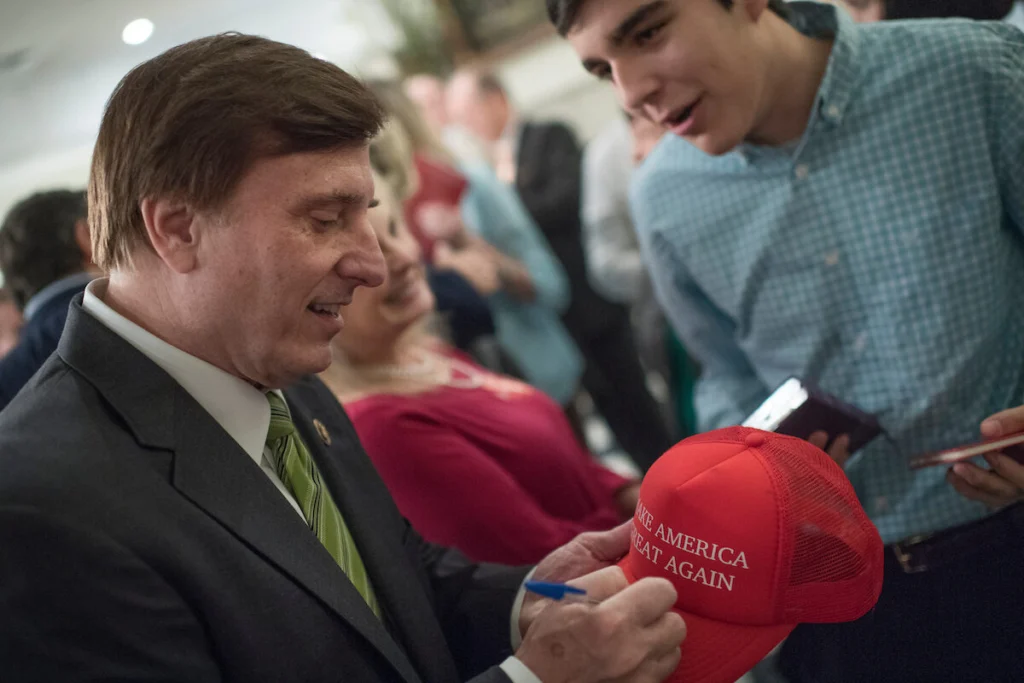
(In this 2016 photo from the Roll Call Archives, John Fleming, then a Louisiana congressman making his first Senate run, signs a MAGA hat at a rally in Baton Rouge. (Tom Williams/CQ Roll Call))
As Saturday approaches, all eyes are on Louisiana. The Republican runoff is more than just a local election; it’s a barometer for the state of the GOP, a test of presidential influence, and a critical step in shaping the political future of a deeply conservative state. The votes cast this weekend will not only determine who represents Louisiana in the Senate but will also send ripples through the national political landscape, offering crucial insights into the evolving power dynamics of American politics.
Subscribe now using this link so you don’t miss out on the best news and analysis from our team.