
Tensions Surge in the Strait of Hormuz: Rubio Vows ‘No Deal at Any Price’ Amidst Maritime Chaos

By Global Affairs Desk
The fragile detente between Washington and Tehran, brokered in the wake of the late-February conflict, is facing its most significant test to date. As U.S. Secretary of State Marco Rubio conducts a critical diplomatic tour of the Gulf, the volatility in the Strait of Hormuz has intensified, casting a long shadow over ongoing negotiations regarding Iran’s nuclear program, sanctions relief, and the future of global energy security.
The diplomatic landscape shifted sharply on Thursday following a direct strike on a cargo vessel within the strategic waterway. The incident prompted the United Nations’ International Maritime Organization (IMO) to abruptly suspend a high-stakes evacuation mission for over 600 trapped mariners, citing a collapse in safety guarantees.
The Anatomy of the Crisis: A Chronology of Escalation
The current maritime crisis is the culmination of months of geopolitical friction. While a preliminary agreement between the United States, Israel, and Iran was designed to signal a cooling-off period, the reality on the ground—and on the water—remains dangerously fluid.
- Late February: The U.S. and Israel launch a military campaign against Iranian targets, leading to a de facto blockade of the Strait of Hormuz by Iranian naval forces, triggering global economic shocks and an immediate spike in oil prices.
- Early June: Following weeks of back-channel communications, Washington and Tehran sign a memorandum of understanding (MoU). The agreement allows for commercial vessel transit for a 60-day "grace period," though the long-term status of the waterway remains a point of contention.
- Tuesday, June 23: Oman unveils a temporary shipping corridor coordinated with the IMO to bypass high-risk zones. Simultaneously, Tehran and Muscat issue statements suggesting the implementation of "maritime service fees" for vessels traversing the strait.
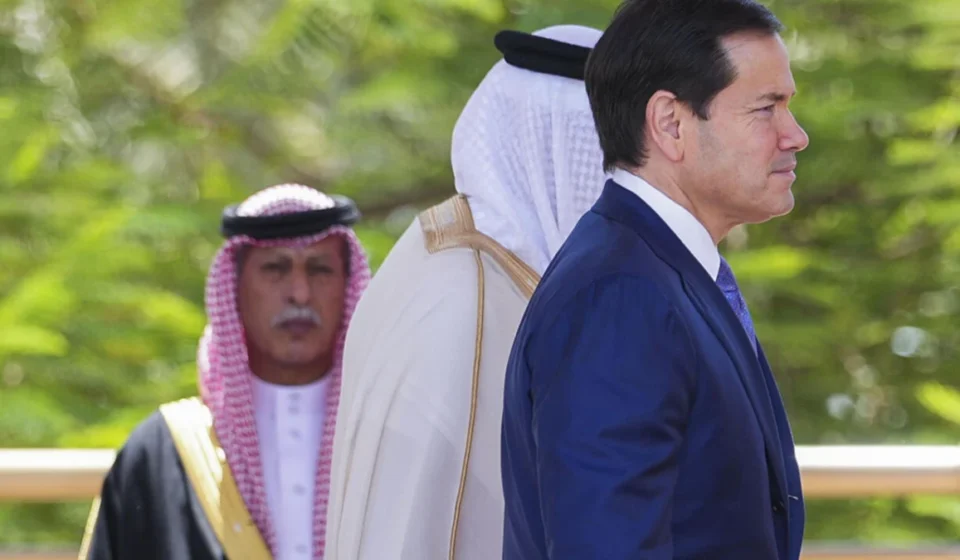
- Wednesday, June 24: Secretary of State Marco Rubio arrives in Bahrain, initiating a tour intended to reassure Gulf Cooperation Council (GCC) partners that U.S. interests will not supersede regional security.
- Thursday, June 25: A cargo ship is struck on its starboard side by an "unknown projectile" approximately 7.5 nautical miles off the Omani coast. The IMO responds by halting its evacuation plan. Iran’s Revolutionary Guard Corps (IRGC) issues a veiled threat, warning that "unauthorized crossings" will be met with force.
The Diplomatic Standoff: Rubio’s "Red Lines"
During his meetings in Manama, Secretary Rubio adopted a firm posture, aimed as much at Tehran as at his nervous regional allies. The Secretary of State was explicit: while Washington is committed to a diplomatic resolution, it is not pursuing an agreement at the expense of regional stability.
"We want to ensure that there is no part of this deal that in any way undermines the security, the stability, or the prosperity of any of our partners in the Gulf region," Rubio stated.
Central to the tension is the Iranian proposal to institute "maritime service fees." Tehran argues these charges are necessary for the maintenance and security of the strait. Washington, however, categorically rejects the premise. Rubio characterized the proposal as a precursor to "total chaos," emphasizing the foundational international legal principle that waterways of such vital importance cannot be treated as the private property of a single nation-state.
"International waterways do not belong to any nation-state," Rubio insisted. "This is a foundational principle in the world today. If we allow the arbitrary taxation of global commerce in international waters, we invite the disintegration of the current global economic order."
Supporting Data: The Strategic Importance of the Chokepoint
The Strait of Hormuz is not merely a geographic feature; it is the jugular vein of the global energy market. Connecting the Persian Gulf to the Arabian Sea and the Indian Ocean, the narrow passage serves as the primary transit route for a massive percentage of the world’s liquefied natural gas (LNG) and crude oil exports.
When the flow through this chokepoint is restricted, the global economic impact is instantaneous. Data from the most recent blockade indicated that a 24-hour disruption in traffic leads to a multi-billion-dollar surge in energy futures. The presence of 600 trapped vessels, as identified by the IMO, highlights the sheer scale of the humanitarian and economic disaster currently unfolding.
The suspension of the evacuation by IMO Secretary-General Arsenio Dominguez marks a significant setback. "I have decided to temporarily pause the implementation of the evacuation plan in order to reconfirm that the necessary safety guarantees continue to be in place," Dominguez stated. The vulnerability of the crews remains a top priority, yet the IRGC’s insistence on policing the area creates a direct conflict with international maritime safety mandates.
Official Responses and Regional Skepticism
The GCC foreign ministers, meeting with Rubio, offered a unified, albeit cautious, response. In a joint statement, the ministers emphasized that true peace requires a comprehensive approach. They argued that the nuclear file cannot be separated from Iran’s wider "full spectrum" of regional activities.
"Lasting regional peace and security requires addressing the full spectrum of Iran’s threats," the statement read, explicitly citing ballistic missiles, the proliferation of suicide drones, and the support of proxy militias that have destabilized the Levant and the Arabian Peninsula for years.
Oman’s diplomatic position appears increasingly complex. While the Omani government initially signaled a willingness to coordinate on transit fees with Tehran, Foreign Minister Badr Albusaidi moved to walk back the perception of a permanent tax regime during the meeting with Rubio, stating that current plans "do not entail the imposition of any transit fees." This discrepancy suggests that while Oman is attempting to act as a regional mediator, it is under intense pressure from both its powerful neighbor to the north and its Western-aligned security partners.
Implications: A Fragile Future
The path forward is fraught with uncertainty. The 60-day MoU signed last week provides a temporary reprieve for commercial shipping, but it does not address the underlying security architecture of the region.
Several critical questions remain unanswered:
- The Scope of Talks: It remains unclear whether the current U.S.-Iran negotiations will expand to include the Iranian missile program and proxy support, as requested by the GCC, or if the talks will remain narrowly focused on the nuclear file and maritime transit.
- Enforcement of Freedom of Navigation: With the IRGC warning of "unauthorized" crossings, the U.S. Navy and its regional allies face a tactical dilemma. Protecting commercial vessels without triggering a broader military engagement requires a level of restraint that is becoming increasingly difficult to maintain.
- The Post-60-Day Reality: As the grace period provided by the MoU ticks down, the lack of a long-term agreement on the status of the Strait of Hormuz threatens to return the region to a state of high-alert, potentially leading to a permanent rerouting of energy supplies—a move that would fundamentally alter global energy economics for decades to come.
As Rubio continues his regional tour, the message from Washington is clear: the United States will prioritize the "unrestricted navigation" of international waters as a non-negotiable pillar of global security. However, with the sound of projectiles hitting hulls in the Strait, the rhetoric of diplomacy is being drowned out by the realities of a maritime conflict that shows no signs of reaching a peaceful harbor.
For now, the world watches the Strait of Hormuz, where the movement of oil, the safety of mariners, and the credibility of international law remain caught in a dangerous, shifting current.