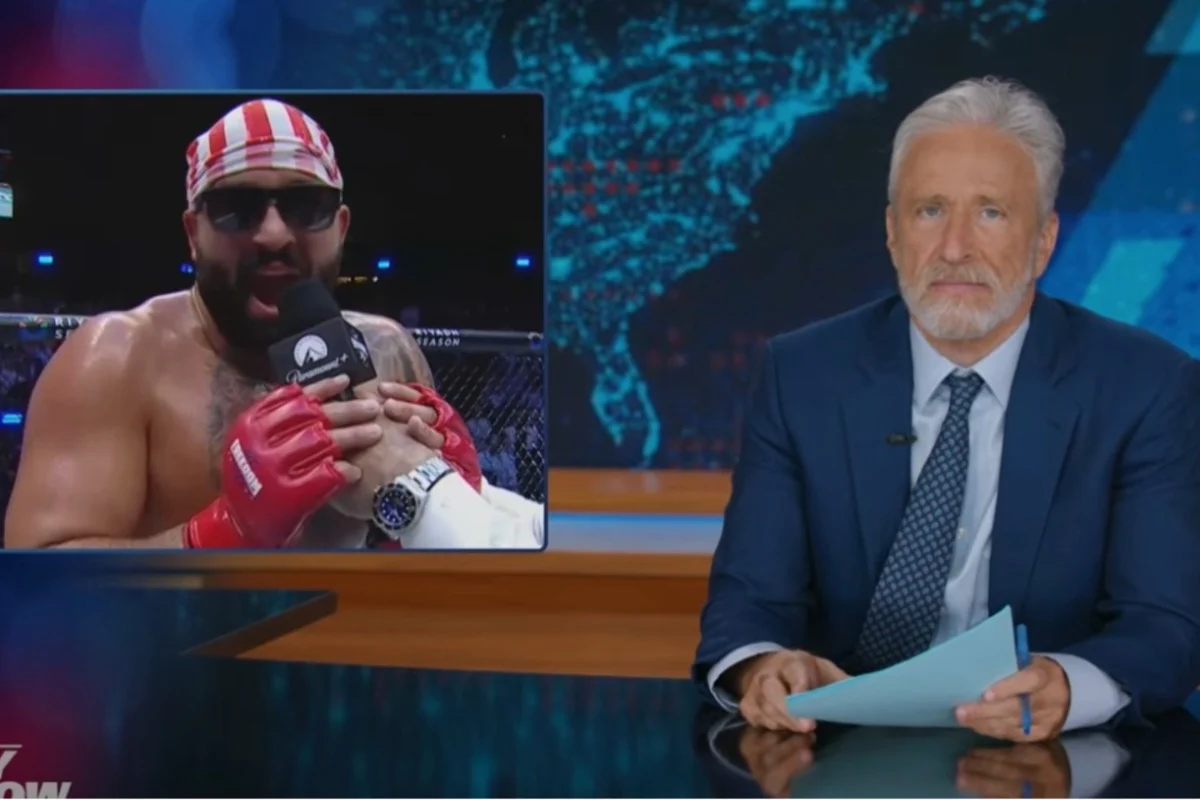
In a blistering monologue that dominated the airwaves on Monday night, Jon Stewart, the veteran host of The Daily Show, delivered a scathing critique of the Trump administration’s recent hosting of "UFC Freedom 250" on the White House lawn. The event, which saw the executive mansion transformed into an impromptu arena for mixed martial arts, sparked a firestorm of controversy, culminating in an on-air slur directed at former First Lady Michelle Obama by fighter Josh Hokit. Stewart’s segment not only dismantled the optics of the event but also highlighted the widening cultural chasm regarding what constitutes appropriate use of the American seat of power.
The Incident at the White House: A Breach of Protocol
The controversy centers on the post-fight interview of UFC fighter Josh Hokit, who, in a moment of undisciplined rhetoric, utilized his national platform to propagate a transphobic conspiracy theory regarding Michelle Obama. The remark, made on the grounds of the White House, sent shockwaves through the media landscape, drawing swift condemnation from Stewart and other political commentators.
For Stewart, the incident was not merely an isolated outburst by an athlete, but a symptom of a larger, systemic degradation of the dignity associated with the White House. During his monologue, Stewart played the clip of Hokit’s comments, pausing only to express his unvarnished outrage. "My God, what a fucking asshole," Stewart remarked, his voice tight with visible frustration. He further suggested that such behavior was emblematic of the kind of "talent" being courted by the current administration, sardonically predicting, "I look forward to his performance on next week’s Comics Unleashed."
Chronology of a Controversial Weekend
The events of Sunday night were framed by the Trump administration as a celebration of American strength, featuring high-profile bouts held under the gaze of the executive mansion. However, the optics of the evening were immediately contrasted by media analysts with the recent celebrations in New York City following the New York Knicks’ NBA championship victory.
Earlier in the week, the country witnessed the contrast between the two gatherings. In New York, thousands of citizens flooded the streets in a display of communal, organic joy—a celebration of team spirit and athletic excellence. In contrast, the White House event was criticized as a "Vegas-style trudge" through a venue that has historically served as a symbol of national gravity.
Stewart’s analysis followed a timeline of the weekend’s coverage, highlighting how conservative media outlets, specifically Newsmax, championed the UFC event while simultaneously condemning the Knicks’ celebrations. By playing clips of Newsmax anchors expressing "overwhelming excitement" for the White House fights, Stewart illuminated a clear double standard in media framing, where political loyalty dictates the aesthetic value of public gatherings.
Supporting Data: The Media Split
The divide in reporting on UFC Freedom 250 underscores the current state of American polarization. While mainstream sports outlets focused on the technical merits of the fights, political commentators were forced to reckon with the logistical and symbolic ramifications of holding an MMA tournament on the White House lawn.
Stewart’s critique leaned heavily on the hypocrisy inherent in this divide. He pointed out that while the administration and its media allies attempted to portray the White House as a "gladiator arena," they effectively stripped the event of its traditional dignity. The juxtaposition was sharp: the Knicks’ win represented a "joyous communion of teamwork," whereas the White House event was portrayed as a "gold-plated pummeling center."
Corporate Complicity: A Tense Moment for Paramount
Perhaps the most biting portion of Stewart’s monologue occurred when he realized the complicity of his own corporate hierarchy. During the broadcast, it was revealed via a CBS News soundbite that Paramount, the parent company of Comedy Central, was the entity responsible for broadcasting the UFC event.
The realization forced Stewart into a delicate, albeit hilarious, dance of corporate satire. Feigning terror and submission, he pivoted from his aggressive critique to a mock-praise of his employers. "And what a fine event it was," he joked, his eyes wide with mock-sincerity. "Once again, the leaders of Paramount+ are providing us all with incredible content at a reasonable price. I am proud to stand with the Paramount family and whatever shows they decide to either cancel or put on."
This moment of self-referential humor underscored the inherent tension in modern late-night television: the struggle to maintain critical integrity while operating within the confines of massive, often profit-driven, media conglomerates.
Implications: The Devaluation of National Dignity
The implications of the White House event, and the discourse surrounding it, are profound. By allowing such rhetoric to be broadcast from the White House lawn—an institution that carries the weight of history and international respect—the administration has set a new precedent for the "spectacularization" of politics.
The Erosion of Norms
The incident involving Josh Hokit is indicative of a broader trend: the normalization of crude, inflammatory language in political discourse. When athletes are invited to the White House to engage in combat sports, and those athletes use the stage to lob insults at former First Ladies, the traditional "bully pulpit" is transformed into a platform for partisan vitriol.
Combat Sports vs. Civic Life
The "pummeling center" remark made by Stewart touches on a deeper philosophical point: the difference between competitive athletics and civic engagement. While combat sports have their place in American culture, there is a traditional expectation that the White House remains a space for diplomacy, debate, and the projection of national unity. By replacing that tradition with a cage match, the administration has arguably devalued both the sport—by politicizing it—and the institution—by trivializing it.
The Future of Political Media
Stewart’s monologue serves as a reminder of the power and necessity of the late-night satirist in a fractured media landscape. By using humor to dismantle the absurdity of the White House UFC event, Stewart performed a necessary function: he forced the audience to look at the "embarrassing shit" (as he termed it) and recognize it for what it is.
Conclusion: A Mockery of an Event
As the dust settles on UFC Freedom 250, the legacy of the event remains contested. Supporters of the administration continue to praise the display as a bold, "new-age" approach to engagement, while critics see it as the final collapse of traditional presidential decorum.
Jon Stewart’s assessment was clear: the event was a "god-awful mockery" that managed to "devalue both combat sports and our national dignity." Whether or not this event will influence future political staging remains to be seen, but one thing is certain: the conversation has shifted. As long as the White House continues to serve as a venue for professional fighting, the satire will only grow sharper, the critique more biting, and the divide between those who celebrate it and those who mourn the loss of institutional dignity will continue to widen.
In the end, Stewart’s monologue was more than just a rant against a fighter or an administration; it was a meditation on what happens when the lines between entertainment and governance are blurred to the point of erasure. When the arena of ideas is replaced by the literal arena of a UFC ring, the resulting "pummeling" is not just physical—it is a blow to the shared expectations of what the American government should represent.