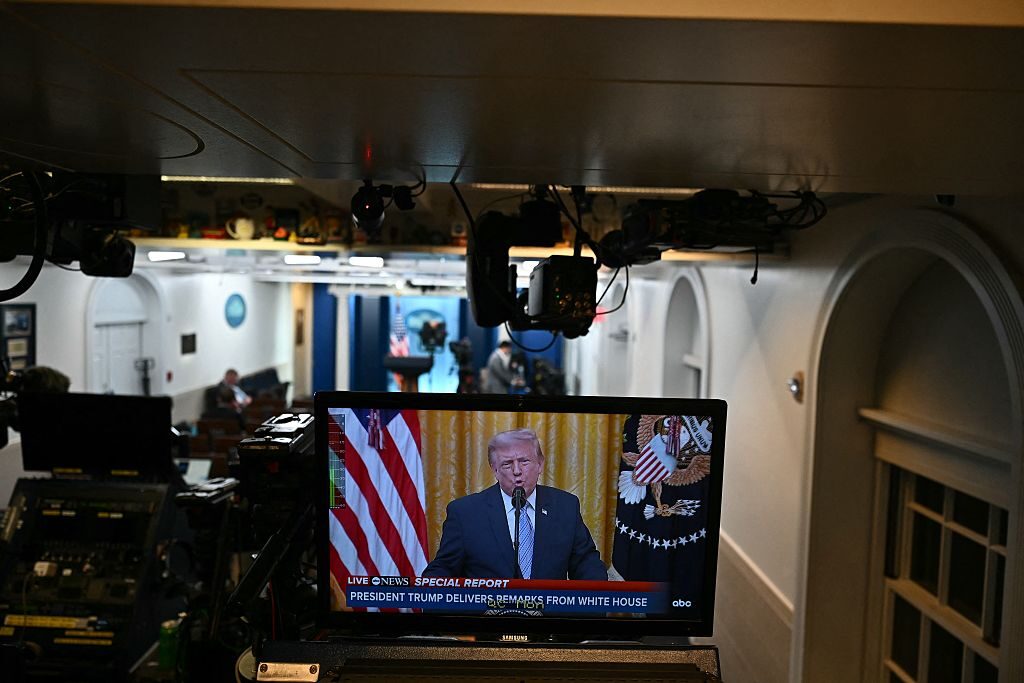
Washington D.C. – In a historically stunning primetime address from the East Room of the White House on Thursday night, President Donald Trump escalated his long-running campaign to cast doubt on the integrity of American elections, peddling a series of unsubstantiated conspiracy theories about the 2020 presidential contest. The nationally televised speech, delivered just months before crucial midterm elections, immediately drew sharp rebukes from Democrats and ignited concerns about the future of democratic processes, even as Republicans braced for the political fallout.
Speaking from the solemn backdrop of the White House, typically reserved for moments of national unity or urgent policy announcements, President Trump launched into a detailed, yet evidence-free, narrative of widespread election fraud. He accused a foreign adversary, specifically China, of engaging in "the largest compromise of election data in history," alleging the "illicit acquisition of 220 million U.S. voter files" by a dedicated intelligence unit. While making these sweeping claims, the President notably failed to provide any direct evidence linking these alleged efforts to the actual alteration of American votes or the manipulation of election outcomes.
The address represents a significant political gamble for the President and the Republican Party, who are actively fighting to retain their congressional majorities in November. The timing was particularly striking, coming just one day after Vice President JD Vance had publicly affirmed the administration’s commitment to accepting the outcome of the upcoming congressional races. Trump, however, appeared intent on sowing doubt not only about past elections but also about the integrity of the impending midterms, tying his new allegations to his administration’s aggressive, though stalled, push for the "SAVE America Act," a package of GOP-crafted election restrictions that Senate leaders have deemed unpassable.
The Presidential Address: Unfounded Allegations from the East Room
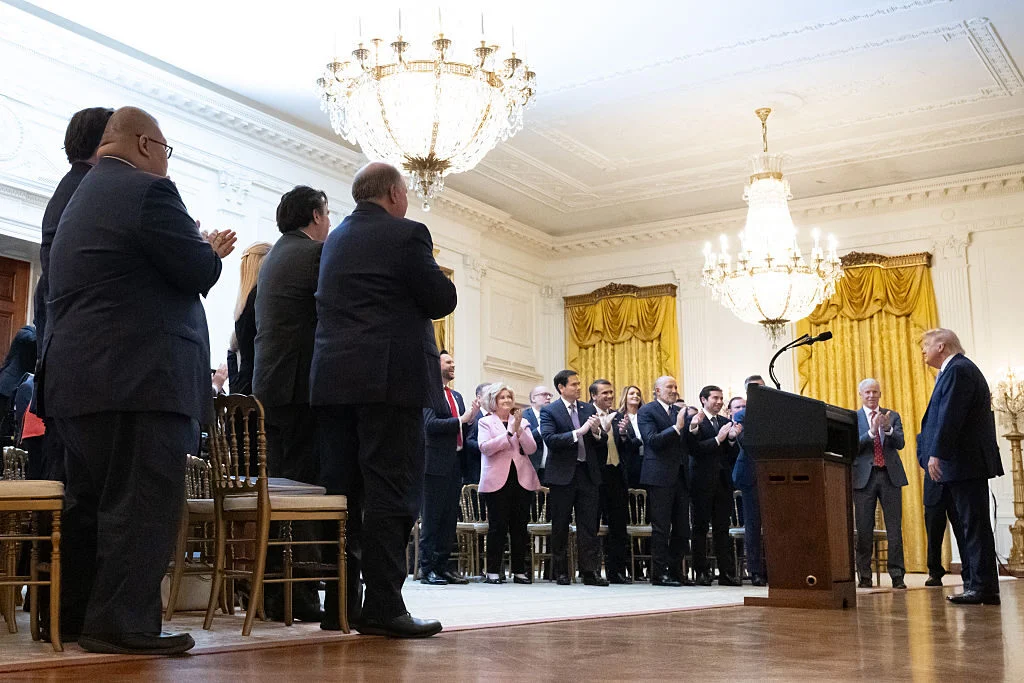
President Trump’s Thursday night address was a carefully choreographed event, designed to command national attention and lend an air of gravity to his extraordinary claims. Flanked by cabinet members and senior White House aides who offered applause, the President outlined what he presented as findings from his second administration’s investigation into election security. He promised the imminent release of "hundreds of pages of previously classified information" that he claimed would substantiate his assertions.
At the heart of his allegations was the accusation against China. Trump asserted that Chinese intelligence had specifically targeted U.S. elections, not only attempting to "influence" the 2018 midterms but also, starting in 2019, the 2020 presidential race which he lost to Joe Biden. "They wanted to just make you sound like your president wasn’t so hot, when actually your president has done a great job," Trump stated, referring to himself in the third person, a characteristic rhetorical flourish.
Beyond foreign interference, the President also railed against the domestic mechanisms of American elections. He warned of "rogue bureaucrats" and declared the U.S. election system "so broken and so vulnerable that no one can possibly defend it." He went further, stating that "Our [voting] machines and ballot counting systems are exposed to hacking and manipulation and corruption."
Crucially, throughout his lengthy remarks, President Trump offered no tangible evidence to connect these alleged vulnerabilities or foreign intelligence activities to any successful efforts that demonstrably changed votes or altered the outcome of an American election. He even described discussing "raw intelligence," a level of detail presidents rarely, if ever, disclose in a public address, underscoring the unusual nature of the moment. The claims stood in stark contrast to the consensus view of U.S. intelligence agencies and election security experts, who have consistently affirmed the overall integrity of American elections, while acknowledging the persistent threat of foreign interference primarily aimed at sowing discord rather than altering vote counts.
A Pattern of Disputed Outcomes: A Chronology of Election Integrity Claims
President Trump’s address did not emerge in a vacuum but rather as the latest chapter in a protracted narrative of questioning election legitimacy, particularly when results do not favor him or his party.
Preceding Statements and Legislative Push
The speech gained additional resonance due to its timing. Just the day before, Vice President JD Vance had publicly stated that the administration would accept the outcomes of the congressional races in the upcoming midterms, a seemingly conciliatory stance intended to reassure voters. Trump’s subsequent address directly contradicted this sentiment, demonstrating a clear divergence within the administration regarding election integrity rhetoric.
Alongside his rhetoric, Trump has actively pursued legislative changes. He tied his new allegations about the midterms to his administration’s fervent advocacy for the "SAVE America Act." This package of proposed election restrictions, crafted by the GOP, aimed to introduce measures such as stricter voter ID laws, limits on mail-in voting, and enhanced federal oversight of state election processes. However, despite the President’s vocal support, Senate leaders have reportedly informed him that the bill lacks the necessary bipartisan support to pass their chamber, highlighting a disconnect between the administration’s political agenda and legislative realities.
Contradictory Intelligence Assessments
A significant omission from Trump’s address was any mention of a March 15, 2021, National Intelligence Council report. This comprehensive assessment, widely available to the public, presented findings that directly contradicted many of the claims made by the President on Thursday evening. The report concluded, with "high confidence," that while foreign adversaries, including China, did engage in influence operations, there was "no indication that any foreign actor had successfully altered any votes or otherwise disrupted the ballot tabulation process in the 2020 U.S. federal elections." This official intelligence consensus directly undermined the premise of Trump’s speech, casting his claims as at odds with the findings of the very intelligence community he oversees.
A History of Doubt: From 2015 to Present
The President’s focus on election fraud is not a recent development. Data analyzed by Roll Call’s Factba.se reveals a consistent and escalating pattern. Since launching his first presidential bid in June 2015, Trump has referred to election fraud an astonishing 3,062 times. Upon his return to office in January 2025, the frequency remained high, with 544 mentions before Thursday’s address. In 2026 alone, he has raised the issue an average of 1.30 times per day – once every 18 hours, 28 minutes. This relentless focus extends beyond presidential contests to international, House, Senate, state, and local elections, especially those where his preferred candidates or his side loses. The pattern suggests a deep-seated and selective skepticism towards election outcomes that do not align with his desired results.
Statistical Foundations and Contradictions: Supporting Data
While President Trump presented his claims as grounded in intelligence, public sentiment and factual electoral history offer a more nuanced, and often contradictory, picture.
Public Opinion Divided: The Persistence of "Rigged Election" Beliefs
Despite numerous audits, court rulings, and official certifications affirming the integrity of the 2020 election, a significant segment of the American population continues to believe it was "rigged." A YouGov-The Economist poll conducted last month revealed that more than one in four Americans (28 percent) still hold this view. This belief, however, is sharply divided along partisan lines. A striking 50 percent of Republicans believe the 2020 election was rigged, compared to a mere 9 percent of Democrats.
Further dissecting Republican sentiment, the poll highlighted the powerful influence of the MAGA movement. A substantial 66 percent of self-identified MAGA Republicans believe the election was rigged, roughly double the 32 percent of non-MAGA Republicans who share that view. These statistics underscore the deep partisan chasm in public trust regarding electoral processes and illustrate the significant, albeit ideologically concentrated, audience for President Trump’s allegations. The persistence of these beliefs, fueled by repeated claims, poses a profound challenge to national unity and the perceived legitimacy of democratic institutions.
Selective Scrutiny: The Overlooked North Carolina Case
Adding another layer of scrutiny to President Trump’s claims of systemic fraud is his selective attention to actual instances of electoral impropriety. Despite his extensive and frequent denunciations of election fraud, Trump has conspicuously never mentioned the North Carolina 9th District race in 2018. In that election, a bipartisan Board of Elections unanimously found that McCrae Dowless, a Republican operative, had engaged in ballot harvesting and tampering. As a result, Republican Mark Harris’s initial win was tossed out, and a new election was held, which Republican Rep. Dan Bishop subsequently won.
This incident, a verified case of election fraud that led to the overturning of results and a new election, stands out precisely because of its absence from Trump’s lengthy list of grievances. Out of 132 U.S. races at all levels of government where he has commented or posted on social media about fraud, this particular case, involving a Republican operative and a clear breach of electoral integrity, remains unmentioned. This selective focus reinforces the perception that the President’s concern about election fraud is primarily activated when outcomes are unfavorable to him or his allies, rather than a consistent concern for the purity of the electoral process itself.
The Political Landscape: Approval Ratings and Midterm Stakes
President Trump’s decision to deliver the primetime address came despite challenging political indicators. A Washington Post-Ipsos poll released on the same Thursday morning revealed his standing with the American public remained weak, particularly concerning his handling of the economy and Iran policy. Overall, the poll found only 37 percent of surveyed U.S. adults approved of Trump’s job performance, while 61 percent disapproved.
These approval ratings complicate Republicans’ efforts to defend their congressional majorities in the upcoming midterms. The outcomes of these races in November will directly determine which party controls the House and Senate, profoundly influencing the remainder of Trump’s domestic agenda. A Democratic-run Senate, for instance, would largely quash his administration’s desire to continue populating federal courts with conservative judges, a cornerstone of his political legacy. By focusing on contentious and unproven election fraud claims, the President risks alienating independent and moderate voters, potentially undermining his party’s chances at a critical juncture.
Vocal Rebuttals and Warnings: Official Responses
The immediate aftermath of President Trump’s address saw a swift and unified condemnation from Democratic lawmakers, alongside a revealing defense from within the administration.
Democratic Alarm: Warnings of Constitutional Crisis
Democratic lawmakers wasted no time in describing Trump’s address as a dangerous prelude to potential interference in the upcoming midterms and a fundamental threat to American democracy.
House Intelligence Committee ranking member Jim Himes articulated a stark warning, suggesting the President was "setting the context. He was setting the basis for him to turn around at midnight on Election Day and say, ‘I warned you. I warned you back in July that the Chinese were doing X, Y, Z, and the Venezuelans were doing X, Y, Z, and all this terrible stuff,’ Himes told MS Now. ‘It happened tonight.’"
Himes then painted a chilling hypothetical scenario for a potential November address: "‘I am deploying federal officers from the Department of Homeland Security to seven states. They will be seizing ballot boxes in those states because we know that lots of undocumented aliens voted in those things. So we are seizing ballot boxes now.’ What happens when all of a sudden we’ve lost the chain of custody of 70 ballot boxes? … That is the moment in which American democracy dies. Make no mistake [about] what happened tonight.” This powerful imagery underscored the profound fears among Democrats that the President’s rhetoric could be a precursor to unprecedented executive actions aimed at subverting electoral outcomes.
Rep. Joseph D. Morelle, ranking member of the Administration Committee, echoed these concerns, telling C-SPAN moments after Trump concluded that he heard a chief executive "preparing an effort under which he could be calling into dispute 2026." Morelle added that Trump’s intention was to "sow so much confusion" that in the coming months he "can claim extraordinary powers" to carry out a "fundamental effort to weaken the foundation of our democracy."
Sen. Raphael Warnock (D-Ga.) offered a more personal assessment of the President’s motivation, stating at a voting rights event on Capitol Hill, “I’m sorry that the people of Georgia so hurt Donald Trump’s feelings that he can’t get over 2020, even after he won 2024. I suggest he go see a therapist." He added a defiant message: "We’re going to the polls, and we’re going to hold him accountable.”
House Minority Leader Hakeem Jeffries later told reporters that Trump “needs to be checked out,” urging the President to focus on "driving down the high cost of living" rather than "conspiracy theories."
Sen. Maria Cantwell (D-Wash.), speaking at the same voting rights event, called on local election officials to stand firm against any potential administrative overreach. She recounted a recent conversation with an election official in her home state: “I asked that election official, ‘What are you going to do if Homeland Security tries to come in and say you can’t even mail out those ballots?’ He says, ‘I don’t give a damn if I have to Uber them. I’m getting the voters their ballots.’” Cantwell concluded, “And all we have to do now is evangelize getting them in the ballot box.”
Warnock further elaborated on the perceived strategy behind the President’s claims: “One of the most significant things they’re trying to do is that they’re trying to weaponize despair. … They’re trying to convince us that they’ve already won, and if you’re convinced that they’ve already won, then you stop fighting.”
Administration’s Stance and Republican Defense: "Too Big to Rig"
In a remarkable and telling moment earlier on Thursday, White House press secretary Karoline Leavitt effectively admitted the administration’s selective approach to election integrity concerns. During a rare briefing, a reporter pressed her on why the administration was not examining whether any fraud plagued the 2024 election. Leavitt, with a wide smile, replied using a phrase made famous by her boss: “Because it was too big to rig. … There was a massive amount of votes for this president. That’s why he’s in the Oval Office right now.” This candid response underscored the administration’s position that election results are legitimate only when favorable to them, stripping away any pretense of universal concern for election security.
Despite the widespread criticism, some Republicans defended the President’s decision to address the nation. Aaron Cutler, a former senior aide to House Republican leaders, dismissed concerns about negative political repercussions. “Anytime the American people hear directly from President Trump live and unfiltered it’s a good thing,” Cutler said in an email. “President Trump is the leader of the Republican Party, so yes, Republicans want the President addressing the nation now and often before Election Day.” This perspective highlights the internal Republican belief that direct communication from Trump, even on controversial topics, energizes his base and is beneficial for the party.
Profound Implications for Democracy and Future Elections
President Trump’s primetime address, laden with unsubstantiated claims and warnings of a compromised election system, carries profound implications for American democracy, the upcoming midterms, and the very fabric of public trust.
Erosion of Trust in Democratic Institutions
The most immediate and damaging implication is the continued erosion of public trust in core democratic institutions. When a sitting president uses the highest office to cast doubt on the integrity of elections without providing credible evidence, it sows deep seeds of cynicism among the populace. This can lead to decreased voter participation, a greater acceptance of political violence, and a weakening of the foundational belief that elections are fair and legitimate mechanisms for transferring power. The partisan divide in believing the 2020 election was rigged underscores how deeply ingrained these doubts have become within certain segments of the electorate.
Heightened Political Polarization and Instability
The address further exacerbates political polarization. By framing election security as a partisan battle rather than a shared civic responsibility, it deepens the divide between those who accept election results and those who are encouraged to view them with suspicion. This environment of mistrust makes it harder for political adversaries to find common ground, potentially leading to increased legislative gridlock and social unrest. The warnings from Himes and Morelle about potential post-election chaos, including federal intervention in ballot counting, highlight the fear that such rhetoric could incite real-world instability.
The Stakes of the Midterm Elections
The address directly impacts the political calculus of the upcoming midterm elections. By preemptively questioning the legitimacy of these races, President Trump may be attempting to galvanize his base, but he also risks discouraging moderate voters and independents who are wary of undermining democratic processes. The outcome of these elections will determine control of Congress, directly influencing the President’s ability to govern and shape policy. If Republicans lose their majorities, it could be seen as a rebuke of the President’s approach, including his persistent focus on past election grievances. Conversely, if they retain control, it could be interpreted as an endorsement of his rhetoric, potentially emboldening further challenges to electoral norms.
Setting a Dangerous Precedent for Presidential Power
The concern articulated by Rep. Morelle about the President preparing to "claim extraordinary powers" and "call into dispute 2026" is particularly alarming. The use of presidential authority to question election results, potentially leading to federal interference in state-run elections, would set a dangerous precedent. It challenges the fundamental principle of federalism, where states primarily administer elections, and could open the door to future presidents attempting to unilaterally alter electoral processes or outcomes based on unsubstantiated claims.
The Pervasive Threat of Disinformation
Finally, the President’s address underscores the pervasive societal challenge posed by high-level dissemination of disinformation. When a leader with immense influence broadcasts unverified claims, it legitimizes conspiracy theories and makes it more difficult for citizens to discern fact from fiction. This environment strains the media’s ability to inform the public accurately and empowers malicious actors, both foreign and domestic, who seek to destabilize democratic systems through the spread of false narratives. Sen. Warnock’s observation that the aim is to "weaponize despair" and convince voters that the fight is already lost highlights the psychological impact of such a strategy on civic engagement.
In conclusion, President Trump’s primetime address marks a critical juncture in the ongoing debate over election integrity in the United States. By using the presidential platform to amplify unfounded conspiracy theories, he has deepened partisan divides, raised serious questions about the political risks for his party in the upcoming midterms, and ignited profound concerns among lawmakers and civil society about the long-term health and stability of American democracy. The coming months, leading up to and beyond the November elections, will undoubtedly test the resilience of the nation’s democratic institutions against these persistent challenges to public trust and electoral legitimacy.
Bill Frischling and Valerie Yurk contributed to this report.