For decades, America’s community colleges have functioned as the nation’s "hidden in plain sight" infrastructure. They are the institutions that train the nurses staffing our hospitals, the technicians maintaining our power grids, and the students bridging the gap between high school and the modern economy. Yet, despite serving 40 percent of the nation’s undergraduates, these institutions frequently find themselves relegated to the periphery of national discourse, overshadowed by the prestige and endowment-heavy narratives of four-year universities.
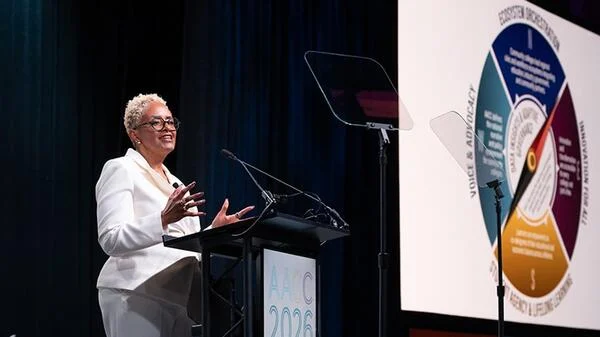
Dr. DeRionne Pollard, the new president and CEO of the American Association of Community Colleges (AACC), is on a mission to change that. Since taking the helm of the organization last October, Pollard has framed the future of community colleges not merely as a subset of higher education, but as a critical pillar of national security and economic innovation. Her mantra is simple yet stinging: "When you serve everyone, you’re noticed by no one."
A Career Rooted in the Classroom
To understand Dr. Pollard’s drive, one must look at her personal history, which is inextricably linked to the very institutions she now represents. Her journey is not one of ivory tower detachment but of lived experience.
Chronology of a Leadership Journey
- Early Childhood: Pollard’s earliest memories are of Kennedy King College in Chicago. At age three, she sat in a campus childcare center while her mother attended classes. These formative years instilled in her a foundational belief in the "potency" of the community college experience.
- The Formative Years: Following the death of her mother, Pollard lived with her aunt, who attended Prairie State College. Pollard and her sister became "early college navigators," helping students find their way around campus—an experience that cemented her connection to the sector.
- Academic Leadership: Before joining the AACC, Pollard served as president of three distinct institutions: Las Positas College, Montgomery College, and Nevada State University. Each stop provided her with a granular understanding of the challenges facing regional institutions.
- The AACC Presidency: In October of last year, Pollard transitioned into the national advocacy role, aiming to leverage her decades of institutional experience to reshape how Washington and the public perceive two-year colleges.
The Strategic Imperative: Why Community Colleges Matter
Pollard argues that in an era of extreme political polarization, community colleges remain a rare oasis of bipartisan support. Unlike some four-year institutions that have become entangled in culture wars, community colleges are viewed by both sides of the aisle as essential, practical, and localized.
A Catalyst for National Security
"I personally think community colleges stand at the forefront of being a part of our national security," Pollard stated in an interview. Her definition of national security is expansive, encompassing the "hard" infrastructure of manufacturing and technology, as well as the "soft" infrastructure of civic engagement and workforce development.
In a global economy defined by rapid technological shifts—particularly the rise of Artificial Intelligence—Pollard believes that the nation’s ability to remain competitive rests on its ability to rapidly reskill and upskill its workforce. Community colleges, she asserts, are the only institutions with the scale and the proximity to the labor market to execute this mission.
Challenging the "Discount Bias"
One of the most persistent hurdles facing the sector is what Pollard terms "discount bias." Because community colleges maintain lower tuition rates to ensure accessibility, the public—and some policymakers—often conflate low price with low quality.
"Poverty is the No. 1 barrier to college completion—not potential, not promise," Pollard noted. By keeping education affordable, these colleges are actively removing the primary obstacle to success for millions of Americans. However, this has created a public relations paradox where the sector is penalized for its commitment to the public good.
Furthermore, Pollard critiques the metrics used by traditional media and ranking systems. "There are some media sources that will put out lists of the most innovative institutions," she said, pointing to U.S. News & World Report. "There’s not one community college on there." This, she argues, is a fundamental failure to define innovation correctly. For Pollard, true innovation is not found in exclusive research labs, but in the ability to pivot an entire community’s economy when a major employer leaves, or to provide a pathway for an emancipated foster youth and a working veteran within the same classroom.
The Data Dilemma: From Information to Intelligence
Accountability is a buzzword that often creates friction between federal regulators and community colleges. Pollard is not opposed to accountability, but she is critical of the current, often bureaucratic, approach.
"I’m beyond data. I want to get to intelligence," she explained. Her vision for the future involves moving away from the "drowning in data" phase of educational management. Instead, she advocates for the creation of systems that synthesize complex datasets into actionable intelligence. This, she believes, is how colleges will finally prove their value to skeptical stakeholders.
The Shift to Post-Completion Outcomes
The sector has already begun to embrace this shift. Moving beyond the old metrics of "access" (who gets in), institutions are now increasingly focusing on "outcomes" (what happens after they leave). By prioritizing post-completion success, community colleges are better aligning themselves with the workforce demands of the 21st century.
Preparing the Next Generation of Leaders
Perhaps the most personal aspect of Pollard’s current agenda is her focus on the "leadership crisis" in higher education. As budgets tighten and the political climate becomes more tumultuous, many qualified administrators are opting out of the presidency.
"I had a vice president say to me, ‘I don’t want to be a president. Who’s the fool here? Who wants to do this work right now?’" Pollard shared. This sentiment reflects a dangerous trend: if the most capable minds in education are discouraged from taking the helm, the mission suffers. Consequently, Pollard has committed a significant portion of her tenure at the AACC to training, mentoring, and preparing the next generation of leaders to handle the "question of character" required to steer these vital institutions.
Implications for the Future
As the nation faces demographic shifts and the inevitable evolution of the labor market, the role of the community college will only grow in importance. For Pollard, the path forward is clear:
- Amplify the Story: The sector must stop being "too modest" about its achievements. It must narrate its impact on national security, health, and economic stability.
- Define Innovation on Our Terms: The sector must challenge the traditional orthodoxies of higher education and assert that scaling accessibility and workforce readiness is, in fact, the highest form of innovation.
- Modernize the Business Model: Colleges must align their practices with the realities of 21st-century learners—who are as likely to be a 55-year-old worker looking for a career change as they are a 19-year-old student.
- Strengthen the Pipeline: The AACC must act as a "convener" and "catalyst," building networks that allow colleges to share best practices and collectively influence federal policy.
Dr. Pollard remains "cautiously optimistic." She views the current political moment not as a threat, but as an opportunity for community colleges to double down on their identity as the "nation’s workhorse." By serving everyone, she believes these institutions provide the foundation upon which the rest of the country’s successes are built.
"Every time this nation has challenges," she concluded, "there’s always the nation’s community colleges that have been there to help bolster us and help heal, which is what I think will happen now." As she moves forward, the eyes of the higher education sector will be on her, waiting to see if she can successfully transition community colleges from the "unsung" heroes to the recognized architects of the American future.