For over two decades, a deep-seated geological debate has simmered beneath the surface of the North Sea, buried 700 meters (2,300 feet) beneath the seabed. At the center of this controversy was the Silverpit Crater—a mysterious, ringed structure approximately 80 miles off the Yorkshire coast. While initial discovery in 2002 hinted at an extraterrestrial origin, the scientific community remained deeply fractured. Now, a definitive study published in Nature Communications has finally silenced the skeptics, confirming that the site is indeed a rare hypervelocity impact crater formed by an asteroid strike roughly 43 to 46 million years ago.
The resolution of this debate, led by Dr. Uisdean Nicholson of Heriot-Watt University and supported by the Natural Environment Research Council (NERC), marks a milestone in planetary science. By synthesizing advanced seismic imaging, microscopic petrography, and complex numerical simulations, the research team has provided the "silver bullet" evidence required to classify Silverpit as one of Earth’s few verified underwater impact scars.
A Chronology of Controversy: From Discovery to Consensus
The story of Silverpit began in 2002, when seismic data acquired for oil exploration revealed a peculiar, circular depression spanning three kilometers in diameter, surrounded by a complex web of concentric faults stretching 20 kilometers wide. The structure’s morphology—featuring a central uplift and symmetrical faulting—strongly suggested a classic impact crater.
However, the geological community was unconvinced. Throughout the 2000s, alternative hypotheses proliferated. Some experts argued that the structure was the result of "salt tectonics," where the shifting of thick underground salt deposits caused the surface to collapse. Others posited that volcanic activity, specifically the expulsion of gases or magma, had triggered a localized subsidence of the seabed.
The disagreement reached a fever pitch in 2009, when geologists held a formal debate and vote on the crater’s origin. The result was a stunning rebuke of the impact theory: the majority of participants concluded that Silverpit was likely a terrestrial geological phenomenon rather than an extraterrestrial one. For 15 years, the crater remained a subject of academic ambiguity, a ghost of an event that seemed too perfect to be anything other than an impact, yet lacked the definitive "fingerprints" required for scientific consensus.
The Smoking Gun: Microscopic Evidence and Seismic Clarity
The breakthrough came when Dr. Nicholson’s team leveraged new, high-resolution 3D seismic data. If the original 2002 images were like a low-resolution ultrasound, the new data functioned like a high-definition MRI of the Earth’s crust, revealing the intricate internal architecture of the crater’s rock layers with unprecedented clarity.
Yet, seismic images alone were not enough to convince the skeptics. The turning point came from the "needle-in-a-haystack" discovery of mineralogical evidence within rock samples extracted from an oil exploration well drilled near the site.
"Samples from an oil well in the area revealed rare ‘shocked’ quartz and feldspar crystals at the same depth as the crater floor," Dr. Nicholson explained. "We were exceptionally lucky to find these. These prove the impact crater hypothesis beyond doubt, because they have a fabric that can only be created by extreme shock pressures."
Shocked minerals are the definitive hallmark of hypervelocity impacts. When a projectile strikes the Earth at several kilometers per second, the instantaneous pressure—far exceeding anything generated by volcanic activity or tectonic shifting—literally rearranges the internal lattice of quartz crystals. Finding these at the Silverpit site provided the empirical "hard evidence" that had eluded researchers for years.
Reconstructing the Catastrophe: A 100-Meter Tsunami
With the origin confirmed, the research team, including Professor Gareth Collins of Imperial College London, utilized numerical modeling to reconstruct the event as it unfolded some 45 million years ago.
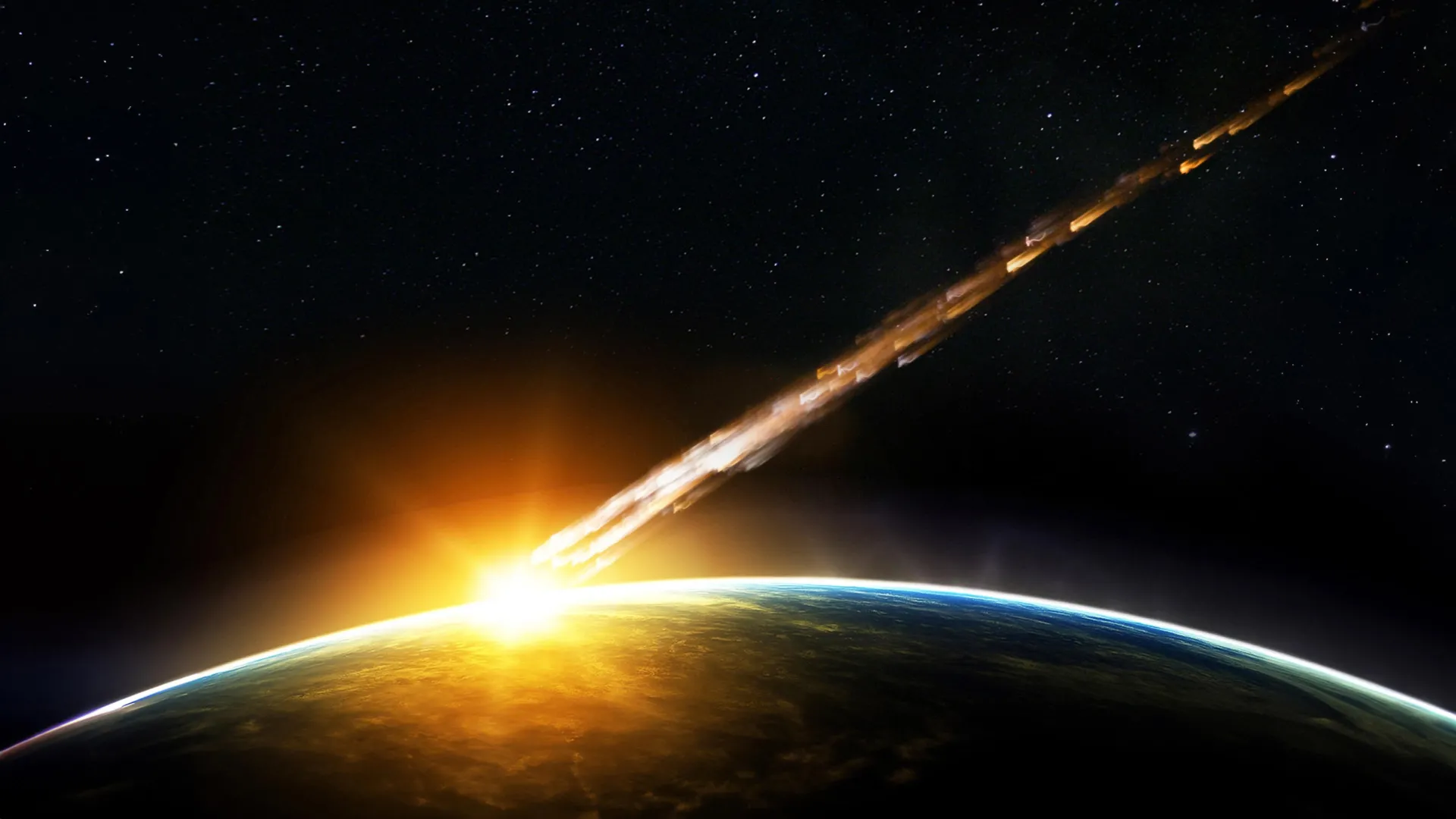
The perpetrator was an asteroid approximately 160 meters (525 feet) in diameter. Approaching from the west at a shallow angle, the object slammed into the ancient North Sea with violent intensity. The impact did not merely leave a dent; it triggered a localized apocalypse.
Within moments of contact, a 1.5-kilometer-high "curtain" of pulverized rock, sediment, and seawater was ejected into the atmosphere. As this massive volume of debris collapsed back into the ocean, it generated a mega-tsunami exceeding 100 meters (330 feet) in height—a wall of water taller than many of today’s urban skyscrapers. The sheer energy of the impact excavated the seafloor, leaving behind the circular crater and the complex, concentric fault system that had baffled geologists for two decades.
Implications for Earth’s Dynamic History
The confirmation of Silverpit provides a vital case study in why such features are so rare. Earth is a geologically "alive" planet. Plate tectonics, volcanic eruptions, sedimentation, and erosion act as a relentless eraser, constantly scrubbing the planet’s surface of its history.
"Silverpit is a rare and exceptionally preserved hypervelocity impact crater," noted Dr. Nicholson. "These are rare because the Earth is such a dynamic planet. Around 200 confirmed impact craters exist on land, and only about 33 have been identified beneath the ocean."
Because the majority of our planet is covered by water, the discovery of underwater craters like Silverpit—and the recently identified Nadir Crater off the coast of West Africa—is essential for understanding the frequency of impacts over geological time. By studying how these craters persist beneath the sediment, scientists can better calibrate their models for how asteroid collisions have shaped—and could potentially reshape—our planet.
A New Natural Laboratory
For Professor Gareth Collins, who played a central role in the 2009 debates, the conclusion of this study is a vindication of the scientific process. "I always thought that the impact hypothesis was the simplest explanation and most consistent with the observations," Collins said. "It is very rewarding to have finally found the silver bullet. We can now get on with the exciting job of using the amazing new data to learn more about how impacts shape planets below the surface."
The Silverpit Crater now joins an elite list of confirmed impact sites, including the massive Chicxulub Crater, which serves as a grim reminder of the power of celestial bodies to alter the trajectory of life on Earth.
As researchers turn their attention toward further analysis, the North Sea crater will serve as a natural laboratory. It offers a rare opportunity to observe how an impact crater survives and settles in a marine environment. By bridging the gap between geological observation and computer simulation, the team has not only resolved a 20-year mystery but has also provided a framework for identifying future impact sites hidden beneath the waves.
In the quiet, dark depths of the North Sea, the Silverpit Crater no longer hides its identity. It stands as a testament to a violent collision that occurred millions of years ago, finally yielding its secrets to the persistence of modern science. The debate is over, but the study of Earth’s place in a volatile solar system has only just begun.