For nearly two decades, the sprawling neo-Gothic courtyards of Yale University have served as a bastion of intellectual inquiry and, at times, radical discourse. Yet, for those currently walking its hallowed grounds, the atmosphere has shifted from one of collegial exploration to one of surveillance and administrative containment. As the university navigates an increasingly fraught political landscape, the institution finds itself locked in an internal battle over its identity, its autonomy, and its willingness to "bend the knee" to external political pressures.
The Mandate of Conformity: A Tale of Two Events
The tension at Yale reached a boiling point earlier this month, manifesting in a stark juxtaposition between administrative theater and grassroots dissent. As the academic year commenced, the Yale College administration mandated that all incoming first-year students attend a formal lecture—styled euphemistically as a "conversation"—on the university’s role in democracy.
This move, critics argue, serves as a preemptive socialization tactic. By insisting that students receive the "official" institutional narrative before they have even opened a textbook, the university appears to be prioritizing ideological alignment over organic intellectual development. This top-down approach has been perceived by many as an attempt to sanitize the university’s current trajectory, framing its controversial administrative decisions as inevitable outcomes of democratic participation.
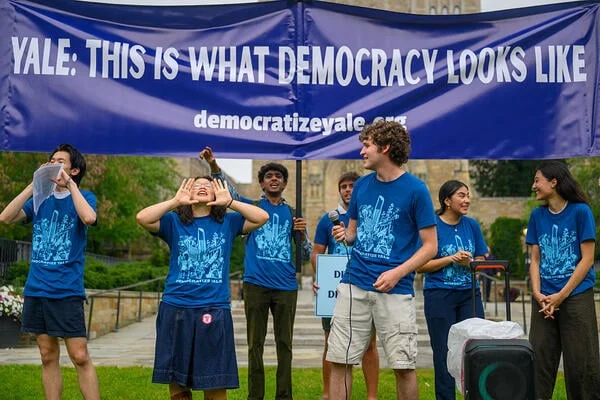
In direct response, a newly formed coalition—comprising students, faculty, and alumni under the banner "Democratize Yale"—staged a counter-event. Held on a central quadrangle, the teach-in served as a vibrant, if defiant, critique of the current administration. The event was not merely a protest; it was a seminar on the erosion of academic freedom, the fragility of shared governance, and the profound dangers inherent in the university’s ongoing, closed-door settlement negotiations with the federal government.
Chronology of a Campus Crackdown
The events of the week were punctuated by a series of administrative maneuvers that many see as a calculated effort to stifle dissent.
- The Directive: On the morning of the teach-in, university leadership circulated an email to the entire campus community, effectively tightening the leash on public assembly. The new guidelines, presented under the guise of “campus safety,” imposed severe restrictions: no outdoor gatherings without a permit, rigid time constraints, and a total ban on “amplified sound” or “elevated noise” (including chanting) without pre-approval.
- The Rhetorical Pivot: The email notably warned that any expression deemed to cross the line into "discrimination or harassment" would be met with institutional sanctions. By linking the fundamental act of protest to the specter of harassment, the administration has effectively signaled that public assembly is no longer a right, but a risky endeavor subject to punitive review.
- The Facilitator Presence: During the teach-in, the presence of "free expression facilitators"—staff members from the Office of the Assistant Vice President for University Life—was palpable. While billed as guardians of free speech, these facilitators have historically been utilized to deliver warnings to protesters, citing university policy and threatening disciplinary action or arrest.
- The Expulsion of the Press: Perhaps most alarming was the reported removal of journalists from the site of the teach-in. Reporters from The Chronicle of Higher Education and Connecticut Public Radio were escorted off university grounds by public affairs staff. This act of censorship, occurring in an open, public-facing space, represents a departure from standard university practice and suggests a sensitivity to documentation that borders on panic.
Supporting Data: The Apparatus of Control
The mechanism of control at Yale is not merely reactive; it is highly structured. The "Free Expression Facilitator Program," once presented as a tool to navigate complex campus debates, has been transformed into an instrument of bureaucratic intimidation.
The experience of those at the teach-in provides a window into this process. When organizers were approached, they were presented with forms requiring signatures to “request permission” for their assembly. By refusing to sign these documents as a matter of principle, activists were forced into a performative standoff with low-level staffers. This delegation of "dirty work"—sending young employees to manage dissent while leadership remains insulated—has drawn sharp criticism for its cowardice and lack of transparency.
Furthermore, the legal implications of the university’s behavior are significant. By restricting access to public-facing areas, the university risks alienating its own community. The inclusion of figures such as actor and alumnus Sam Waterston at the teach-in underscores the broad spectrum of opposition, spanning from current students to alumni from the Class of 1962. This coalition is not a fringe movement; it is a cross-generational consensus that the current administration is failing to uphold the values of an independent academy.
Official Responses and Administrative Stance
The university’s official posture remains one of "caution" and "compliance." President Maurie McInnis and the Board of Trustees have largely remained behind closed doors, continuing negotiations with the Trump administration’s Department of Justice. While the specifics of these negotiations remain opaque, the campus community fears that the university is trading its academic integrity for federal favor or regulatory leniency.
In communications, the university maintains that its policies on public gatherings are intended to ensure the "smooth functioning of academic life." Yet, when asked about the specific decision to remove journalists from the quadrangle, the Office of Public Affairs and Communications has offered little in the way of explanation, choosing instead to lean on boilerplate language regarding private property rights—a claim that rings hollow in an open-access space that has historically welcomed the public.
Implications: The Future of the University
The conflict at Yale is emblematic of a broader malaise affecting American higher education. As institutions come under pressure from political actors to conform, the "ivory tower" is being forced to choose between serving its masters or serving its mandate.
The implications for Yale are dire. By suppressing internal criticism and treating its own faculty and students as potential liabilities, the administration is effectively dismantling the very culture of open inquiry it was built to protect. If a university cannot model democratic debate within its own walls, it loses the moral authority to advocate for those same values in the wider world.
As Saul Austerlitz noted in Liberal Currents, the current strategy of the university leadership—"being sensible and cautious as the arsonists surround our homes"—is a profound miscalculation. The "arsonists" in this metaphor are the forces of intolerance and autocracy, and by attempting to appease them, Yale is merely accelerating its own degradation.
The emergence of the Democratize Yale movement signals that the community is no longer willing to be a passive witness to this decline. The fight for the soul of the university is now being waged on its quadrangles, in its digital forums, and through the persistent, often ignored, voices of those who refuse to be silent.
Ultimately, the university’s survival as a great institution depends on whether it can reclaim its independence. If Yale’s leaders continue to prioritize administrative control over the principles of academic freedom, they may find that they have preserved the buildings, but lost the institution itself. For now, the "line" is drawn—not by the administrators and their facilitators, but by the students, faculty, and alumni who believe that a university’s greatest strength is its willingness to challenge, rather than surrender to, the powers that be.