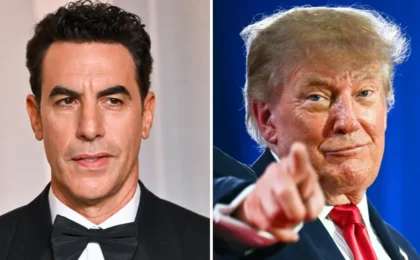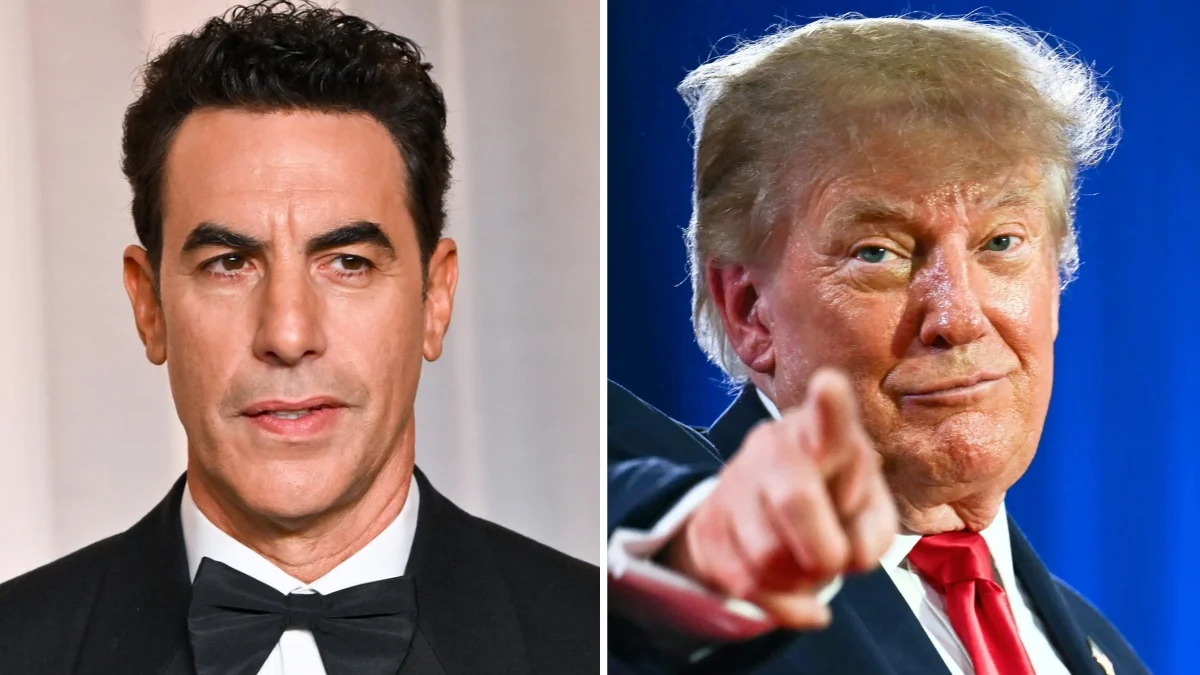
Two decades after he ostensibly retired his most iconic creation, Sacha Baron Cohen has dusted off the signature yellow tracksuit, the oversized bling, and the impenetrable slang of Ali G. The satirical firebrand, known for dismantling the egos of the world’s most powerful figures, has returned to the character for Ali G: Who Iz I?—a project that serves as both a retrospective and a reminder of the comedian’s unique ability to hold a mirror to society’s absurdities. As the production hits theaters ahead of its October 30 premiere on Amazon Prime, the cultural conversation has inevitably turned back to the man who arguably became the most famous target in the history of the "Da Ali G Show": Donald J. Trump.
The Chronology of an Iconic Encounter
The year was 2003. Sacha Baron Cohen was at the height of his powers, a British provocateur who had successfully hoodwinked high-ranking politicians, academic luminaries, and industry titans. Among his most ambitious targets was a New York real estate mogul named Donald Trump.
In a recent appearance on Josh Horowitz’s "Happy Sad Confused" live podcast at New York’s 92nd Street Y, Baron Cohen provided a vivid, behind-the-scenes account of that fateful meeting at Trump Tower. Accompanied by his longtime collaborator and director, James Bobin, the duo arrived at the billionaire’s office expecting a standard interview. Instead, they were greeted by a display of calculated intimidation.
"As Ali G, I had the privilege of sitting with some of the smartest and most powerful people in the world, and all of them were punctual," Baron Cohen told the audience, pausing for effect. "Donald Trump kept us waiting for about 40 minutes."
During this waiting period, Baron Cohen and Bobin were privy to a volatile phone call between Trump and his then-associate, Rudy Giuliani. According to Baron Cohen, Trump spent the time shouting a string of expletives at Giuliani—language the comedian dryly noted was "not for the likes of delicate Jewish ears." Looking back, Baron Cohen identified the behavior as a deliberate "power move," a tactic he later learned was a signature of the future president’s negotiation style.
The deception took a turn when Trump initially engaged with Bobin, whom he perceived as a "very handsome, blond, Oxford-educated" Englishman. However, when the veil was lifted and Trump realized he was to be interviewed by the caricatured, tracksuit-clad Ali G, his demeanor shifted instantly. The resulting segment became a legendary moment in television history, leaving Trump visibly confused and irritated.
The Fallout and the "Power Move"
The aftermath of the 2003 interview was as revealing as the encounter itself. Baron Cohen recounts hearing from a source who was in the car with Trump immediately following the shoot that the mogul was "furious."
"He actually went out publicly a couple of times to criticize me," Baron Cohen noted. "And in the end, we used all those clips and used them to advertise another show that I did."
This cycle of exploitation—where the satirist uses the target’s own reactions to amplify the message—is the hallmark of Baron Cohen’s career. By the time Trump moved from the boardrooms of the Trump Organization to the set of NBC’s The Apprentice, and eventually to the Oval Office, the footage from 2003 had been repurposed countless times, cementing the comedian’s reputation as a thorn in the side of the establishment.
Supporting Data: Why We Underestimated Him
The discourse surrounding the return of Ali G has invited a deeper analysis of the political landscape, particularly regarding the rise of populism. Reflecting on his past interactions and the broader evolution of the American electorate, Baron Cohen offered a nuanced, if controversial, take on Trump’s endurance.
"People underestimated him," Baron Cohen said, addressing the question of how Trump managed to secure a second term. "We were too easy to dismiss him as a nincompoop. There are elements of brilliance to him, otherwise. And that explains his appeal with the fact that he’s there for a second term."
This analysis aligns with contemporary political science data regarding the shift in American political communication. Baron Cohen argues that Trump’s mastery of the media—often through the use of comedy and sarcasm—is a tool used by the far right to neutralize criticism. "He’s intentionally being funny," the comedian explained during a separate appearance on the Pivot podcast with Kara Swisher and Scott Galloway. "And if you have a look on the far right, they use comedy and sarcasm as an engaging way to dismiss criticisms."
The comedian posits that Trump’s ability to "transform" the country is rooted in a fundamental understanding of human psychology that his critics failed to grasp for years. By treating Trump as an outlier rather than a symptom of a shifting media culture, the establishment effectively cleared a path for his political ascendancy.
Official Responses and Public Discourse
While the White House has not issued a formal response to Baron Cohen’s recent comments, the comedian’s assessment of Trump’s "brilliance" has ignited a firestorm on social media and within political commentary circles. Critics of the comedian suggest he is "normalizing" or "legitimizing" Trump by assigning him a degree of strategic genius. Conversely, supporters argue that Baron Cohen—a man who has spent two decades studying the mechanics of charisma and manipulation—is uniquely qualified to identify why the former president’s rhetoric resonates with such a large segment of the population.
Baron Cohen himself seems to embrace the complexity of the debate. When asked by interviewers about his stance on the impact of Trump’s presidency, he remained deliberately coy. "I won’t say positively or negatively," he remarked, maintaining the neutrality of a satirist who prefers to let the audience arrive at their own conclusions.
The Implications of Satire in a Polarized Age
As Ali G: Who Iz I? arrives on screens, the implications of its release go beyond mere nostalgia. In an era where the line between political theater and reality television has become increasingly blurred, the return of a character who exists purely to expose the artifice of others feels particularly timely.
The core of Baron Cohen’s philosophy, as evidenced by his reflections on Trump, is that the world is rarely "black and white." He suggests that the success of populist figures lies in their ability to exploit the "complicated" nature of reality. By using comedy to navigate the gray areas, these figures can bypass traditional intellectual defenses.
For Baron Cohen, the "brilliance" he attributes to Trump is not necessarily a moral virtue; it is a tactical proficiency. It is the ability to recognize that in a modern media landscape, being the subject of a joke is often preferable to being ignored. Whether it is through a chaotic phone call with an associate or a viral soundbite, the goal remains the same: dominance of the narrative.
As he prepares to bring his iconic character to a new generation, Baron Cohen is once again positioning himself as the observer-in-chief. He has spent 20 years testing the boundaries of public discourse, and if his recent comments are any indication, he has concluded that the joke, for better or worse, is on all of us.
The return of Ali G serves as a stark reminder: the most effective way to understand the power structures of our time is to look at them through the eyes of someone who knows exactly how to make them look ridiculous—even if, in the end, they are the ones who come out on top.