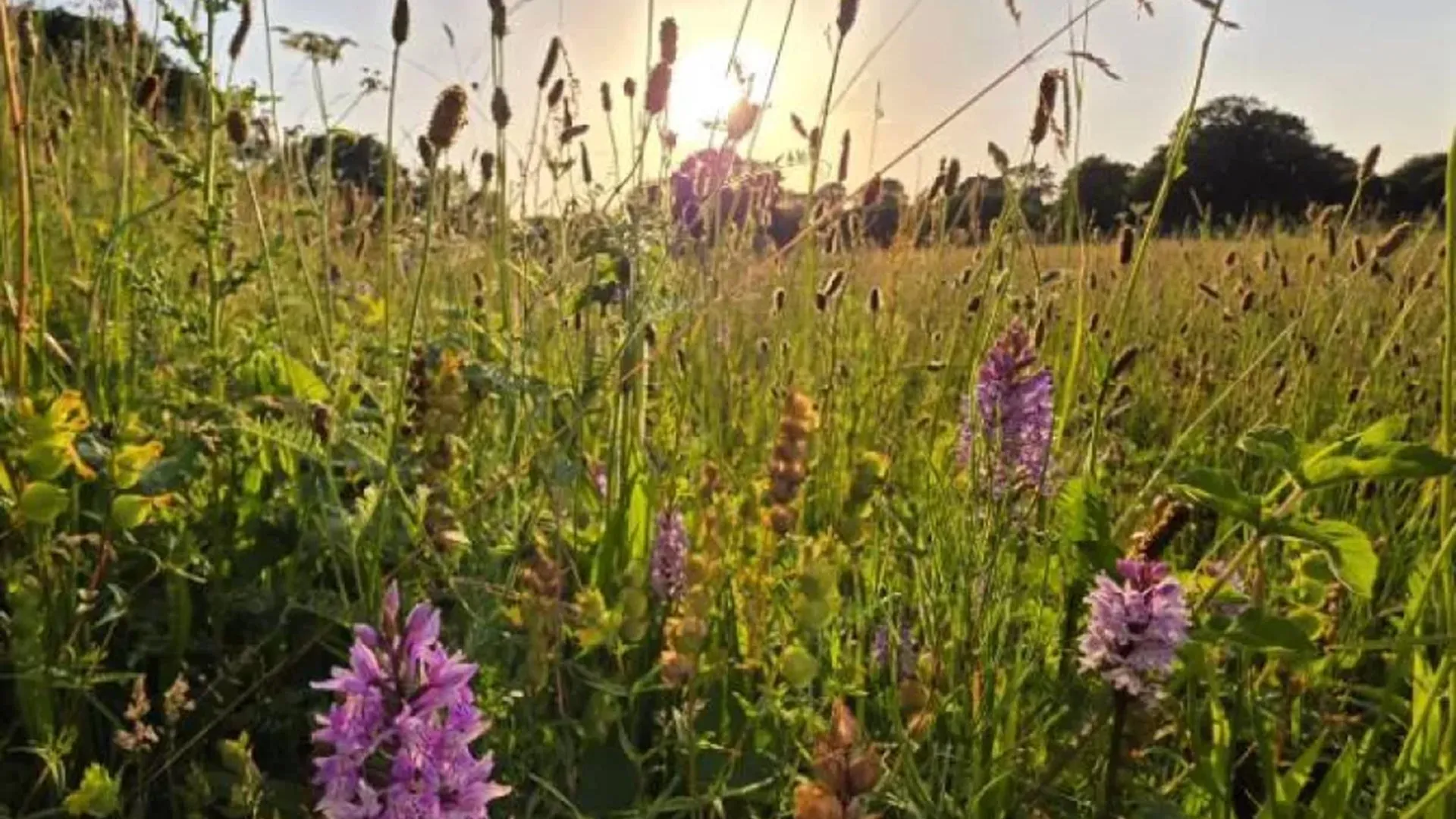
In the race to reverse the catastrophic decline of global biodiversity, conservationists have long relied on intensive, often expensive, human-led interventions. From the widespread distribution of commercial seed mixes to the mechanical preparation of soil, the prevailing wisdom has been that nature needs a "helping hand" to heal from the scars of industrial agriculture. However, a landmark study led by researchers at UCL Geography is challenging this orthodoxy, suggesting that the most effective restoration tool may simply be the courage to do nothing at all.
Published in the journal Restoration Ecology, an 11-year longitudinal study has revealed that abandoned farmland possesses a remarkable, inherent capacity to transform itself into a vibrant, species-rich wildflower meadow—without the need for costly commercial inputs or active seeding.
The Case of Sayer’s Meadow: A Study in Spontaneity
The focal point of this research is a two-hectare plot in Bodham, North Norfolk, known as Sayer’s Meadow. The land, owned by Derek Sayer and overseen by his son, Professor Carl Sayer—a distinguished scholar in limnology and freshwater ecology at UCL—served as the primary laboratory for what would become an accidental masterclass in ecological succession.
The site’s agricultural journey came to an abrupt end in 2005 following the harvest of an oilseed rape crop. The land had long been problematic for commercial farming, largely due to poor drainage that made it an arduous site for machinery. Rather than attempting to force the land into further productivity or paying for expensive, pre-packaged meadow restoration kits, Professor Sayer opted for a radical experiment: he let the land be.
For the subsequent 17 years—11 of which were subjected to rigorous, systematic monitoring—the only human intervention was a traditional annual hay cut. This practice, a staple of historical land management, prevents the dominance of scrub and woody species, keeping the field in the optimal state for grassland biodiversity. Beyond this, the meadow was left to the devices of nature.
Chronology of a Landscape’s Rebirth
The transformation of the site did not happen overnight; it was a rhythmic, decade-long unfolding of biological processes.
The Early Years (2005–2010): The Quiet Foundation
In the immediate aftermath of farming, the field remained dominated by the remnants of the previous agricultural cycle. The soil, enriched by years of intensive fertilizers, initially supported hardy, fast-growing weeds. However, as the residual nutrient levels began to deplete through the annual hay cuts—which remove nitrogen from the system—the competitive landscape began to shift.
The Observation Phase (2011–2022): Tracking the Transition
From 2011 to 2022, Professor Sayer and his collaborator, Pete Robinson, conducted detailed vegetation surveys every two to three years. This level of longitudinal, granular data is exceptionally rare in ecology, as most studies lack the funding or the long-term site security to monitor restoration at such a frequency over more than a decade.
By 2011, the meadow was already showing signs of transition. But it was between 2011 and 2022 that the real "rewilding" took hold. The surveys tracked permanent plots across the two-hectare field, recording every plant species identified. The results were striking: the average number of plant species found in each survey plot doubled, climbing from approximately 10 species in 2011 to nearly 20 by 2022.
Data-Driven Biodiversity: Beyond the Seed Packet
The implications of the data go far beyond the aesthetic success of a pretty meadow. The study provides quantitative evidence that natural colonization is not only possible but often superior to human-led restoration.
The Rise of Indicator Species
The most compelling evidence of the meadow’s health is the return of "indicator species"—plants that are highly sensitive to soil quality and habitat disturbance. Among the species that colonized the meadow without any human planting were:
- Southern Marsh Orchids: Once rare in the area, these appeared in their thousands, signaling a stable and healthy ecosystem.
- Yellow Rattle: A hemiparasitic plant that is crucial for meadow restoration because it suppresses vigorous grasses, allowing other wildflowers to take root.
- Greater Tussock-Sedge and Common Centaury: These species established themselves as permanent residents, further diversifying the meadow’s architecture.
The researchers hypothesize that the arrival of these species was facilitated by local wildlife. Birds and mammals, particularly deer moving through the North Norfolk landscape, likely acted as vectors for seeds, bringing in local flora that were already perfectly adapted to the regional soil and climate conditions.
Official Perspectives: The Philosophy of "Less is More"
The findings have sparked a lively debate within the conservation community regarding the "seed packet" mentality.
"Our study shows that resisting seeding and allowing nature to lead may be worth trying a lot more in wildflower meadow restoration," says Professor Sayer. "Natural plant recovery better safeguards genetic diversity than seeding and ensures that local species thrive, making meadows less generic."
Professor Sayer’s critique of the status quo is rooted in the "generic" nature of commercial seed mixes. When conservationists buy off-the-shelf seed, they often introduce plants that, while technically wildflowers, may not be genetically suited to the specific site. Furthermore, these mixes often fail to include the full spectrum of local biodiversity that would naturally arrive if the land were given the chance to "speak for itself."
"The UK needs nature recovery fast, at big scales," Sayer notes. "In the push to achieve this goal, our study poses the question: should we be employing patience over seed packets more often?"
Implications for Climate and Policy
As governments across the UK and Europe scramble to meet ambitious biodiversity targets—such as the "30 by 30" goal (protecting 30% of land for nature by 2030)—the Sayer study offers a blueprint that is both economically and ecologically advantageous.
Economic Viability
Restoration projects are notoriously expensive. Mechanical preparation, specialized machinery, and the purchase of high-quality, native-origin seeds can run into the thousands of pounds per hectare. By contrast, the "Sayer Method"—which involves simple site abandonment followed by consistent hay management—drastically reduces the overhead. This could allow for much larger swathes of land to be restored under limited government budgets.
Ecosystem Resilience
Beyond beauty, species-rich grasslands provide essential ecosystem services. They are critical habitats for pollinators—bees, butterflies, and hoverflies—which are currently in freefall. Furthermore, a diverse meadow with a complex root structure acts as a carbon sink and helps landscapes adapt to the erratic weather patterns associated with climate change, including better water retention and flood mitigation.
Genetic Integrity
By allowing nature to restore the land, the project ensures that the plants present are those that have historically thrived in the specific micro-climate of North Norfolk. This preserves the genetic integrity of local populations, preventing the "homogenization" of the landscape that occurs when identical seed mixes are deployed across disparate regions.
A Legacy of Spontaneity
Reflecting on the success of the project, Professor Sayer emphasizes the personal connection to the land. "The field belongs to my family, and after an oilseed rape crop in 2005 we stopped farming it as the land was difficult to drain," he recalls. "I really wanted a wildflower meadow and all advice was to seed it, but I resisted the temptation, as I have always been interested in nature’s ability to recover itself."
The result is more than just a scientific success; it is a cultural asset for the village of Bodham. The thousands of orchids that now bloom each spring have become a point of local pride, a testament to the fact that when we step back, nature often surprises us with its ability to heal.
"A visit to the meadow is like stepping back through time," Sayer says. "It shows what can be achieved by a traditional hay-cutting approach combined with nature’s brilliant spontaneity."
Conclusion: A New Paradigm for Land Management
The study at Sayer’s Meadow serves as a poignant reminder that human beings are often too eager to dominate the processes of restoration. By imposing our own timelines and methods, we risk bypassing the intricate, slow-burn wisdom of ecological succession.
As we look toward a future where large-scale landscape restoration is an environmental necessity, the "patience-first" approach championed by the UCL team offers a beacon of hope. It suggests that the most effective way to restore the planet might not be to build a new nature from scratch, but to provide the space, time, and minimal management required for nature to rebuild itself. The evidence is clear: the seeds of recovery are already present; they are simply waiting for the opportunity to grow.