The roar emanating from the stands at Lumen Field as the second half resumed against Australia was not merely a reaction to a kickoff; it was a collective acknowledgment of a new era. The United States Men’s National Team (USMNT) is no longer a side defined by cautious transitions or reactive tactics. Under Mauricio Pochettino, the Americans have adopted a high-octane, aggressive, and suffocating pressing system that has dismantled their first two group-stage opponents with clinical, if not always polished, efficiency.
Two games into the 2026 World Cup, the USMNT has secured two victories, clinching their place in the knockout stages. Yet, as the excitement builds, a tactical shadow looms: while this "Pochettino brand" of football is devastating against teams of a certain tier, it remains an open question whether it will hold up against the global elite.
The Chronology of Control: From Paraguay to Australia
The USMNT’s tournament trajectory has been defined by their ability to dictate the tempo early. In the opener against Paraguay, the Americans arrived with a statement of intent, blowing their opposition out of the water with a relentless offensive display.
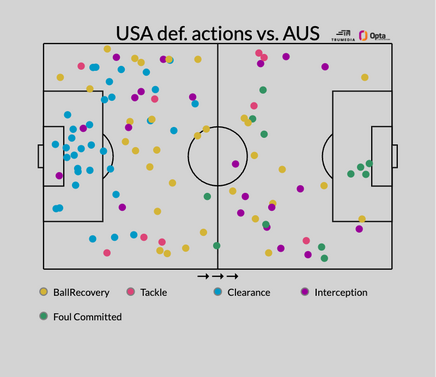
The match against Australia, while a 2-0 victory, served as a more nuanced case study in endurance. From the opening whistle, Folarin Balogun functioned as the tip of the spear, forcing Australian defenders into panicked clearances and uncharacteristic turnovers. The USMNT’s tactical discipline was evident in their possession recoveries; by the time the first hydration break arrived, the U.S. had already notched four recoveries in the final third.
By the end of the 90 minutes, the statistics reflected a team that dominated the narrative, even if the final third finishing lacked the surgical precision seen in the opener. With only 10 shots on target and a combined 1.3 xG (Expected Goals), the scoreline was bolstered by a forced own goal—a direct result of Balogun’s relentless pressure. While the efficiency could be questioned, the tactical dominance was undeniable: Australia was suffocated, finishing the match with a dismal 71.4% passing success rate.

Tactical Analysis: The "Pochettino" Effect
What makes this iteration of the USMNT so intriguing is how perfectly the squad seems to mirror the managerial philosophy of Mauricio Pochettino. During his tenures at Paris Saint-Germain and Chelsea, Pochettino often appeared to be compromising his high-pressing, high-energy ideals to accommodate star-studded, often disjointed squads.
In the U.S. camp, however, he has found something different: a young, athletic, and malleable group that hasn’t yet developed the "big club" ego that can stifle a coach’s tactical vision.
The Engine Room
The USMNT’s current approach relies on "hunting in packs." By utilizing the youthful legs of players like Weston McKennie and the speed of their forward line, the U.S. is turning the pitch into a gauntlet. It is a system that demands immense physical output, but in the international game—where team chemistry is often secondary to individual talent—the sheer intensity of the American press is neutralizing opponents before they can settle into a rhythm.
The Pulisic Paradox
The most striking aspect of these two victories is that they were achieved without the USMNT’s primary creative engine, Christian Pulisic. The absence of a player who serves as both the team’s leader and top scorer would usually derail a tournament campaign. Instead, the team has leaned into a collective identity. When Pulisic eventually returns, he will provide the final-third quality that was occasionally missing against Australia, potentially transforming a "gritty" win into a rout.
Supporting Data: The Efficiency of the Press
The metrics provided by TruMedia highlight the efficacy of Pochettino’s approach. The USMNT’s ability to force turnovers in the attacking third is not just a statistical anomaly; it is the cornerstone of their game plan.

| Metric | Paraguay Match | Australia Match |
|---|---|---|
| Final Third Possessions Won | 5 | 4 |
| Opponent Passing Accuracy | 68% | 71.4% |
| Total Shots (USMNT) | 14 | 10 |
| Defensive Intensity Rating | High | Very High |
These numbers suggest a team that thrives on chaos. By disrupting the opponent’s build-up phase, the USMNT bypasses the need for long, intricate passing sequences, instead opting for immediate verticality. While this is effective against mid-tier nations, the coaching staff is likely aware that these margins are thin. A 1.3 xG performance against a team like Australia is acceptable, but against a defensive stalwart or a high-possession team, the lack of clinical finishing could prove fatal.
The Path Forward: Implications and Potential Pitfalls
As the group stage concludes, the focus shifts to the bracket. With the top spot currently in their sights, the USMNT is positioning itself for a favorable path through the Round of 16. If they avoid a slip-up against Turkiye, they will likely face a third-placed finisher from the lower-ranked groups, potentially setting up a clash with a side like Bosnia and Herzegovina or New Zealand.
The "Apex Predator" Problem
The true test for Pochettino’s system lies in the quarterfinals and beyond. The philosophy of high-pressing is, by its very nature, a high-risk, high-reward strategy.
In the modern European club game, elite teams have learned to "bait the press." Giants like Spain, France, and England possess the technical composure to lure a team like the U.S. into a high-pressure trap, only to play a single incisive ball that breaks the entire defensive structure. If the USMNT encounters a team capable of bypass-passing—moving the ball around or over the press with rapid, one-touch transitions—they could find themselves exposed in wide-open spaces.
The Home-Field Advantage
While the tactical risks are significant, one factor cannot be ignored: the 2026 World Cup is on American soil. The atmosphere at stadiums like Lumen Field provides a psychological cushion that can invigorate a tired squad. In one-off knockout matches, the energy of the home crowd can often bridge the gap between a "good" tactical system and an "unbeatable" one.
Conclusion: A Gamble on Greatness
Mauricio Pochettino has succeeded in giving the USMNT an identity that is both recognizable and feared. They are a team that hunts, a team that refuses to let the opposition breathe, and a team that embodies the athleticism of its young roster.
Whether this "Pochettino Blueprint" is enough to reach the semifinals remains to be seen. If the U.S. ultimately crashes out against an "apex predator," critics will point to the tactical inflexibility of the high press. However, if they find a way to navigate these high-grade matchups, it will be remembered as one of the most successful tactical impositions in international football history. For now, the USMNT is living in the moment, playing their game, and forcing the rest of the world to adjust to them. As the tournament progresses, the margin for error will shrink, but for the first time in a long time, the U.S. is not playing not to lose; they are playing to win.