
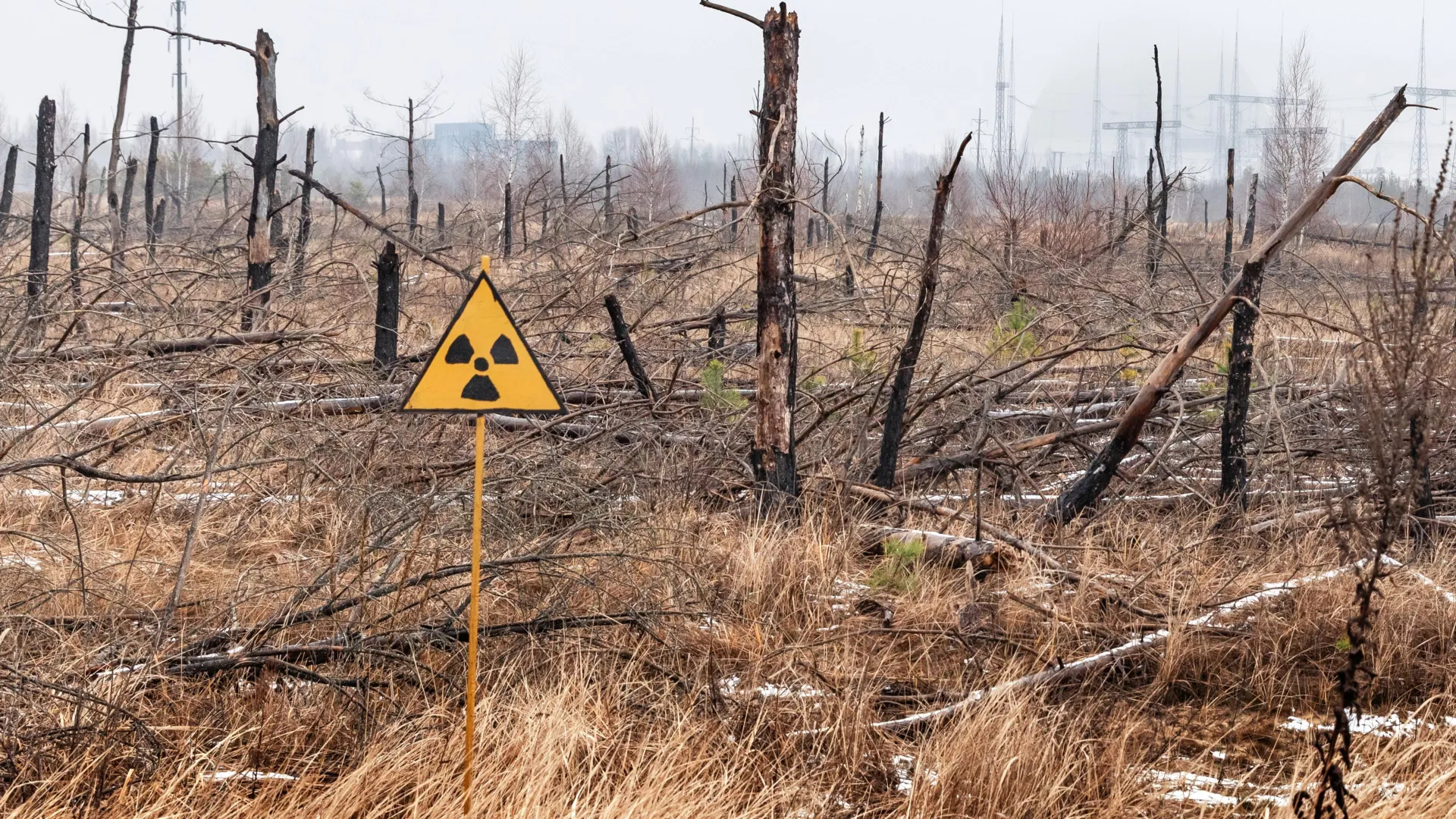
Four decades after the catastrophic reactor failure at the Chornobyl Nuclear Power Plant, the Exclusion Zone remains one of the most enigmatic and hazardous landscapes on Earth. While the site of the 1986 disaster has been reclaimed by nature in many respects, a microscopic, silent threat persists beneath the soil. New research, utilizing cutting-edge synchrotron technology, has peeled back the layers of this radioactive debris, revealing that the legacy of the accident is far more complex—and more stable—than scientists previously dared to assume.
Main Facts: The Microscopic Remnants of 1986
The disaster at Chornobyl did not merely release gaseous isotopes; it pulverized the very core of the reactor, ejecting enormous quantities of radioactive debris into the atmosphere. Among this fallout are microscopic particles, measuring between 8 and 50 micrometers, which remain scattered throughout the soil of the surrounding region. These particles are not uniform; they are complex chemical entities born from the extreme heat and volatile conditions of a melting nuclear core.
Physicist Tobias Weissenborn, a doctoral candidate at Leibniz University Hannover, has categorized these remnants into three distinct classes based on their chemical composition. The first class consists of particles that remain chemically and physically similar to the original uranium dioxide fuel. The second category comprises fuel that, during the inferno, fused with the zirconium cladding—the highly resistant metal casing designed to protect the fuel rods. The third and most fragile class was created during the ten-day fire that consumed the reactor’s graphite moderator, causing the fuel to oxidize into various forms of uranium oxide, such as $U_3O_8$.
These uranium oxides are notoriously brittle. As they weather over time, they break down into even smaller fragments, which can be lifted by the wind or leached into groundwater. Inhaling or ingesting these particles continues to pose a significant health risk, necessitating the use of specialized protective gear for anyone entering the most contaminated sectors of the Exclusion Zone.
A Chronology of the Disaster and Its Aftermath
To understand the current state of these particles, one must look back at the events of April 1986. The disaster began during a safety test that went catastrophically wrong, leading to a power excursion that blew the roof off Reactor No. 4.
- April 1986: The initial explosions released massive quantities of volatile fission products and solid radioactive fuel particles into the environment.
- The "Ten-Day Fire": As the graphite moderator ignited, the reactor core became a chemical furnace. The intense heat forced the oxidation of the fuel, creating the varied landscape of particles that researchers are studying today.
- 1986–2000s: Initial containment efforts focused on the "Sarcophagus," a temporary concrete structure, followed by the long-term planning of the New Safe Confinement (NSC). During this period, the scientific community primarily tracked broad radiation levels across the landscape.
- 2020s: With the deployment of advanced spectroscopic and X-ray techniques, the focus has shifted from macro-level environmental monitoring to the molecular study of the fuel particles themselves, seeking to understand the chemical evolution of the fallout.
Supporting Data: Peering into the Heart of the Atom
The recent study, spearheaded by Dr. Christoph Hennig of the Helmholtz-Zentrum Dresden-Rossendorf (HZDR) and Tobias Weissenborn, represents a milestone in radiochemistry. Using the Rossendorf Beamline at the European Synchrotron Radiation Facility (ESRF) in Grenoble, the team successfully performed the first detailed structural analysis of six radioactive fragments recovered from the Chornobyl region.
The process was as meticulous as it was dangerous. Because the particles are highly radioactive, they required rigorous containment throughout their transport from Ukraine to France. Once in the laboratory, the samples were isolated and mounted onto tungsten electrodes.
The team utilized synchrotron X-ray diffraction, a technique that maps the arrangement of atoms within crystalline materials. By rotating the particles in an X-ray beam focused to just 100 micrometers—the approximate width of a human hair—the researchers captured data from 2,000 different angles. This allowed them to distinguish between different crystalline phases of uranium oxide, revealing information about the internal structure that had been previously inaccessible.
The most startling discovery was the preservation of the original crystalline structure. Despite four decades of exposure to the elements—subjected to fluctuating temperatures, rain, and soil chemistry—the nuclear fuel inside the examined particles remained largely intact. This challenges the long-standing assumption that these particles were rapidly degrading and releasing their radioactive payloads into the environment.
Official Responses and Scientific Caution
While the discovery of increased chemical stability might seem like positive news for environmental containment, the scientific community remains firmly committed to a stance of extreme caution.
"Every single particle has a different structure," Weissenborn warns. "Our experiment only studied six such particles from two different locations."
The researchers emphasize that these findings cannot be extrapolated to characterize the entire Exclusion Zone. The heterogeneity of the radioactive fallout—a mixture of different fuel states and environmental conditions—means that what holds true for one particle may not hold true for another just a few meters away.
Official agencies, including the State Agency of Ukraine on Exclusion Zone Management, continue to maintain that the area is not ready for human habitation. The new findings do not suggest that the contamination is becoming "harmless." Instead, they suggest that the behavior of radioactive isotopes is more complex and less predictable than previously modeled. The stability of a particle today does not guarantee its stability tomorrow; environmental weathering is a slow, relentless process that could release concentrated doses of radionuclides long after the surface soil appears to have stabilized.
Implications for the Future: A Long-Term Hazard
The implications of this research are twofold. First, they provide a more accurate model for predicting the long-term movement of radioactive contaminants. If the fuel remains trapped within stable crystalline structures, the spread of contamination into the wider water table may be slower than previously feared. This could help environmental scientists refine their remediation strategies and long-term management plans for the zone.
Second, the study highlights the "outlier" problem. Even if the majority of particles were to follow a uniform decay or degradation pattern, there will always be a subset of highly persistent, slow-weathering particles. These remnants act as long-term "time bombs," capable of releasing radionuclides decades or even centuries after the initial event.
As Dr. Hennig and Weissenborn continue their work, their focus is shifting toward transuranic phases—elements heavier than uranium, such as plutonium and americium—which are also present in the debris. These elements present their own unique risks and chemical behaviors, adding further layers of complexity to the Chornobyl puzzle.
For now, the Exclusion Zone remains a living laboratory. The research conducted in Grenoble serves as a sobering reminder that while the fire of 1986 has long since been extinguished, the chemical consequences of the disaster are still unfolding at the atomic level. The "Chornobyl legacy" is not a static condition, but a dynamic, evolving process that will demand scientific vigilance for generations to come. The goal is no longer just to monitor radiation levels, but to fundamentally understand the chemical persistence of the disaster’s remnants, ensuring that we are not blindsided by the slow, silent changes occurring within the soil of this scarred landscape.