As I sat in a sterile, nondescript conference room in the heart of Apple’s midtown offices, a sudden, sharp chill raced up my spine. Raindrops, hyper-realistic and crystalline, seemed to fall directly into my eyes, leaving me with the distinct, tactile sensation of being damp and cold. For a brief, disorienting moment, I wasn’t in a corporate suite in Manhattan; I was lost in the gloom of a 19th-century nightmare.
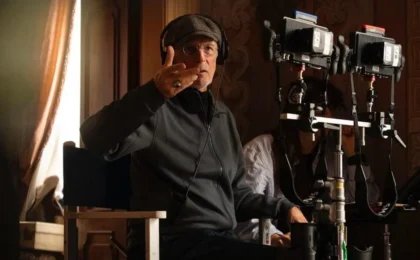
The experience was the centerpiece of Remnants, a 27-minute horror short directed by acclaimed auteur Ti West. Designed exclusively for the Apple Vision Pro, the film represents one of the most ambitious attempts yet to marry high-end narrative filmmaking with the "spatial computing" paradigm. While the industry has long toyed with the concept of VR and 3D cinema, West’s latest project suggests that we have finally crossed a threshold where the fourth wall is not merely broken—it is obliterated.
The Architect of Fear: Ti West’s Pivot to Spatial
Ti West has spent the better part of two decades establishing himself as a master of atmospheric dread. From the low-budget, slow-burn tension of 2009’s The House of the Devil to his recent, wildly successful trilogy—X (2022), Pearl (2022), and Maxxxine (2024)—West has built a career on understanding the geometry of fear.
When news broke that West would be directing Remnants for the Vision Pro, it caught many in the industry by surprise. Two weeks prior, the only high-profile project linked to the director was the upcoming holiday feature Ebenezer, starring Johnny Depp. Remnants, released quietly on October 16 as a "spooky season treat," feels like a departure from the traditional theatrical experience, yet it is undeniably a Ti West production: grounded in character, rich in period detail, and deeply committed to the sanctity of the genre.
A Chronology of the Immersive Experience
The transition from passive viewer to active participant in Remnants is seamless, provided one has the hardware to facilitate it. My journey began with an orientation on the Apple Vision Pro. Having tested various iterations of VR and AR hardware over the years, I approached the device with a healthy degree of skepticism, expecting another expensive, gimmicky novelty.

That skepticism dissolved within minutes. The interface is intuitive, leveraging the same design language as the iPhone, which creates an immediate sense of familiarity. However, the "brain-busting" aspect kicks in during calibration. As the headset tracks my eyes and hands, the physical world begins to merge with the digital. "Oh, so this is Minority Report, minus the bad stuff," I remarked. Once the device mapped my gaze, my eyes essentially became the cursor. A simple tap of my thumb and forefinger allowed me to navigate a digital landscape with precision that felt almost telepathic.
Before diving into Remnants, the Apple team provided a series of demos showcasing 180-degree 3D 8K Apple Immersive Video. The sensory input was overwhelming. One moment, I was standing on stage at a Metallica concert, close enough to see the texture of James Hetfield’s skin; the next, I was trapped in a submarine, feeling as though the leaking pipes were drowning me. The most startling moment occurred during a nature sequence: an orangutan approached to within inches of my face, its gaze so piercing it shattered any lingering sense of being in an office.
Then, the feature presentation began. Remnants tells a straightforward, effective story: In 1886 London, Eleanor (Lucy Boynton) is tasked with appraising the abandoned Woldmere Castle. Despite the ominous warnings of a local inhabitant (played with gravelly gravitas by Ralph Ineson), she ventures into the manor. The plot serves its purpose perfectly—it provides a skeleton upon which to drape the sensory experience.
Supporting Data: The Tech Under the Hood
The technical specs behind Remnants represent a massive leap forward in digital cinematography. Filmed in 8K resolution with Spatial Audio, the film utilizes high frame rates that provide an unparalleled sense of presence. However, this is where the debate within the cinephile community ignites.
Much like Peter Jackson’s The Hobbit or the "motion smoothing" settings on modern high-definition televisions, Remnants suffers from a hyper-reality that can sometimes feel jarring. By rendering scenes with such absolute clarity, the film occasionally crosses into the uncanny valley, where the "lush" quality of cinema gives way to the aesthetic of a high-budget soap opera.

Yet, for this specific medium, the trade-off is fascinating. During the pub scene at the start of the film, the detail was so granular I found myself obsessing over the texture of the characters’ clothing and the specific application of Eleanor’s makeup—details that would be lost in the soft focus of a traditional film. It was less like watching a movie and more like being a ghost in the room, observing the scene unfold in real-time.
Official Responses and Creative Intent
While Apple has not launched a massive, multi-million dollar marketing blitz for Remnants, the project serves as a "hero demo" for the Vision Pro platform. The strategy appears to be a "slow burn" approach, relying on tech-forward press and word-of-mouth to demonstrate the capabilities of the hardware.
For West, the challenge was recontextualizing horror tropes. In a traditional film, the director controls the viewer’s eye. In Remnants, the viewer has agency. West leans into this by placing the audience in situations where they must choose where to look. When Eleanor hides under the bed, the viewer is right there with her, heart pounding, scanning the dark corners for the monster. When an apparition walks through the viewer, the sensation is visceral, shifting the horror from a passive viewing experience to a physiological event.
Implications: The High Cost of the Future
As I exited the Apple offices and stepped back into the blinding afternoon sun, I found myself grappling with the implications of what I had just witnessed. Remnants is a technical marvel, a triumph of spatial storytelling that proves immersive cinema has a viable future. But that future is tethered to a significant hurdle: the price tag.
With the entry-level 256GB Apple Vision Pro retailing at $3,699, this medium remains, for the moment, the province of the ultra-wealthy. We are seeing a glimpse of a medium that could redefine entertainment, yet it is trapped behind a wall of cost that prohibits mass adoption.

Furthermore, there is the question of the "motion smoothing" effect. If filmmakers are to fully embrace this technology, they will need to find a way to balance 8K hyper-clarity with the artistic warmth that audiences associate with "cinema." Until then, Remnants remains an exquisite, chilling, and slightly eerie test case—a brilliant demonstration of what is possible, even if we aren’t quite ready for it to become the norm.
For now, the ghost in the machine is real, it’s terrifying, and it’s waiting for those who can afford the ticket.