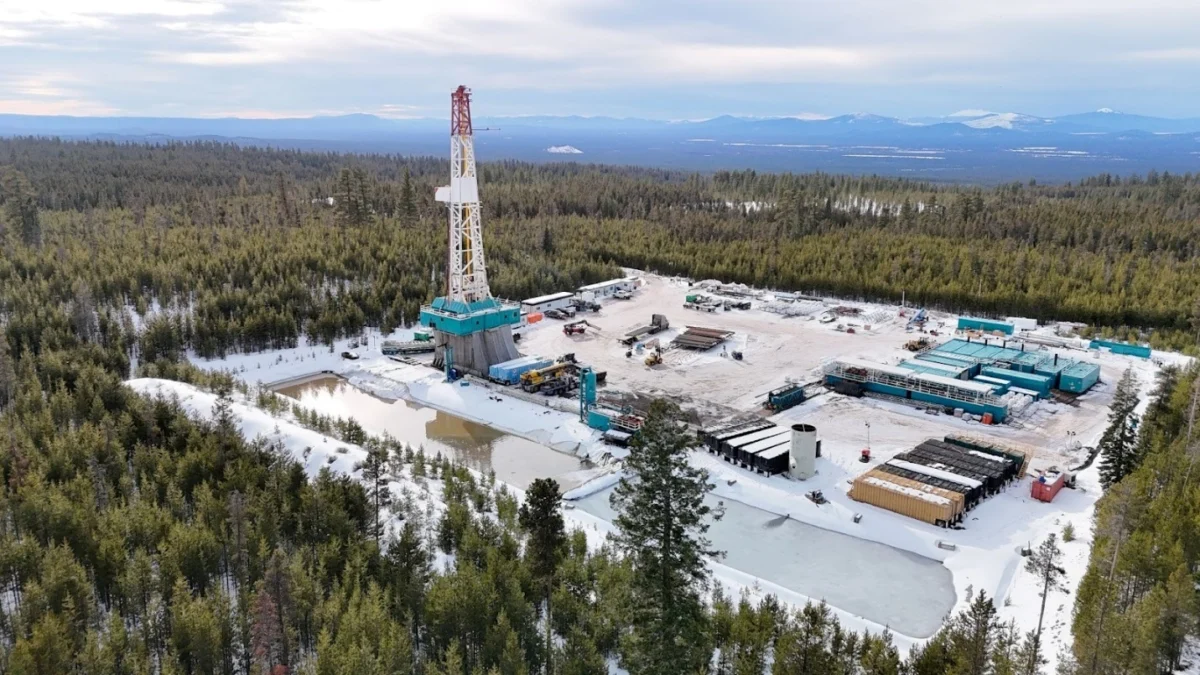
In a landmark moment for the burgeoning clean energy sector, Mazama Energy—a geothermal startup incubated at the powerhouse venture firm Khosla Ventures—has announced the successful closure of a $135 million Series B funding round. The round, which the company reported as oversubscribed, signals a tectonic shift in investor sentiment regarding the role of "super-hot rock" energy in the global transition toward a carbon-free grid.
As the world scrambles to satisfy the insatiable power demands of AI data centers and industrial electrification, Mazama Energy is positioning itself as a "dark horse" contender. By leveraging advanced drilling techniques to access supercritical heat deep beneath the Earth’s crust, the company aims to deliver 24/7, baseload carbon-free power—a feat that has historically eluded intermittent renewable sources like wind and solar.
Main Facts: The $135 Million Bet
The Series B capital injection, led by Centaurus Capital and Doerr Capital, brings a massive influx of resources to Mazama’s ambitious roadmap. The round also saw participation from industry heavyweights, including ConocoPhillips and Shell Ventures, alongside returning backers like Khosla Ventures and Gates Frontier. New investors, including SiteGround Capital, H. Barton Asset Management, and the Jeffrey and Marieke Rothschild Foundation, rounded out the syndicate.
The core of Mazama’s value proposition lies in its proprietary approach to horizontal drilling. While traditional geothermal energy has long relied on finding rare, naturally occurring hydrothermal reservoirs, Mazama is pioneering "Enhanced Geothermal Systems" (EGS). By drilling deeper—often exceeding 15,000 feet—into impermeable, super-hot rock, the company can circulate water to generate heat at temperatures near 750°F (400°C). At these depths and pressures, water transitions into a "supercritical fluid," possessing the density of a liquid and the viscosity of a gas. This state allows for significantly higher energy extraction rates, with Mazama claiming each well is capable of producing 15 megawatts of electricity—roughly ten times the output of conventional geothermal wells.
Chronology: From Incubation to Industrial Scale
Mazama Energy’s trajectory has been defined by rapid technical milestones and increasingly bold output projections.
- Incubation and Early Proof of Concept: Born from the laboratories at Khosla Ventures, Mazama began with the mission of proving that the depths of the Earth could be treated as an engineering problem rather than a geological gamble.
- 2024: The Initial Assessment: During its early development phases, investor Vinod Khosla highlighted the immense potential of the company’s primary site in Oregon, estimating a capacity of 5 gigawatts.
- October 2025: The Revision: Following successful test drills, the company updated its outlook for the Oregon site, doubling its previous estimate to 10 gigawatts of potential capacity. This dramatic upward revision underscored the efficiency of their drilling technology.
- November 2025: Series B Success: The company successfully closed its $135 million Series B round, providing the financial runway to transition from pilot-scale drilling to commercial electricity generation.
- 2026 and Beyond: Mazama has signaled that it intends to begin grid-scale electricity generation by late 2026. The current roadmap targets a 200-megawatt production milestone at the Oregon site by 2030.
Supporting Data: The Physics of Supercriticality
The math behind Mazama’s technology is as compelling as it is ambitious. The global energy potential of super-hot rock is staggering. According to research from the University of Twente and the Clean Air Task Force, tapping into just 1% of the world’s super-hot rock resources could yield over 63 terawatts of electricity. To put that in perspective, the entire current global power capacity is a fraction of that figure.
Mazama’s drilling efficiency is the key technical barrier they have managed to break. In recent operations, the company successfully drilled past the 10,000-foot mark in just 15 days, a velocity that makes deep-well geothermal projects economically viable for the first time. By achieving high-speed, deep-crust penetration, Mazama is effectively commoditizing the heat of the Earth’s mantle, turning what was once a scientific curiosity into a repeatable industrial process.
Official Responses and Strategic Partnerships
The composition of the funding round is perhaps the most significant indicator of the industry’s changing landscape. The presence of oil and gas majors like ConocoPhillips and Shell Ventures alongside climate-focused investors like the Gates Frontier suggests that the transition to geothermal is being viewed as a natural evolution for firms with deep expertise in subsurface engineering.
"Mazama Energy is not just a renewable energy company; it is an infrastructure firm capable of scaling the most reliable form of energy on the planet," noted a spokesperson close to the deal. By securing land for a second development site even as the Oregon project remains in its early stages, the company is demonstrating a commitment to building a portfolio of assets rather than relying on a single, unproven site.
For the investors, the partnership is a hedge against the volatility of the grid. As data center developers search for reliable, 24/7 power to replace the reliance on fossil-fuel-burning peaker plants, Mazama offers a "plug-and-play" solution that occupies a fraction of the land area required for massive wind or solar farms.
Implications: A New Era for the Grid
The rise of enhanced geothermal energy has profound implications for the global energy transition, specifically regarding the "AI-driven" power crisis.
The Data Center Dilemma
As tech giants like Google, Microsoft, and Amazon expand their AI compute capacity, the energy requirements for their data centers have skyrocketed. The current trend has been a resurgence in natural gas and even interest in nuclear energy. However, geothermal presents a unique, localized solution. Because geothermal plants provide constant, non-intermittent power, they are perfectly suited to the "always-on" nature of compute-heavy infrastructure.
The Land and Resource Footprint
Compared to solar and wind, which require massive geographical footprints and significant battery storage infrastructure to handle intermittency, geothermal is highly compact. A 10-gigawatt site, as envisioned by Mazama, could theoretically power millions of homes or dozens of large-scale AI campuses while occupying a relatively small surface area.
Challenges Ahead
Despite the optimism, Mazama faces significant hurdles. The drilling of super-hot, supercritical wells is notoriously difficult. Maintaining well integrity at temperatures of 750°F under extreme pressure requires advanced materials science that is only just beginning to be tested at scale. Furthermore, the regulatory environment for deep-well drilling—which often touches on water table protections and seismic monitoring—remains complex.
Mazama’s success will ultimately depend on its ability to maintain its current drilling speed and cost efficiency as it scales from one well to hundreds. If they succeed, they will not only have revolutionized the geothermal industry but will have provided a critical missing piece in the puzzle of achieving a fully decarbonized, high-compute future.
Conclusion: A Turning Point
The $135 million infusion into Mazama Energy is a clear signal that the era of "fringe" geothermal energy is coming to an end. With the backing of some of the world’s most sophisticated investors and a clear, albeit ambitious, path to commercialization, Mazama is moving to the front of the line in the race to power the next generation of technological advancement. As the company moves toward its 2030 targets, the energy sector will be watching the Oregon site closely, waiting to see if the Earth’s own heat can finally be harnessed as the reliable, clean, and infinite battery that humanity has long been looking for.