By a Correspondent in Mumbai
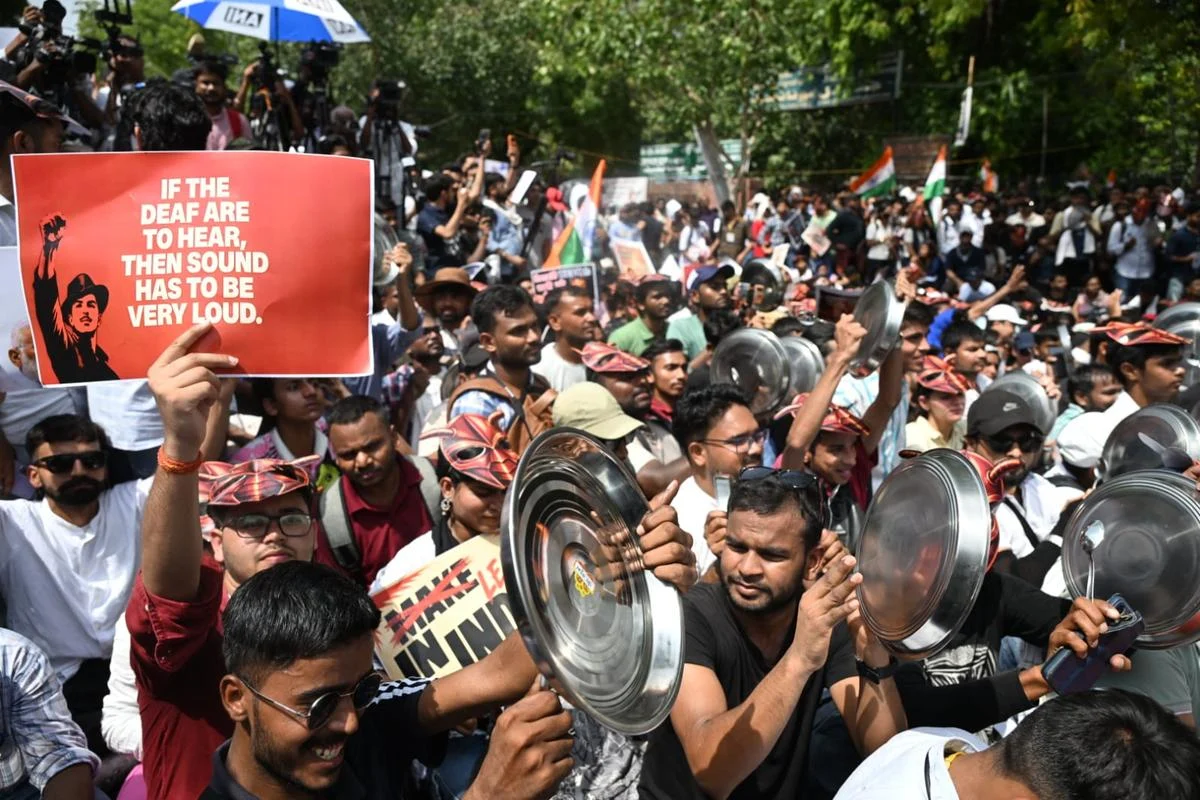
For the third consecutive day, the national capital of India has been transformed into a theater of unrest. Thousands of students—collectively identifying themselves as "cockroaches"—have flooded the streets of Delhi, marching toward Parliament in a desperate bid to be heard. What began as a localized outcry over the catastrophic leak of the National Eligibility cum Entrance Test (NEET) has metastasized into a broader, existential struggle between the Indian state and its younger generation.
The movement, which has garnered significant traction across major metropolitan hubs, is defined by its reclamation of a derogatory label. The term "cockroach" stems from inflammatory remarks made by Chief Justice of India (CJI) Surya Kant, who, in a recent address, characterized unemployed youth and activists challenging the legal system as "cockroaches and parasites." This judicial framing of dissent has acted as a catalyst, igniting a social-media-driven wildfire that has now spilled out into the physical landscape of Delhi, where it is being met with the heavy-handed machinery of the state.
Chronology of the Crisis: From Exam Leak to Street Conflict
The current agitation finds its roots in the systemic failure of the National Testing Agency’s (NTA) NEET examination. For millions of students, the NEET is the singular gateway to medical education. When reports of systematic question-paper leaks emerged, the trust between the student body and the state evaporated.
- Initial Mobilization: Following the disclosures, student unions moved from online advocacy to offline protests, seeking accountability for the compromised examination process.
- The Judicial Trigger: The movement took on a sharper, more radical tone after the Chief Justice’s comments were broadcast, transforming the protest from a demand for educational integrity into a defense of the right to dissent.
- The "Chalo Sansad" March: This week, organizers issued a call for a mass march to Parliament ("Chalo Sansad"), leading to the current siege of the capital.
- Police Escalation: As demonstrators attempted to bypass barricades, the Delhi Police initiated a massive crackdown. By day three, the imagery emerging from the capital is harrowing: students blinded by tear gas, bloodied faces, and mass detentions.
The Anatomy of Repression: Disproportionate Force
The visual record of the protests is stark. Footage circulating on social media captures the chaotic reality of the police cordon: young men and women being struck by lathis (wooden batons), the choking haze of tear gas canisters, and the overwhelming presence of tactical riot gear.
Protesters and civil society observers argue that the police response has been fundamentally disproportionate. They contend that the force used—ranging from traditional batons to allegations of electric batons and nail-studded sticks—exceeds the requirements of "crowd control" and enters the realm of punitive suppression.
The Delhi Police, conversely, maintain that their actions were defensive. In official statements issued across social media platforms, the department claimed that officers were performing their mandated duties to maintain public order. They asserted that protesters breached barricades and defied prohibitory orders, forcing the police to resort to standard crowd-control measures to prevent a total collapse of security in the high-security zone near Parliament.
A Judiciary in Retreat: The Refusal of Redressal
Perhaps the most troubling aspect of the current crisis is the silence of the courts. When the matter was brought before the Delhi High Court, the bench offered an obiter dictum urging petitioners not to "drag the Court into this matter." Despite the urgency, the hearing was deferred to September 2026, effectively denying the protesters any immediate legal protection or accountability for the injuries sustained.
The Supreme Court, traditionally viewed as the "Guardian of Fundamental Rights," has proven equally inaccessible. Chief Justice Surya Kant, the source of the "cockroach" rhetoric, declined an urgent listing of a plea against the police crackdown, dismissing it as a "waste of time." The court further remarked that it had "no time to watch videos" of the clashes. This refusal to engage with the evidence of state violence has left a legal vacuum, leaving the streets as the only available forum for the students’ grievances.
The Legal Threshold: Policing and Constitutional Mandates
Indian jurisprudence has long struggled to balance the police’s power to maintain order with the citizen’s right to protest. Decades of legal precedents, including Joginder Kumar v. State of Uttar Pradesh and D.K. Basu v. State of West Bengal, have established that the mere existence of statutory power does not validate its abuse. These cases emphasize that constitutional protections are most vital precisely when citizens face the coercive apparatus of the state.
Furthermore, the Delhi Police’s own "Standing Order" dictates that officers on duty must be clearly identifiable by uniform, name plates, and badges. However, the current protests have been marred by reports of plainclothes officers operating within the crowds, an opaque tactic that removes accountability and heightens the risk of violence. Following an intense public outcry, the police were forced to issue a directive mandating that all personnel wear proper uniforms.
The Ministry of Home Affairs’ Code of Conduct for the Police in India and the National Crime Investigation Bureau’s guidelines both dictate that force must be a "last resort." They state that any force must be:
- Minimal: Using the least amount of physical pressure possible.
- Proportionate: Calibrated to the level of threat.
- Discontinued Early: Stopped as soon as the objective—such as dispersal—is met.
The use of the lathi in this context is especially contentious. The Delhi High Court has previously ruled that batons can exclusively be used to disperse an unlawful assembly, not to punish those present. When police force moves from dispersal to infliction of pain, it violates the core tenets of the Indian Constitution.
The Gendered Dimension of Custodial Violence
Among the most harrowing reports are those concerning the treatment of female protesters. Indian law provides stringent procedural safeguards for women in custody or during police interactions to prevent the historical scourge of custodial abuse. These safeguards are rooted in the right to dignity under Article 21 of the Constitution.
Allegations that male police personnel have physically handled female protesters—many of whom are young students—represent a severe breach of these procedural norms. In a city already struggling with a reputation regarding the safety of women, such reports are not merely procedural failures; they are a direct assault on the dignity of the female citizenry and a violation of the state’s duty to protect its vulnerable populations.
Implications for Democratic Dissent
The crisis in Delhi raises an uncomfortable question: Has the Indian state redefined "public order" to include the suppression of any inconvenient dissent?
Democratic participation is inherently disruptive. It involves noise, movement, and the questioning of authority. However, the current trend toward using "public order" as a constitutional trump card to bypass fundamental rights suggests a shift in the relationship between the state and the individual. If the police are allowed to operate without the constraints of proportionality, and if the judiciary refuses to act as a check on that power, the right to protest will transition from a guaranteed constitutional freedom to a privilege granted at the sufferance of the government.
As the "cockroach" movement continues to hold its ground, the implications for India’s democracy are profound. The students are not merely fighting for an exam; they are fighting against a dehumanizing rhetoric that seeks to strip them of their agency. The state’s reliance on the lathi as its primary interlocutor with the youth serves only to deepen the divide, transforming a generation of aspiring professionals into a generation of hardened dissenters.
The ultimate resolution of this crisis will serve as a bellwether for the health of India’s democracy. Whether the state chooses to listen to the voices of its youth or continues to view them as an infestation to be cleared, the events of these past few days have already ensured one thing: the political landscape of the nation has been permanently altered. The "cockroaches" are no longer just in the streets; they are at the door of the state, and they are refusing to leave.
Disclaimer: Opinions expressed in JURIST Dispatches are solely those of our correspondents in the field and do not necessarily reflect the views of JURIST’s editors, staff, donors, or the University of Pittsburgh.