For billions of years, the Moon has served as a silent, scarred witness to the chaotic energy of our solar system. Devoid of a protective atmosphere or a global magnetic field, the lunar surface has been relentlessly sandblasted by the solar wind—a constant, high-speed stream of charged particles flowing from the Sun. However, recent scientific analysis of soil samples returned by China’s Chang’e 6 mission has unveiled a startling truth: this bombardment has not been uniform.
New evidence published in Nature Geoscience reveals that the Moon’s two hemispheres have experienced fundamentally different solar wind histories. The disparity is not a result of lunar geography, but rather the profound, protective influence of Earth’s magnetosphere. This discovery fundamentally alters our understanding of the Earth-Moon-Sun relationship, positioning the lunar regolith as a "fossilized" archive of our planet’s magnetic history.
The Archive in the Dust: A New Perspective on Lunar History
The solar wind is composed of protons, electrons, and heavier ions ejected from the Sun’s corona. When these particles strike the Moon, they become embedded in the upper layers of the lunar regolith. Because these particles include noble gases—helium, neon, argon, krypton, and xenon—which are chemically inert, they do not react with surrounding minerals. Instead, they remain trapped, acting as time-stamped markers of the solar wind’s composition and energy at the time of their arrival.
For decades, planetary scientists were constrained by a significant "near-side bias." All samples brought back by the Apollo missions, as well as the more recent Chang’e 5 mission, were collected from the lunar near side—the hemisphere that perpetually faces Earth. Without material from the far side, scientists lacked a control group, leaving the question of hemispheric variation in solar wind exposure largely to theoretical speculation.
The landscape of lunar science shifted in 2024, when China’s Chang’e 6 mission achieved a historic milestone: it successfully touched down in the South Pole-Aitken basin on the far side of the Moon and returned 1.935 grams of precious, pristine regolith. This material provided the first-ever direct opportunity to compare the solar wind implantation signatures of the far side against the established baseline of the near side.
Chronology of a Discovery: From Chang’e 6 to the Laboratory
The journey to this discovery began with the meticulous curation of the Chang’e 6 samples. Upon their return to Earth, a team led by the Institute of Geology and Geophysics (IGG) of the Chinese Academy of Sciences (CAS) undertook a comprehensive analysis of the noble gas concentrations within the dust.
The research team, headed by postdoctoral researcher Xuhang Zhang under the guidance of Professor HE Huaiyu, collaborated with experts from the University of Science and Technology of China and the Chang’e 7 volatile payload team. The process unfolded through several key phases:
- Sample Preparation: The regolith was carefully handled to prevent terrestrial contamination, ensuring that the ancient solar wind signatures remained undisturbed.
- Isotopic Mass Spectrometry: Researchers measured the ratios of noble gas isotopes, specifically focusing on the neon isotope 20Ne/22Ne ratio.
- Stepwise Heating Experiments: To determine how deeply the particles had penetrated the soil, the samples were subjected to controlled, incremental heating, which released gases stored at different depths within the lunar grains.
- Comparative Analysis: The data from the far-side samples was contrasted against the wealth of existing data from the Chang’e 5 near-side mission to isolate the influence of Earth’s magnetic influence.
Supporting Data: Decoding the Isotopic Fingerprints
The evidence for hemispheric divergence lies in the fine details of atomic behavior. The most striking discovery involved neon isotopes. In the Chang’e 6 samples, the 20Ne/22Ne ratio averaged 11.34 ± 0.22. This figure is significantly lower than that observed in any near-side sample collected to date.
In the language of solar physics, a lower ratio is a classic indicator of "strong solar wind fractionation." As solar wind particles interact with a surface, the lighter isotope (20Ne) is often stripped away or altered differently than the heavier one (22Ne). The far-side samples exhibited a level of fractionation that strongly suggests the solar wind arriving there was not only more intense but also subjected to different physical conditions than that arriving at the near side.
The confirmation of this energy disparity came from the behavior of xenon. During the stepwise heating experiments, the xenon from the Chang’e 6 samples was released almost entirely at high temperatures. In contrast, Chang’e 5 samples released xenon at both low and high temperatures. This indicates that the solar wind particles on the far side penetrated much deeper into the lunar soil. Deeper implantation requires greater kinetic energy; therefore, the far side was clearly exposed to a faster, more energetic stream of solar particles compared to the "shielded" near side.
The Speed-Governing Effect: Earth’s Magnetospheric Buffer
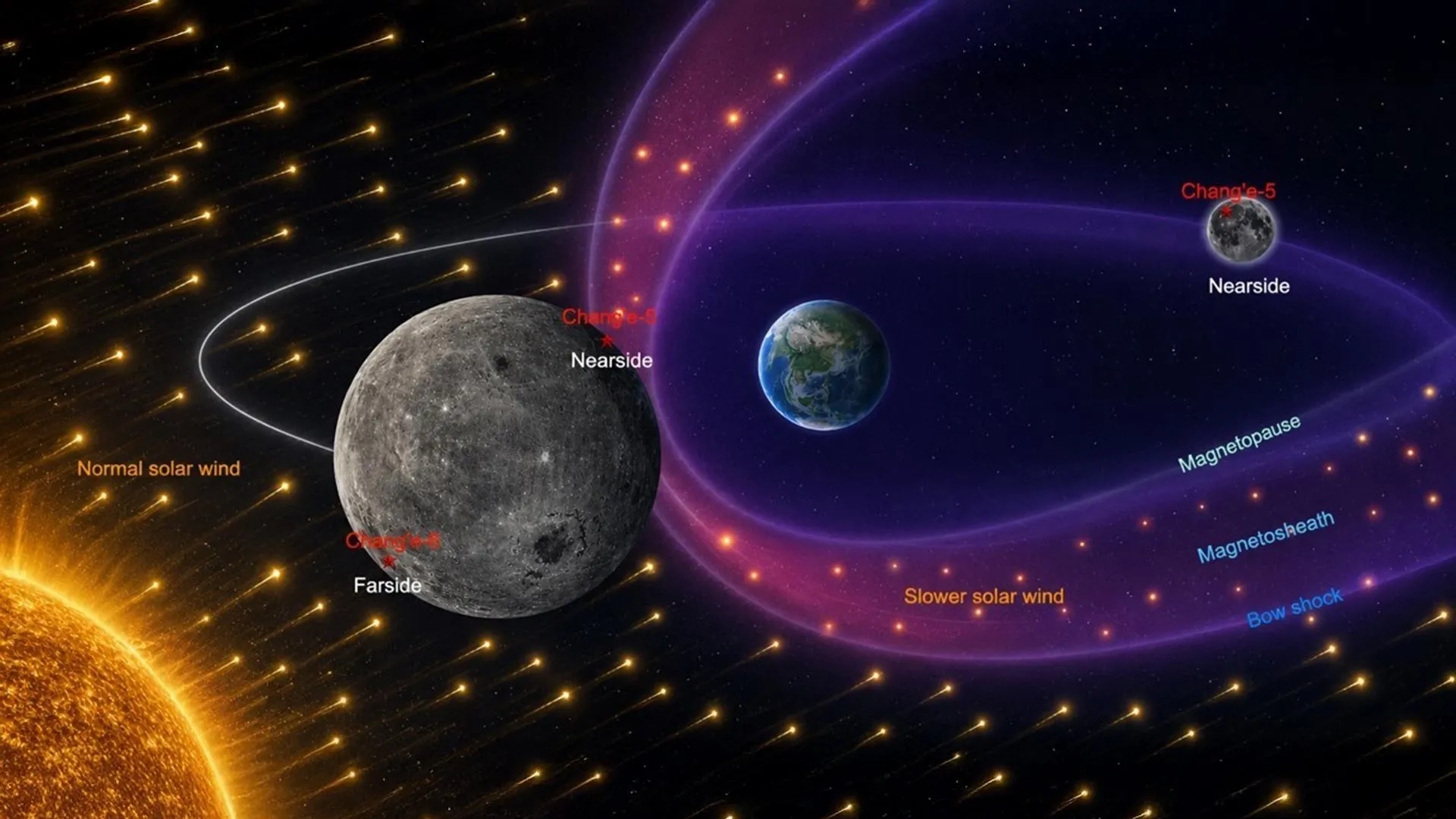
The core finding of the IGG team is the identification of Earth’s magnetosphere as a "speed governor" for the solar wind. Earth is encased in a protective magnetic bubble, the magnetosphere, which creates a region known as the magnetosheath.
As the Moon orbits the Earth, it periodically passes through this magnetosheath. In this buffer zone, the solar wind—which typically travels at a blistering 400 km/s—is decelerated to approximately 200 km/s. Because the near side of the Moon faces Earth, it spends a portion of its time effectively "behind" this magnetic shield, receiving a slower, less energetic bombardment.
The far side, however, is perpetually exposed to the full, unbridled force of the solar wind. The study estimates that nearly 25% of the total solar wind record at the Chang’e 5 (near side) landing site was subjected to this decelerating effect. The Chang’e 6 (far side) site, conversely, showed no such attenuation. This confirms that the Moon acts as a celestial laboratory, where the two sides record the history of solar-terrestrial interactions from entirely different vantages.
Official Responses and Scientific Significance
The findings have been met with enthusiasm within the global planetary science community. Representatives from the Chinese Academy of Sciences noted that this research validates the immense value of the Chang’e 6 mission, which was the first to successfully navigate the complexities of a far-side landing.
"This is the first direct physical evidence that Earth’s magnetosphere controls the solar wind speed reaching different parts of the Moon," noted Professor HE Huaiyu. "It isn’t just about the Moon; it’s about the evolution of the Earth."
The broader scientific community emphasizes that this discovery bridges the gap between solar physics and geophysics. By using the Moon as a giant, permanent sensor, researchers can now look back in time. Because the lunar soil records these noble gas signatures over billions of years, the regolith acts as a "fossil record" of how Earth’s magnetosphere has behaved throughout deep time.
Implications: A New Era for Paleomagnetism
The implications of this research are profound. By comparing the noble gas signatures in lunar soil with existing paleomagnetic evidence from Earth, scientists may finally be able to reconstruct the history of Earth’s magnetic field.
If Earth’s magnetic field were stronger or weaker in the past, or if the orientation of the magnetosphere shifted, the "shielding" effect on the Moon would have fluctuated accordingly. These changes would be written into the isotopic ratios of the lunar regolith. This offers a new, independent method for tracking the evolution of the Earth’s core—the engine that drives our magnetic field—over geological timescales.
Furthermore, this study highlights that our solar system is a deeply interconnected system. The relationship between the Sun, the Earth, and the Moon is not merely gravitational; it is a complex, dynamic interplay of magnetic fields and particle flows.
As we look toward future missions, including the upcoming Chang’e 7 and Artemis initiatives, the focus on lunar volatile materials will only intensify. The Moon is no longer just a barren rock to be explored; it is a repository of historical data, a sentinel that has captured the invisible, shifting currents of the Sun and the Earth for eons. The dusty plains of the far side, once thought to be a uniform landscape, are now revealed to be a complex diary of our planet’s past—a diary we are only just beginning to read.