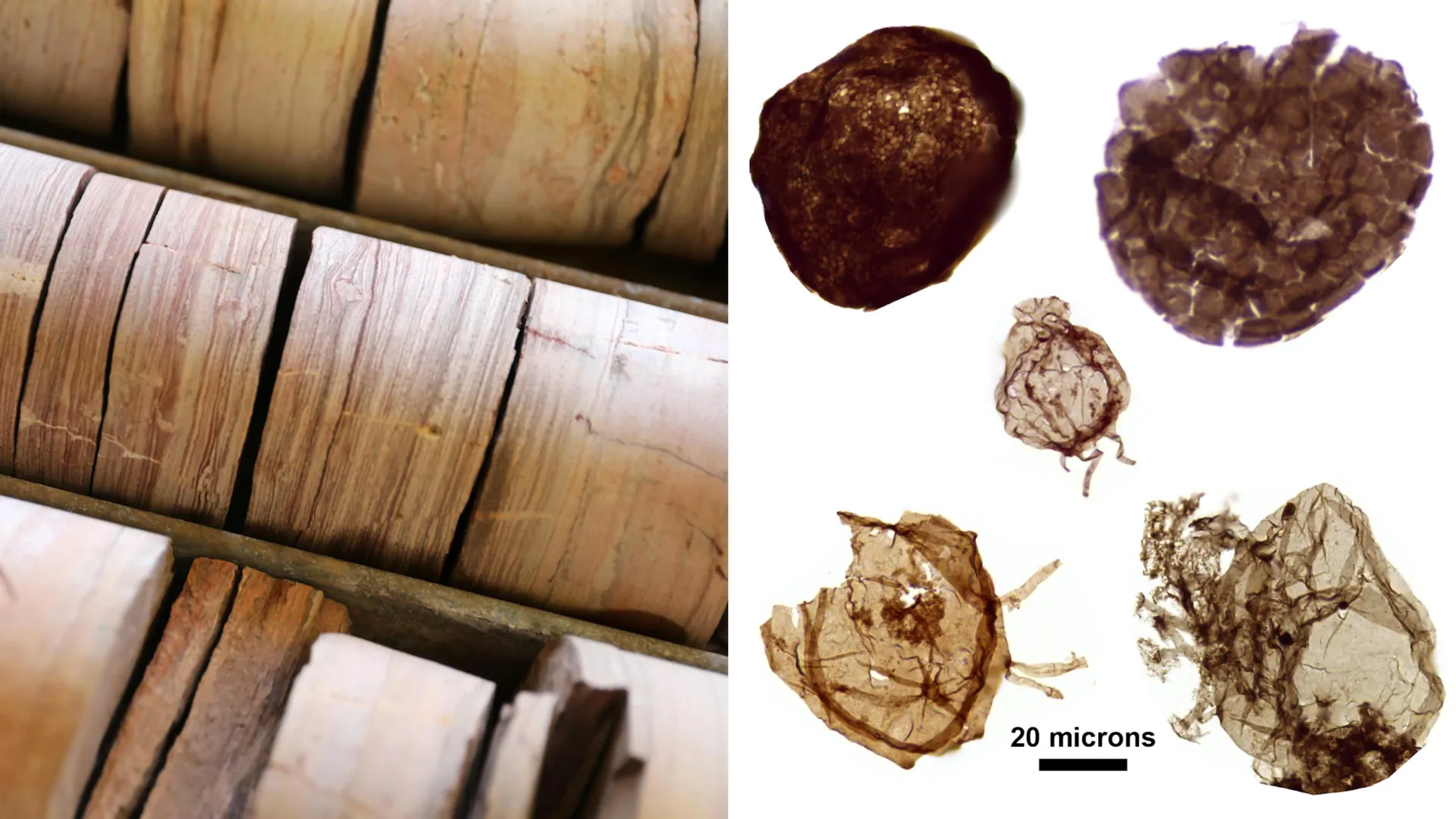
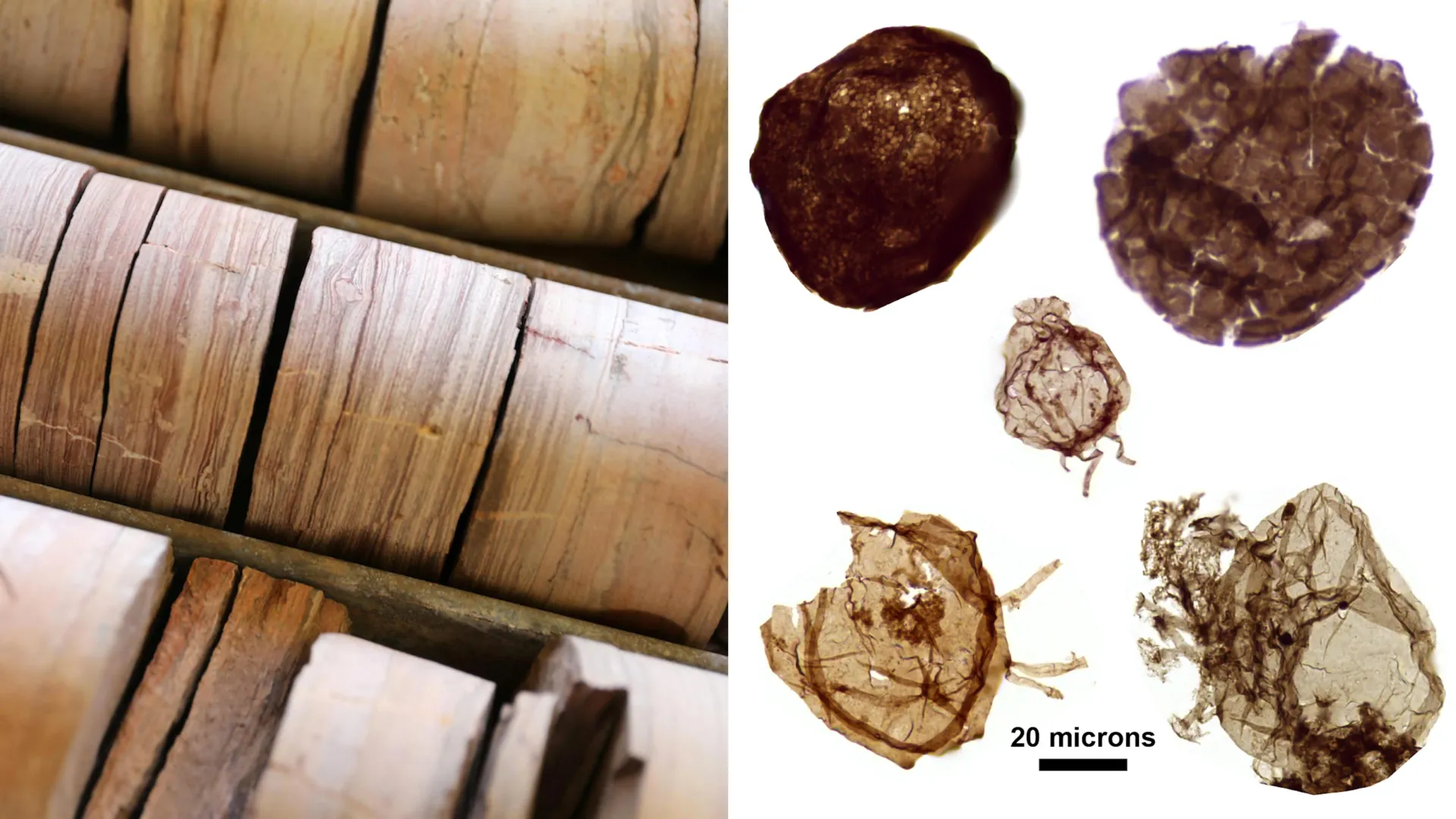
In a quiet, open-air warehouse in tropical Darwin, Australia, thousands of unassuming cylindrical rock cores sit in neatly arranged trays. These cores, extracted from hundreds of meters beneath the surface by mineral exploration companies decades ago, were originally intended to map the economic potential of the Northern Territory. They were meant to reveal veins of gold or iron, not the secrets of our own biological origins.
However, researchers working with the Northern Territory Geological Survey (NTGS) have discovered that these mudstones—sedimentary rock formed from hardened seafloor silt—contain a treasure far more valuable than any mineral. Buried within this compressed ancient mud are microscopic fossils of organisms that thrived 1.75 billion years ago. These fossils, the subject of a groundbreaking new study published in Nature, provide the most compelling evidence yet for how the eukaryotic revolution—the leap from simple, single-celled bacteria to the complex life that eventually became animals, plants, and humans—actually occurred.
The Great Evolutionary Divide: Understanding Eukaryotes
To appreciate the significance of these 1.75-billion-year-old fossils, one must understand the fundamental architecture of life on Earth. All living organisms fall into two primary camps at the cellular level: the prokaryotes and the eukaryotes.
Prokaryotes, which include bacteria and archaea, represent the "simple" life forms. They lack a centralized nucleus and are largely composed of a single, efficient, but minimalist cell. Eukaryotes, by contrast, are the heavyweights of complexity. Every animal, plant, fungus, and algae species on the planet is a eukaryote. Our cells are defined by a sophisticated interior: a nucleus that houses our genetic blueprints, and specialized organelles, such as mitochondria, that act as the cell’s power plants.
For decades, biologists have debated the "eukaryotic revolution." Genetic evidence from living organisms suggests that the last common ancestor of all eukaryotes was born from a symbiotic "marriage" between two prokaryotes: an archaeon and a bacterium. This union allowed for the development of internal membranes and the energy-efficient machinery required to support complex life. But while we have theories about how this happened, the fossil record—the physical proof of this transition—has long remained fragmented and difficult to interpret.
Chronology of an Ancient World
The timeline of early Earth is vast, characterized by long stretches of relative biological stasis punctuated by transformative events. The fossils discovered in the Northern Territory are, quite simply, the oldest known eukaryotic remains on the planet.
- 1.75 Billion Years Ago: The earliest fossils identified in the Darwin mudstones emerge. These represent the dawn of the eukaryotic record.
- 1.7 to 1.4 Billion Years Ago: The timeframe covered by the study, during which these microscopic organisms were deposited across a range of marine environments.
- The Proterozoic Era: This period was marked by the "boring billion," a phase of Earth’s history often perceived as having slow evolutionary progress. These fossils suggest that beneath the surface, the biological "engine" was undergoing a radical upgrade.
By meticulously cataloging these specimens, researchers have been able to trace a clearer path through the Proterozoic, showing that complex life did not appear overnight but was an incremental process shaped by the chemistry of the ancient oceans.
Supporting Data: Unlocking the Warehouse
The methodology behind the Nature study was as much a feat of chemical engineering as it was of paleontology. Researchers took samples of the mudstone cores and subjected them to a rigorous dissolution process. By crushing the rock and dissolving the mineral matrix, they were able to isolate the resilient organic residue—the carbonized remains of organisms that had been dead for over a billion years.
Under high-powered microscopes, the researchers identified more than 12,000 individual fossils. This is a staggering volume of data that allows for robust statistical analysis rather than relying on a handful of isolated, anomalous specimens.
The team didn’t stop at just identifying the fossils. They performed a geochemical analysis of the surrounding rock to reconstruct the environmental conditions of the ancient seafloor. This involved looking for chemical signatures that indicate the presence or absence of oxygen. What they found was a striking correlation: eukaryote fossils were found exclusively in layers of sediment that showed signs of having been deposited in oxygenated water. In layers where the chemistry indicated an oxygen-free environment, there was a total absence of complex life—only simple, prokaryotic forms remained.
The Oxygen Controversy: Friend or Foe?
For a long time, the scientific community operated under the assumption that oxygen was the "magic bullet" for eukaryotic evolution. Because aerobic respiration—using oxygen to break down food—provides the massive amounts of energy required for complex cellular functions, it was assumed that as soon as oxygen became available in the atmosphere, complex life would flourish.
However, this narrative has faced significant pushback in recent years. Researchers have discovered "enigmatic" eukaryotes that can survive in low-oxygen or even anaerobic environments. Furthermore, geological evidence suggests that during the early stages of eukaryotic evolution, the Earth’s oceans were largely oxygen-depleted. This led some scientists to argue that eukaryotes might not have been dependent on oxygen at all in their infancy.
The data from the Northern Territory cores, however, provides a powerful rebuttal to this recent skepticism. By proving that early eukaryotes were restricted to oxygen-rich niches, the study reaffirms the classical hypothesis: oxygen was, indeed, the primary driver that allowed eukaryotes to break through the "complexity barrier." It appears that while some later eukaryotes evolved to survive without oxygen, the origin of the eukaryotic cell was inextricably linked to the availability of the very gas that fuels our own modern existence.
Official Perspectives and Scientific Implications
The study has sent ripples through the scientific community, particularly among astrobiologists and evolutionary biologists. By bridging the gap between genetic theory and the physical fossil record, the researchers have provided a benchmark for what "early" life looks like.
"The study of these microfossils is more than just an exercise in ancient history," says one of the researchers involved. "It is an exercise in understanding the constraints of life."
By analyzing the habitats—from coastal mudflats to deep-sea environments—the team has demonstrated that the distribution of these organisms was not random. They were opportunistic, colonizing oxygenated environments as soon as they became available. This implies that life is highly responsive to its environmental "budget." When the budget for energy (oxygen) is increased, life invests that energy into complexity.
Implications for Life in the Cosmos
Perhaps the most profound implication of this research lies in its potential to inform the search for life beyond Earth. If we understand the specific environmental conditions—specifically the chemical thresholds—that were required for life to move from simple cells to complex entities, we can better calibrate our search for life on other planets.
If complex life is inherently dependent on specific oxygen levels, we might narrow our focus to exoplanets with atmospheres that show signs of oxygenic photosynthesis. Conversely, if we find that life can emerge in simpler, low-energy environments, our search parameters may need to expand.
The thousands of fossils sitting in a warehouse in Darwin are no longer just geological curiosities. They are the ancestral archives of a revolution that began 1.75 billion years ago. As researchers continue to probe these samples, they aren’t just looking at the past; they are looking at the foundational rules of biological complexity. We are finally beginning to understand the specific set of circumstances that had to align for the first eukaryote to draw its first breath, eventually leading, through an unimaginably long chain of events, to the sentient beings currently writing and reading this article. The mystery of the "eukaryotic revolution" is far from solved, but thanks to these ancient rocks, the map of our origins has never been clearer.