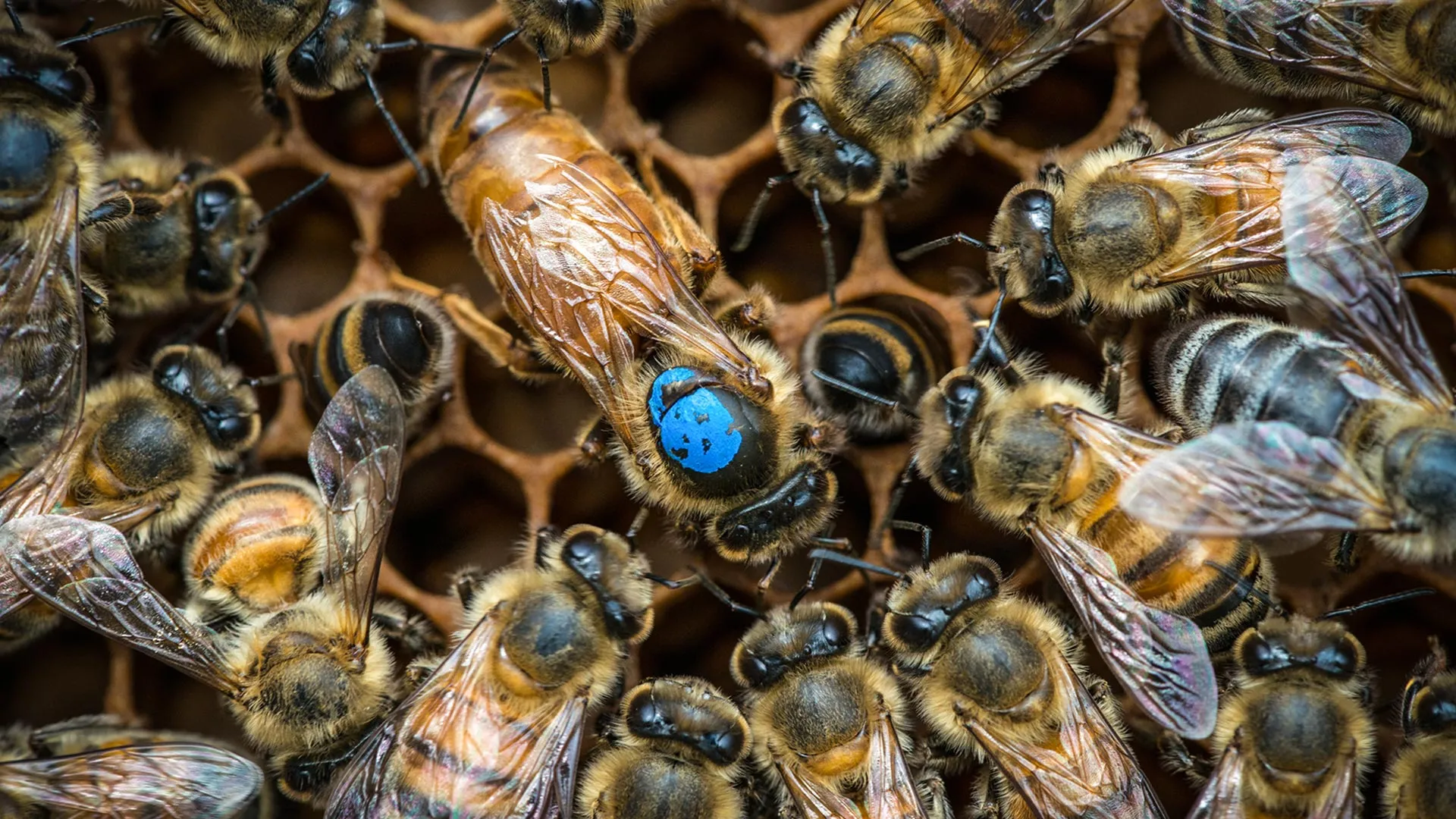
In the complex, bustling metropolises of honeybee colonies, order is not maintained by a central authority or a top-down management hierarchy. Instead, the hive functions through a sophisticated, decentralized system of labor that has fascinated biologists for centuries. Now, a groundbreaking study conducted by an interdisciplinary team from Heinrich Heine University Düsseldorf (HHU), in collaboration with the universities of Cologne and Frankfurt/Main, has unveiled the "biological switchboard" that dictates how these insects transition through their lifelong roles.
Published in the Proceedings of the National Academy of Sciences (PNAS), the research reveals that the age-dependent transition of worker bee responsibilities—from nursery duties to field foraging—is governed by specific neural circuits. By manipulating a singular gene, researchers successfully "reprogrammed" the behavior of older bees, effectively turning back their biological clock and causing them to revert to the tasks of their youth.
The Mystery of Decentralized Efficiency
For a human society to function, tasks are assigned through discussion, delegation, and planning. A bee colony, however, operates on an entirely different paradigm. With no central planner or "queen-as-manager"—the queen is primarily reproductive, not administrative—a colony of Apis mellifera manages to coordinate the labor of tens of thousands of individuals with remarkable precision.
The life of a worker bee follows a strictly defined, age-based progression. Upon emerging from its cell, a young worker spends its initial days nursing the queen and tending to developing larvae. As the bee matures, its role shifts toward the maintenance and infrastructure of the hive, followed by defensive duties. Only in the final chapter of its life does the bee venture into the treacherous world outside the hive to forage for nectar and pollen.
While scientists have long observed this "temporal polyethism," the physiological mechanisms behind it remained elusive. The question remained: How does the nervous system, composed of roughly one million neurons, orchestrate this seamless transition from the nursery to the field?
A Chronological Breakthrough: From Genetics to Behavior
The journey to this discovery began in the laboratory of Professor Dr. Martin Beye at HHU’s Institute of Evolutionary Genetics. Beye’s team had been investigating the functional role of the doublesex gene, a gene traditionally associated with sexual differentiation across many species.
During their initial observations, the researchers noted a striking anomaly. When the doublesex gene was deactivated in mature worker bees, the insects did not simply cease their foraging activities; they underwent a behavioral regression. The older bees began to exhibit the characteristics of young "nurse" bees, returning to the center of the colony to care for the queen and the brood.
The Experimental Timeline
- Initial Observation: During genetic studies, the team observed that deactivating the doublesex gene prompted older worker bees to abandon their age-appropriate roles in favor of nursery tasks.
- Circuit Mapping: Recognizing that the gene operated only within specific neural pathways, the team mapped these circuits to identify how they influenced social behavior.
- The Chemical Trigger: Researchers engineered a system to selectively silence these neurons. By using the doublesex gene to produce a protein that suppresses neural activity, they created a "remote control" for the bees’ behavior.
- Validation: By feeding the bees a specific substance, the team activated the suppression protein, effectively silencing the neural circuits. The result was consistent: older bees reverted to juvenile behaviors immediately upon inhibition of these targeted pathways.
Supporting Data: The Mechanics of Neural Suppression
The methodology employed by Dr. Jana Seiler and her colleagues represents a milestone in neurobiology. By combining genetics with chemical inhibition, the team bypassed the need for invasive physical manipulation, which could have compromised the bees’ natural social interactions.
The key to the experiment was the precision of the neural silencing. The researchers did not inhibit the entire brain; they targeted only the neural circuits where doublesex was active. This allowed them to isolate the specific "task-assignment" pathways from the bees’ other motor and sensory functions.
The data derived from the study provided a clear correlation:
- Active doublesex circuits: Bees perform age-appropriate tasks (foraging/guarding).
- Inhibited doublesex circuits: The brain’s regulatory feedback loop is interrupted, causing the bees to default to the "nursing" state.
This suggests that the "default" state of a honeybee is that of a nurse, and the transition to more advanced, external tasks is a process of active neural development—a process that can be reversed if the underlying circuitry is suppressed.
Official Responses and Expert Insight
Dr. Jana Seiler, the lead author of the study, emphasized the significance of these findings in understanding the plasticity of animal behavior. "The older worker bees then resumed caring for the queen, which only younger bees would do otherwise," Seiler noted in the study’s conclusion. "When the circuits were not inhibited, the bees exhibited their normal, age-dependent behavior. In this way, we were able to control which tasks the worker bees performed."
Professor Beye, who spearheaded the collaboration, highlighted that this research provides a vital missing link in the study of social evolution. "The ability to control the social behavior of bees offers us new opportunities to explore the fundamentals of innate behavioral diversity and social cooperation," Beye stated. "The solution to the secret of how bees and other animals cooperate so well without a blueprint for work is likely hidden in the brain’s neural circuits."
The research team noted that their findings do not suggest that the doublesex gene is the only factor in behavior, but rather that it acts as a critical node in a larger network of neural communication. By interacting with other circuits, this gene helps the bee "perceive" its own age or maturity level, subsequently triggering the corresponding behavioral program.
Implications: The Future of Behavioral Neurobiology
The implications of this study extend far beyond the apiary. Understanding the neural foundation of labor division in bees provides a blueprint for how complex societies—both animal and potentially human—organize themselves without central governance.
Why This Matters:
- The Evolution of Sociality: This research provides early evidence that social cooperation is not merely a learned cultural behavior but is deeply rooted in the architecture of the brain. If behavior is determined by specific, manageable circuits, it implies that social roles are biologically "wired" into the nervous system.
- Neuro-Genetic Mapping: The techniques developed by the HHU team offer a new template for neuroscientists to study behavior in other model organisms. By identifying which genes regulate which social circuits, scientists may be able to better understand the biological basis of anxiety, aggression, and cooperation.
- Insights into Behavioral Flexibility: The fact that the researchers could "reverse" the aging process of the bee’s behavioral role suggests that biological maturity is not a fixed, irreversible state but a dynamic condition that can be modulated by neural activity.
A New Frontier in Behavioral Studies
The work of Seiler, Beye, and their colleagues effectively shifts the focus of sociobiology from the external environment to the internal hardware. If the "secret of the hive" is indeed hidden within these neural circuits, the next phase of research will likely involve identifying the sensory inputs that "flip the switch" on these circuits in a natural setting.
Does a nurse bee, for instance, transition to a forager because of hormonal cues, environmental signals, or a programmed internal clock that dictates when to "turn off" the doublesex-related nursing circuits? The study suggests that the brain is constantly monitoring its own state and adjusting task performance accordingly.
As the scientific community continues to digest these findings, the image of the bee as a mere "worker" is being replaced by that of a highly complex biological machine. Each bee is a node in a massive, living network, governed not by a queen’s orders, but by the elegant, silent firing of neural circuits that ensure the colony survives, thrives, and grows. The research from Düsseldorf provides the first real map of this hidden infrastructure, proving that even in the smallest of creatures, the most complex social structures are built from the neuron up.