Main Facts
President Donald Trump spent the final weekend of September engaging in high-visibility public appearances at major sporting events across the United States. Utilizing Air Force One for a low-altitude flyover at a high-stakes college football game in Tennessee before traveling to suburban Chicago to celebrate a U.S. team victory at the Presidents Cup golf tournament, the president showcased a strategy of high-profile populism amid mounting domestic and foreign policy challenges.
The presidential weekend circuit unfolded against a backdrop of heightened political and economic pressure:
- Impending Midterm Elections: With exactly 36 days remaining before the midterm elections and mail-in ballots already circulating in several states, Republican prognosticators have begun downgrading prospects for GOP candidates in critical Senate and House races.
- Diplomatic Aftermath: The administration hailed last week’s summit between President Trump and Chinese President Xi Jinping as "historic." However, the White House has yet to announce substantive breakthroughs, beyond extending a bilateral trade truce and securing a temporary delay in Beijing’s planned restrictions on rare earth mineral exports. An anticipated agreement on artificial intelligence (AI) regulation failed to materialize.
- Rising Energy Costs and Military Conflict: Domestically, voters are expressing growing discontent over inflation and surging energy costs, amplified by the military conflict involving the United States, Israel, and Iran. The average price of gasoline has climbed to $4.4768 per gallon, up significantly from around $3.10 when the previous administration ended on January 20, 2025. Diesel fuel has similarly risen to $6.4531 per gallon, compared to $3.6856 one year ago.
- Legislative Action: On Capitol Hill, the Senate prepared for a final vote on the "Protect College Sports Act," a bipartisan measure regulating Name, Image, and Likeness (NIL) framework that President Trump has endorsed.
Chronology
[Late Last Week] ─── Trump-Xi Summit in Washington/Beijing Framework
                       └─ Extended trade truce; delayed rare earth limits; no AI deal.

[Saturday] ───────── Air Force One Flyover in Knoxville, TN
                       ├─ Low-altitude pass over Neyland Stadium (Texas vs. Tennessee).
                       └─ Trump publicly rejects Tehran's latest peace proposal.

[Sunday] ─────────── Presidents Cup Victory at Medinah Country Club
                       ├─ Presentation of trophy alongside PGA Tour CEO Brian Rolapp.
                       ├─ Team Captain Brandt Snedeker credits Trump for "the juice."
                       ├─ Evening return to White House; claims record oil flows in Hormuz.
                       └─ 10:00 PM White House dinner with Anthropic CEO Dario Amodei.

[Monday] ─────────── Senate Scheduled Vote on "Protect College Sports Act"

[Late Week] ──────── Planned West Coast Fundraising & Campaign Trail
                       └─ Stops in Oklahoma (Thursday) and Alabama (Friday).
The Post-Summit Landscape
Following days of intensive negotiations with Chinese President Xi Jinping, administration officials labeled the bilateral talks a sweeping diplomatic victory. However, the concrete outcomes released to the public remained limited to maintaining the existing commercial status quo: a continuation of the trade truce and a postponement of China’s proposed export controls on rare earth elements. Key priorities voiced by congressional Republicans—most notably a structured framework to regulate cross-border AI deployment—were omitted from final briefings.
Saturday: Neyland Stadium Flyover and Foreign Policy Rejection
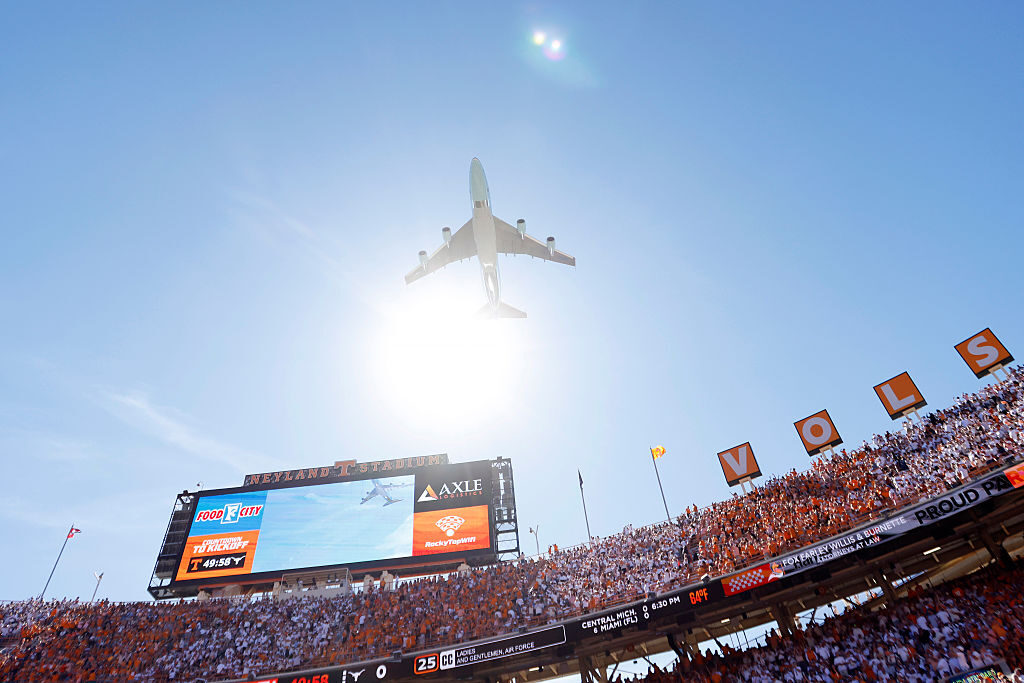
On Saturday, President Trump traveled aboard Air Force One to Knoxville, Tennessee. Before the top-ranked University of Texas Longhorns defeated the No. 14 University of Tennessee Volunteers at Neyland Stadium, the presidential aircraft conducted a low-altitude pass ("buzzing the tower") over the venue.
En route to the game, reporters questioned Trump regarding Tehran’s latest proposal to cease hostilities in the Middle East following direct U.S. involvement alongside Israel. The president unequivocally dismissed the diplomacy, stating, "I reject their proposal." During the Tennessee visit, Trump did not publicly address the pending college sports legislation advancing through Congress.
Sunday: Medinah Country Club and White House Agenda
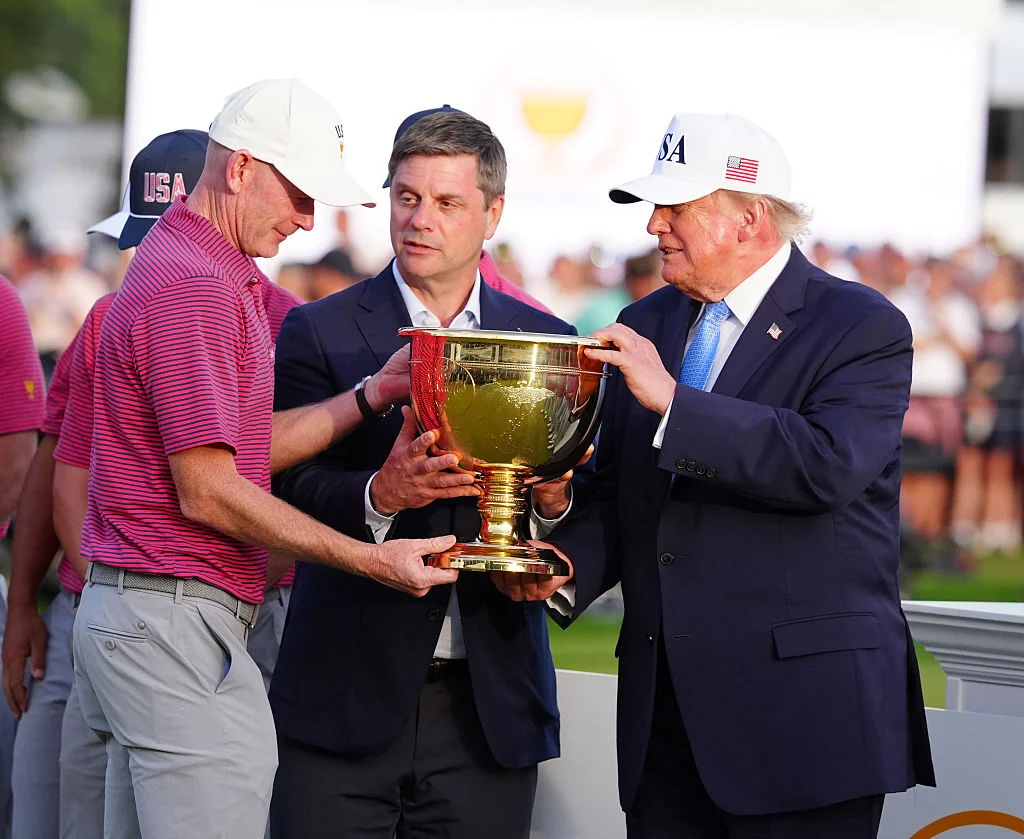
On Sunday, President Trump joined tournament officials at Medinah Country Club in suburban Chicago, Illinois. Following a come-from-behind victory by the U.S. squad over the International team at the Presidents Cup, Trump stood alongside PGA Tour CEO Brian Rolapp to present the trophy to U.S. Captain Brandt Snedeker. Snedeker offered public praise to the president on the 14th hole, noting that Trump met with the team earlier in the day and "brought the juice" that spurred their victory.
Upon returning to the White House on Sunday evening, Trump delivered remarks to reporters addressing energy supply, defending his physical stamina, and mentioning a late-night 10:00 PM dinner with Dario Amodei, co-founder and CEO of AI firm Anthropic, to highlight his heavy workload.
Supporting Data
Fuel and Energy Price Trends
Economic metrics published by the American Automobile Association (AAA) demonstrate significant increases in consumer energy costs:
| Commodity | Current Average (Late Sept 2026) | Baseline Comparison | Price Shift |
|---|---|---|---|
| Unleaded Gasoline (Gallon) | $4.4768 | $3.1000 (Jan 20, 2025) | +$1.3768 (+44.4%) |
| Diesel Fuel (Gallon) | $6.4531 | $3.6856 (One year prior) | +$2.7675 (+75.1%) |
While President Trump asserted on Sunday night that "oil is less expensive now than it was under the Biden administration," official historical tracking from AAA indicates that fuel prices at the pump were lower when former President Joe Biden left office on January 20, 2025.
GASOLINE PRICE COMPARISON (per gallon)
Jan 20, 2025:  [$$$10] $3.10
Sept 2026:     [$$$$$$$$$$$$$48] $4.4768 (+44.4%)

DIESEL PRICE COMPARISON (per gallon)
Sept 2025:     [$$$$37] $3.6856
Sept 2026:     [$$$$$$$$$$$$$$$$$$$$$65] $6.4531 (+75.1%)
Midterm Election Timeline and Polling Trends
- Days Until Midterms: 36 days.
- Voter Participation: Early and mail-in voting is currently active in several jurisdictions.
- Polling Context: Aggregated polling data indicates declining job approval ratings for President Trump, driven primarily by voter concern over cost-of-living metrics, inflation, and federal expenditures tied to foreign operations.
Official Responses
Pushback from Congressional Republicans
The president’s focus on sporting spectacles brought public concern from members of his own party, who urged a pivot toward voter economic distress:
-
Senator John Kennedy (R-LA): Speaking on CBS’s Face the Nation on Sunday, Senator Kennedy warned that the upcoming midterms would be tightly contested and called on the president to directly address domestic cost increases.
"It would help if the president would stay focused on cost of living," Kennedy said. "And I would like to see him give a nationwide address."
-
Former Representative Mike Rogers (R-MI): Running for the U.S. Senate in Michigan, Rogers published a video statement highlighting voter sentiment on the campaign trail regarding fuel, grocery, and energy expenses.
"Michigan families are struggling with the price of everyday life. Groceries cost too much. We have to bring prices down. The war with Iran needs to end, and end quickly," Rogers stated. "Michigan families can’t afford to wait."
                 ┌──────────────────────────────────────────────────────────┐
                 │                GOP CONGERSSIONAL CONCERNS                │
                 └────────────────────────────┬─────────────────────────────┘
                                              │
                     ┌────────────────────────┴────────────────────────┐
                     ▼                                                 ▼
        Sen. John Kennedy (R-LA)                          Mike Rogers (R-MI Senate Nominee)
   • Urges focus on cost-of-living.                  • Cites grocery and fuel struggles.
   • Calls for a nationwide address.                 • Demands rapid end to Iran conflict.
White House Defense and Presidential Statements
President Trump rejected characterizations that economic affordability was eroding his support, dismissing the political focus on "affordability" as a constructed narrative aimed at undermining his administration.
-
On Energy Prices and the Strait of Hormuz: Trump defended his foreign policy choices and contested assertions of constrained energy supplies:
"Oil will come dropping down as soon as demand gives up, as soon as the war … is over," Trump said. "With all of that being said, we’re taking tremendous amounts of oil out. Last night, we took a record amount of oil out of the Hormuz Strait, more than we took out before the war."
Note: Energy market analysts and Democratic lawmakers have expressed skepticism regarding claims of record oil flows through the Strait of Hormuz during ongoing military operations, noting that market instability continues to keep crude prices elevated.
-
On Workload and Executive Stamina: In response to commentary regarding his age and schedule, Trump emphasized his late-night engagements with industry leaders:
"And tonight, I’m having dinner with the head of Anthropic," Trump told reporters, referring to CEO Dario Amodei. "So these are long days, but I seem to be able to have them, right? These are long days. People said, ‘Really?’ I said, ‘I’m having dinner at 10 o’clock tonight.’ So we travel all over the world, and we have dinner, but that’s all right."
Implications
Electoral Strategy and Swing-State Realities
With 36 days remaining before the midterms, the divergence between presidential messaging and localized campaign anxiety presents a challenge for the Republican Party. While President Trump continues to draw large crowds and media attention through ceremonial appearances—such as flyovers and sports trophy presentations—GOP candidates in competitive swing states like Michigan are facing voters deeply concerned by high diesel and gas prices.
Trump’s upcoming campaign itinerary—a Western fundraising swing on Wednesday, followed by targeted rallies in Oklahoma and Alabama on Thursday and Friday—will test whether his presence can bolster enthusiasm among the party’s base without alienating moderate voters seeking solutions to cost-of-living challenges.
                           MIDTERM CAMPAIGN PATH
                                     │
       ┌─────────────────────────────┼─────────────────────────────┐
       ▼                             ▼                             ▼
Wednesday (Out West)          Thursday (Oklahoma)           Friday (Alabama)
Fundraising Circuit           GOP Campaign Rally            GOP Campaign Rally
Military Conflict and Energy Market Dynamics
The ongoing direct engagement alongside Israel against Iran remains a primary driver of domestic energy price spikes. With diesel fuel reaching $6.4531 per gallon, logistics and freight costs are compounding retail food prices, reinforcing voter anxiety over inflation. The administration’s rejection of Iran’s latest diplomatic proposal suggests that military operations—and the associated energy market volatility—will continue in the near term, keeping pressure on domestic fuel prices regardless of baseline production rates.
Bilateral Relations with China
The limited tangible deliverables from the Trump-Xi summit leave critical geopolitical friction points unresolved. While the extension of the trade truce provides temporary predictability for markets, the lack of progress on long-term policy—such as binding rules for artificial intelligence and stabilized supply chains for critical minerals—leaves U.S. technology and manufacturing sectors vulnerable to sudden policy shifts.
As Congress turns its attention to domestic issues like the "Protect College Sports Act," the long-term strategic competition with Beijing remains reliant on executive-level truces rather than formalized legislative or treaty frameworks.