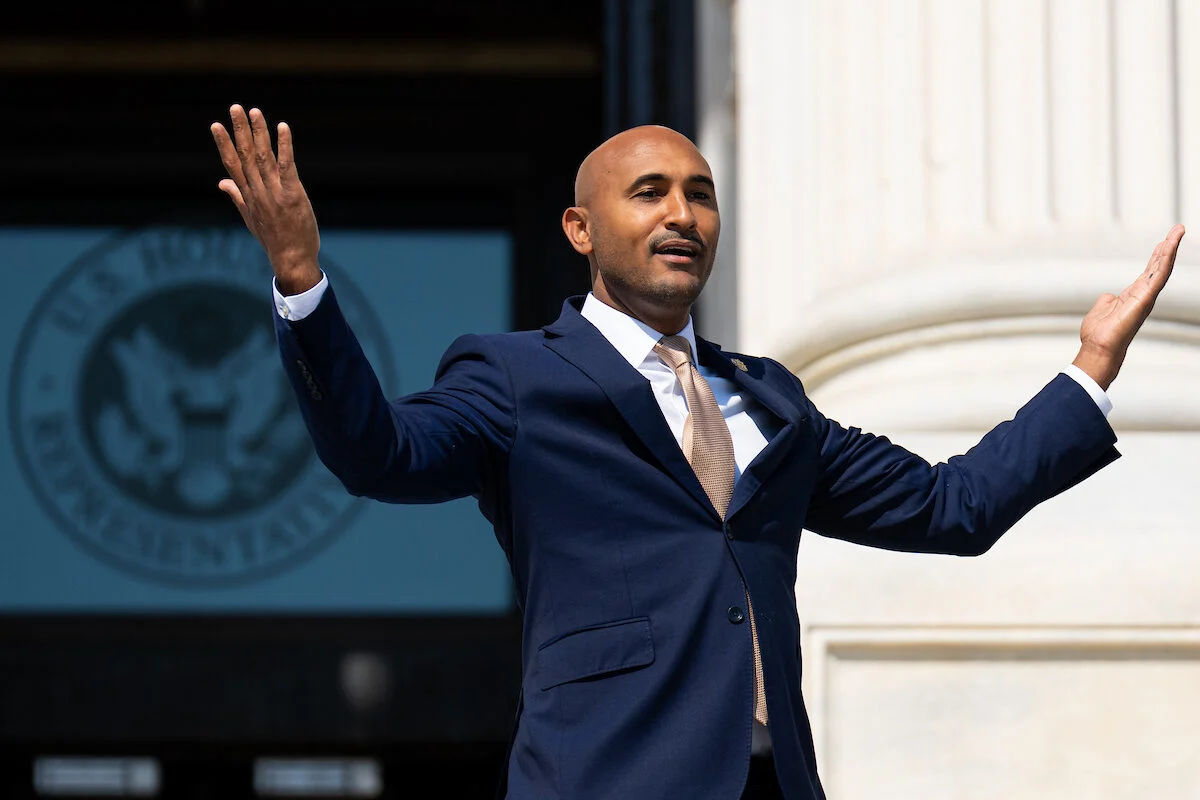
Washington D.C. – The National Republican Congressional Committee (NRCC) has significantly escalated its offensive strategy for the upcoming midterm elections, adding seven additional Democrat-held House seats to its target list. This brings the total number of districts the committee aims to flip to a formidable 36, underscoring an aggressive push to solidify and expand the Republican majority in the U.S. House of Representatives. All of the newly targeted seats are located in states that have recently undergone congressional redistricting, with new maps meticulously drawn to enhance Republican electoral prospects.
“Vulnerable House Democrats are stuck defending a wildly unpopular record and a radical socialist agenda,” declared NRCC Chairman Richard Hudson of North Carolina in a statement released Monday. “The NRCC will take the fight into their districts, hold every one of them accountable, and expand our House majority in November.” Hudson’s assertive tone signals a clear intention to make the midterm elections a referendum on the national Democratic platform, while leveraging the advantageous electoral landscapes created by new district boundaries.
The expansion of the target list comes at a crucial juncture, as both parties brace for what is widely anticipated to be one of the most contentious and high-stakes midterm cycles in recent memory. With control of the House often hinging on a handful of competitive races, the strategic redrawing of district lines has emerged as a pivotal factor in shaping the 2026 electoral map.
The New Battlegrounds: A Strategic Expansion
The NRCC’s decision to broaden its target list reflects a calculated move to capitalize on the profound shifts in electoral geography brought about by the latest redistricting cycle. The 36 districts now on the committee’s radar represent a blend of traditionally competitive seats and those rendered newly vulnerable by legislative action and judicial rulings. The focus on districts specifically altered to favor Republicans highlights a strategy that intertwines partisan map-drawing with an aggressive campaign apparatus.
The seven newest additions to the NRCC’s target list, all currently held by Democrats but redrawn to lean Republican, are:
- Alabama’s 2nd Congressional District: Currently held by Representative Shomari Figures.
- Louisiana’s 2nd Congressional District: Currently held by Representative Latoya Johnson.
- Tennessee’s 6th Congressional District: Currently held by Representative Sarah Evans.
- Florida’s 13th Congressional District: Currently held by Representative Mark Thompson.
- Missouri’s 5th Congressional District: Currently held by Representative Eleanor Vance.
- North Carolina’s 6th Congressional District: Currently held by Representative David Chen.
- Ohio’s 1st Congressional District: Currently held by Representative Greg Landsman.
These districts, scattered across a diverse array of states, represent a critical battleground in the broader fight for congressional control.
A Shifting Electoral Map: The Redistricting Revolution
The current electoral landscape has been profoundly reshaped by a wave of redistricting efforts initiated by Republican-controlled state legislatures since last summer. Driven by a desire to secure enduring partisan advantages and insulate their party against an anticipated challenging midterm environment, these efforts have systematically altered the political composition of numerous congressional districts.
The High Court’s Influence: A Watershed Moment
The Republican redistricting push received a significant boost this spring following a landmark Supreme Court decision that reinterpreted and, critics argue, substantially limited key provisions of the Voting Rights Act (VRA). In the case of Patterson v. Alabama Election Commission, the High Court issued a ruling that narrowly defined the scope of Section 2 of the VRA, making it more challenging to prove racial gerrymandering claims and, consequently, reducing the impetus for states to create additional majority-minority districts.
This decision, viewed by many legal experts as a watershed moment in electoral law, effectively "supercharged" Republican legislative efforts in states where previous VRA interpretations might have constrained their map-drawing ambitions. Emboldened by the ruling, states like Alabama, Louisiana, and Tennessee quickly moved to enact new congressional maps, joining Florida, Ohio, Missouri, North Carolina, and Texas in establishing boundaries that significantly favor the Republican Party. Political analysts project that Republicans could collectively gain more than a dozen seats under these newly implemented lines.
State-by-State Realignment: A Republican Advantage
The impact of these redrawn maps varies by state but consistently points towards a stronger Republican position:
- Florida: Following the Supreme Court’s decision, Florida Republicans finalized a map that eliminated a previously competitive district, consolidating Republican strength and creating several safely red seats, including the now-vulnerable 13th District.
- Ohio: Ohio’s Republican-led legislature approved a map designed to fortify incumbents and make a handful of swing districts lean further right, such as the 1st Congressional District, which now presents a tougher challenge for its Democratic incumbent.
- Missouri: The new Missouri map strategically combines Democratic-leaning urban fringes with reliably Republican rural areas, pushing previously competitive districts into the Republican column. The 5th District is a prime example of this strategy.
- North Carolina: With a long history of intense redistricting battles, North Carolina Republicans passed a map that maximized their gains, particularly targeting districts in the state’s rapidly growing suburban areas, turning them redder. The 6th District is a key focus.
- Texas: The sheer number of congressional districts in Texas allowed Republicans to draw several new maps that gerrymandered districts to their advantage, cracking and packing Democratic voters to create more safe Republican seats.
- Alabama: The Patterson v. Alabama Election Commission ruling directly impacted Alabama, allowing the state to proceed with a map that reduces the number of districts where Black voters could elect their preferred candidates, making the 2nd District, for example, significantly more Republican.
- Louisiana: Similar to Alabama, Louisiana enacted a map that diminished the electoral power of minority voters in several districts, including the 2nd District, pushing it towards a Republican tilt.
- Tennessee: Tennessee’s new map dissected Nashville’s Democratic stronghold, spreading its voters across multiple Republican-leaning districts and making previously secure Democratic seats, like the 6th District, highly competitive for Republicans.
Democratic Counter-Efforts: Gains and Setbacks
While Republicans have largely benefited from the recent redistricting cycle, Democrats have managed to secure gains in select states. In California and Utah, the adoption of new, non-partisan or independently drawn maps is expected to result in Democrats picking up seats. California’s independent redistricting commission produced a map generally considered fairer, while Utah’s process, though still partisan-influenced, yielded some unexpected benefits for Democrats in specific areas.
However, Democrats also faced a significant setback in Virginia. Despite voters approving a new Democrat-favored map via a spring referendum, the Virginia Supreme Court subsequently blocked the redistricting effort, citing procedural irregularities and effectively delaying the implementation of the voter-approved boundaries. This judicial intervention leaves the commonwealth’s electoral map in a state of uncertainty, potentially denying Democrats a crucial opportunity to gain seats.
The Seven Fronts: Profiles of Vulnerability
The NRCC’s expanded target list shines a spotlight on seven specific districts where Republican strategists believe they can achieve victory. Each district presents a unique battleground shaped by demographic shifts, incumbent performance, and, most critically, the impact of redrawn maps.
Alabama’s 2nd Congressional District: Rep. Shomari Figures
Representative Shomari Figures, a rising star within the Democratic Party, now faces a daunting challenge in Alabama’s 2nd Congressional District. The previous iteration of AL-02 was a competitive D+5 district, with a significant Black voter population. However, following the Patterson v. Alabama Election Commission ruling, Alabama’s legislature aggressively redrew the map. The new AL-02 now encompasses more conservative rural areas and fewer urban Black voters, shifting its Partisan Voter Index (PVI) to a more Republican-friendly R+3. This dramatic shift means Figures, who previously won a hard-fought primary, will now have to appeal to a considerably different electorate. The state is set to hold special primary elections next month in four districts, including the 2nd, to officially align candidates with the new lines.
Louisiana’s 2nd Congressional District: Rep. Latoya Johnson
In Louisiana’s 2nd Congressional District, Representative Latoya Johnson is confronting a similar redistricting challenge. Historically a reliably Democratic seat (D+12), the new map, enacted after the Supreme Court ruling, strategically dilutes Democratic strongholds. It carves out portions of urban New Orleans and Baton Rouge, adding more conservative suburban and rural parishes. This has pushed the PVI to a more competitive D+4, making Johnson’s path to re-election significantly narrower. Louisiana will hold all-party House primaries in November, with potential runoffs in December if no candidate secures more than 50 percent of the vote, forcing incumbents like Johnson to fight through multiple rounds of campaigning.
Tennessee’s 6th Congressional District: Rep. Sarah Evans
Representative Sarah Evans holds Tennessee’s 6th Congressional District, a seat that was already a moderate D+3 but has been aggressively redrawn by the Republican-controlled state legislature. The new TN-06 now stretches further into exurban areas and conservative small towns, consolidating Republican voters and shifting the PVI to R+2. This gerrymander specifically targeted areas that had seen a slow but steady influx of Democratic-leaning voters from Nashville, effectively cracking the Democratic vote. Evans, known for her moderate stance, will now be forced to defend against accusations of being too liberal for her newly conservative-leaning district. Tennessee is scheduled to hold its primary elections next month.
Florida’s 13th Congressional District: Rep. Mark Thompson
Florida’s 13th Congressional District, represented by Mark Thompson, was once a swing district with a slight Democratic lean (D+2). However, Florida Republicans, under the guidance of Governor Ron DeSantis, enacted a map that aggressively gerrymandered the district. The new FL-13 now includes additional deeply conservative areas from neighboring counties while shedding more diverse coastal communities. This move has transformed the district into a solid R+4, making Thompson one of the most vulnerable incumbents. Thompson, a vocal critic of the state’s redistricting process, faces an uphill battle to retain his seat in the August primaries.
Missouri’s 5th Congressional District: Rep. Eleanor Vance
Representative Eleanor Vance, who serves Missouri’s 5th Congressional District, now finds her previously safe D+10 seat in jeopardy. The new Missouri map, a product of aggressive Republican gerrymandering, surgically removed portions of Kansas City that were reliably Democratic and appended large swaths of conservative exurban and rural territory. This has dramatically shifted the PVI to a competitive D+1, making Vance’s re-election prospects uncertain. Missouri is set to hold its primary elections next month, where Vance will likely face a well-funded Republican challenger eager to capitalize on the new district lines.
North Carolina’s 6th Congressional District: Rep. David Chen
North Carolina’s 6th Congressional District, held by Representative David Chen, has been a frequent casualty of partisan map-drawing. Previously a D+6 district, the latest Republican-drawn map meticulously packed more Democratic voters into neighboring districts while pulling in conservative rural areas and rapidly developing, but still Republican-leaning, suburban communities. The new NC-06 now has a PVI of R+1, putting Chen, who has focused on technology and economic development, in a precarious position. The district’s historical volatility makes it a prime target for both parties.
Ohio’s 1st Congressional District: Rep. Greg Landsman
Representative Greg Landsman, the incumbent in Ohio’s 1st Congressional District, is no stranger to tough races. His district was already considered a "Tilt Democratic" seat by Inside Elections with Nathan L. Gonzales. The latest Ohio redistricting effort further tightened the screws on Landsman, slightly increasing the Republican lean of the district by including additional suburban areas with strong conservative bases. Landsman is pitted against Republican Air Force veteran and former CIA officer Eric Conroy, who is expected to mount a formidable challenge. The race for OH-01 is viewed as one of the cycle’s most emblematic contests, testing the limits of Democratic incumbency against a redrawn map.
Partisan Rhetoric Heats Up: The Battle for the Narrative
As the midterm elections draw closer and the new maps solidify, the rhetoric from both major parties is intensifying, each seeking to define the narrative and mobilize their respective bases.
NRCC’s Assertive Stance
NRCC Chairman Richard Hudson’s statement is indicative of the aggressive posture Republicans are adopting. The committee’s strategy is multifaceted: first, to relentlessly tie Democratic incumbents to the national party’s agenda, framing it as "radical socialist." This includes frequently cited criticisms of policies related to climate change (e.g., the Green New Deal), criminal justice reform ("defund the police"), and government spending. Second, to highlight the economic challenges facing many Americans, attributing them to Democratic policies and portraying Republicans as the solution for fiscal responsibility and growth.
"These Democrats are out of step with their constituents and are rubber-stamping an agenda that hurts families with rising costs and a weakened border," an NRCC spokesperson elaborated. "We will ensure voters in these districts know exactly where their representative stands on the issues that matter most to them." The NRCC is prepared to pour significant resources into these 36 districts, funding extensive advertising campaigns, grassroots organizing, and direct voter contact programs.
DCCC’s Counter-Offensive
The Democratic Congressional Campaign Committee (DCCC), under the leadership of Chairwoman Representative Lena Hernandez (CA), has swiftly countered the NRCC’s expanded target list, accusing Republicans of undermining democratic principles through extreme gerrymandering.
“The Republican Party is showing its true colors, openly admitting they can only win by rigging the maps and suppressing votes,” stated Chairwoman Hernandez. “These new target districts are a testament to their fear of fair elections, not to any genuine shift in public opinion. Our incumbents are strong, deeply rooted in their communities, and are fighting for issues that truly matter to working families, like affordable healthcare and protecting fundamental freedoms.”
The DCCC plans to emphasize local issues, highlight the incumbents’ records of service, and rally voters against what they perceive as an assault on fair representation. They intend to frame Republican policies as "out of touch" and detrimental to everyday Americans, particularly on issues such as reproductive rights, Social Security, and Medicare. Democrats are banking on a potential voter backlash against what they view as extreme partisan overreach in the redistricting process.
Independent Analysis and Public Opinion
Political analysts acknowledge the strategic advantage gained by Republicans through redistricting but caution against overstating its guarantees. Dr. Marcus Thorne, Director of the Center for Electoral Studies at Georgetown University, commented, "While these new maps undoubtedly give Republicans a significant structural advantage, especially in a challenging midterm environment, they don’t make races unwinnable for Democrats. Turnout, candidate quality, and unforeseen national events can still override partisan lines."
Thorne added, "The Supreme Court’s VRA decision will have long-lasting implications, fundamentally altering how congressional maps are drawn in the South and beyond. It removes a significant check on partisan gerrymandering, leading to more polarized districts and potentially less competitive elections in the long run." Public opinion polls indicate a deeply polarized electorate, with voters often prioritizing national issues but still susceptible to local campaign narratives and incumbent performance.
The Stakes of the Midterm: Implications for Congress and Beyond
The NRCC’s expanded target list and the underlying redistricting shifts carry profound implications for the upcoming midterm elections, the balance of power in Congress, and the future trajectory of American electoral politics.
Path to a Stronger Republican Majority
The immediate and most direct implication is the enhanced probability of Republicans not only retaining but significantly expanding their narrow House majority, which currently stands at 222-213. A gain of a dozen or more seats, as projected by some analysts, would provide the Republican Party with a much more comfortable governing margin. This would empower them to pass legislation more easily, exert greater control over committee agendas, and more effectively block Democratic initiatives, potentially leading to a more assertive and ideologically driven legislative session. The ability to control the legislative agenda would be critical in shaping national policy on issues ranging from the economy and energy to social policy and foreign affairs.
Campaign Finance and Resource Allocation
The expansion of the target list will inevitably trigger a massive influx of campaign spending. The NRCC’s commitment to these 36 districts means a substantial portion of its war chest will be dedicated to flipping these seats. This forces the DCCC into a defensive posture, compelling them to divert considerable resources towards protecting vulnerable incumbents, potentially at the expense of offensive opportunities in other competitive districts. The financial arms race will manifest in saturation advertising, extensive ground operations, and a reliance on Super PACs and other outside groups to amplify partisan messages. Local campaigns in these districts will experience unprecedented levels of financial support, transforming them into national battlegrounds.
Voter Engagement and Democratic Backlash
The impact on voter engagement in these redrawn districts is complex. On one hand, the perceived unfairness of gerrymandering could galvanize Democratic voters, prompting higher turnout as a form of protest. Incumbents will need to work tirelessly to connect with new constituents, adapting their messaging to address a broader and potentially more diverse set of concerns. On the other hand, heavily gerrymandered districts can sometimes lead to voter apathy, as elections become less competitive and the outcome appears predetermined, particularly for minority voters whose electoral power has been diluted. The challenge for Democrats will be to convince voters that their vote still matters, even in districts designed to diminish their influence.
The Future of Redistricting and Electoral Fairness
Beyond the immediate election cycle, the current redistricting landscape, shaped significantly by the Supreme Court’s ruling, raises fundamental questions about the future of electoral fairness and representative democracy in the United States. The increased prevalence of partisan gerrymandering could lead to a more entrenched political divide, where elected officials are less responsive to the broader electorate and more beholden to their partisan base. Calls for independent redistricting commissions and comprehensive electoral reform are likely to intensify, but legislative action at the federal level remains a distant prospect given the current political climate. The long-term implications of these maps could be a House of Representatives that is increasingly unrepresentative of the national popular vote, exacerbating political polarization and making compromise even more elusive.
As the 2026 midterm elections approach, these 36 targeted districts will serve as a microcosm of the national political struggle, embodying the fierce competition for congressional control. With new maps setting the stage and partisan rhetoric reaching a fever pitch, the coming months promise an intense and consequential campaign season that will determine the legislative direction of the nation.