For eons, scientists have been captivated by the seemingly miraculous ability of creatures like sea turtles, migratory birds, and eels to traverse thousands of miles of featureless ocean or sky with pinpoint accuracy. This biological "sixth sense," known as magnetoreception, has long been a subject of intense evolutionary debate. Now, a groundbreaking study published in the journal Communications Earth & Environment has pulled back the curtain on the deep-time origins of this ability, identifying what may be the earliest evidence of a sophisticated, internal "GPS" system dating back 97 million years.
The Discovery: Magnetofossils from the Age of Dinosaurs
The evidence lies in microscopic structures known as "magnetofossils"—tiny, mineralized fossils preserved in ancient seafloor sediments. While these structures have been known to science for some time, their true purpose has remained a matter of speculation. Ranging in shapes that evoke spearheads, spindles, bullets, and needles, these fossils are no larger than a standard bacterial cell.
For decades, the consensus was that these magnetofossils were perhaps the byproducts of ancient bacteria or merely defensive spines. However, a team of researchers from the University of Cambridge and the Helmholtz Zentrum Berlin has shattered this perception. By utilizing cutting-edge 3D imaging technology, the researchers discovered that these fossils possess a complex internal architecture that suggests a far more functional, biological role: a high-precision navigation tool.
Chronology of a Scientific Breakthrough
The path to this discovery was paved by technological innovation. Historically, the internal magnetic structures of these large magnetofossils were impossible to visualize; conventional X-ray techniques lacked the penetration depth to see through the mineralized shells of the fossils without damaging the delicate, nanometer-scale magnetic patterns inside.
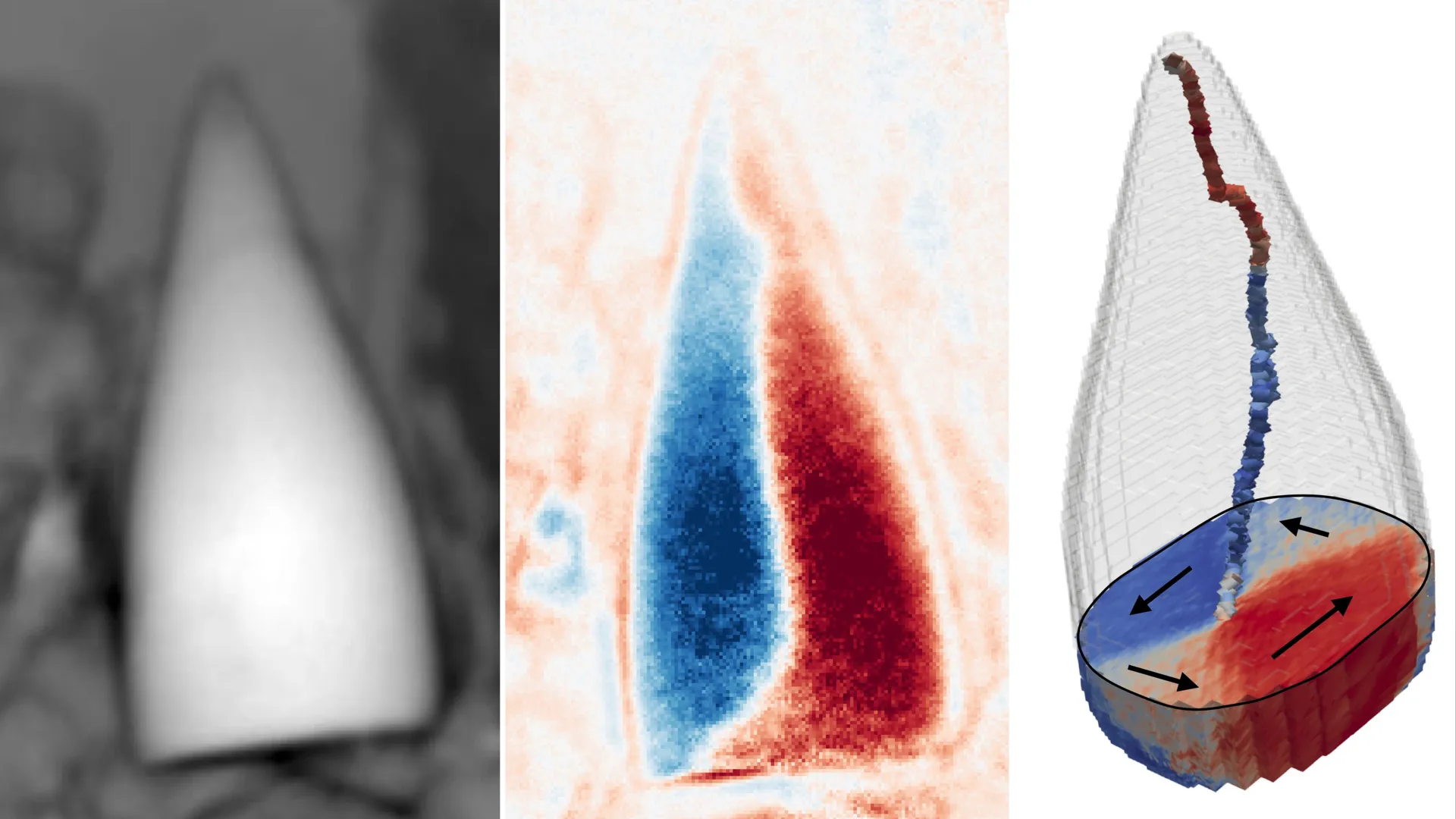
The breakthrough arrived through a collaborative effort involving co-author Claire Donnelly of the Max Planck Institute. Utilizing a specialized magnetic tomography technique, the team was able to map the "magnetic moments"—the tiny magnetic fields generated by spinning electrons—within the fossils. The measurements, conducted at the Diamond Light Source in Oxford, provided the first-ever 3D "inside look" at these prehistoric instruments.
The researchers found that the internal magnetic patterns were not random. Instead, the magnetic moments spiraled around a central axis, forming a tornado-shaped vortex. This specific geometry, the study argues, is not a coincidence of decay or geological pressure, but a highly engineered biological adaptation optimized for detecting both the direction and the intensity of the Earth’s magnetic field.
Supporting Data: Why "Vortex Magnetism" Matters
To understand why these structures are being compared to a GPS, one must look at the physics of magnetism. While some modern bacteria use simple chains of magnetite particles to orient themselves toward preferred depths in water—acting as a basic, binary compass—the magnetofossils analyzed by the Cambridge team are 10 to 20 times larger than these bacterial markers.
Professor Rich Harrison, co-lead of the research from Cambridge’s Department of Earth Sciences, explains that the "vortex" structure is a masterpiece of evolutionary engineering. "If you want to create the most efficient magnetic sense, smaller is usually better," Harrison notes. However, because these fossils are significantly larger, they require a more complex internal arrangement to remain stable.
The vortex geometry provides two critical advantages:
- Stability: The structure is incredibly resistant to environmental interference. In the chaotic, shifting magnetic conditions of the Cretaceous period, this stability would have allowed an organism to maintain a steady heading despite external "noise."
- Sensitivity: The structure is designed to "wobble" in response to subtle variations in the Earth’s magnetic field. By sensing the tilt of the field (which indicates latitude) and the strength of the field (which shifts with longitude), the organism could have possessed a two-dimensional map of its position on the planet.
"This is not just a compass," Harrison remarked. "It is a particle that can be relied upon to navigate thousands of kilometers across the ocean. If nature developed a GPS, this is exactly what it would look like."
Official Responses and Expert Collaboration
The study is the result of a rigorous, multi-year international collaboration. Sergio Valencia, a researcher at the Helmholtz Zentrum Berlin who worked closely with the Cambridge team, emphasized the complexity of the project. "This was a truly international effort involving experts from disparate fields—geophysics, biology, and materials science—all working in tandem to decode the functionality of these ancient structures," Valencia said.
The scientific community has reacted with significant interest. Claire Donnelly, whose imaging technique was fundamental to the study, highlighted the implications of the findings: "That we were able to map the internal magnetic structure with magnetic tomography was already a great result, but the fact that the results provide insight into the navigation of creatures millions of years ago is really exciting."
The research was supported by the European Union, the European Research Council, and the Royal Society, underscoring the high level of academic investment in understanding the origins of sensory evolution.
Implications: Who Was the Navigator?
Perhaps the most haunting question left by the study is the identity of the "architect." If these fossils were indeed internal compasses, the organism that produced them must have been a highly mobile, likely migratory, creature capable of sustaining long-distance journeys.
Professor Harrison has proposed a compelling candidate: the eel. Eels have a deep evolutionary history, appearing in the fossil record around 100 million years ago, roughly the same time as these magnetofossils. Modern eels are famous for their baffling life cycles, often traveling thousands of kilometers from freshwater rivers to specific breeding grounds in the Sargasso Sea.
"The next step is to identify the creature," says Harrison. "We are looking for a migratory animal that was common enough in the ancient oceans to leave behind such an abundance of fossilized material." While magnetite particles have been identified in the tissues of modern eels, they have proven notoriously difficult to isolate and image because of their extreme distribution and tiny size. If researchers can prove that modern eels possess structures similar to these 97-million-year-old fossils, it would confirm a direct link between the navigational strategies of the Cretaceous and those used by animals today.
Tracing the Evolutionary Lineage
The discovery of these magnetofossils provides a "missing link" in the evolutionary history of magnetoreception. For years, scientists struggled to explain the jump from the simple, bacterial "magnetic compass" to the highly complex, multi-modal navigation found in vertebrates.
This research suggests that the evolution of magnetoreception was not a sudden leap, but a gradual refinement of mineral-based sensing. By mastering the internal geometry of magnetite—moving from simple chains to complex, vortex-stabilized structures—ancient lifeforms were able to transition from merely "feeling" the magnetic field to actively "reading" it as a global coordinate system.
As we continue to study these ancient magnets, we gain more than just an understanding of the past; we gain insight into the fundamental biological hardware that allows life to traverse the globe. Whether the organism was an early ancestor of the eel or an entirely different species that vanished during the mass extinctions of the Mesozoic, the fossils serve as a testament to the sophistication of ancient life.
The "GPS" of the Cretaceous era reminds us that the ability to orient oneself in the vastness of the natural world is one of the oldest and most successful evolutionary strategies on Earth. As the research continues, the scientific community looks forward to solving the mystery of the architect, moving ever closer to unlocking the secrets of how life navigated the ancient oceans long before the first map was ever drawn by human hands.