In 1722, a young Benjamin Franklin, writing under the pseudonym Silence Dogood, provided a foundational maxim for the American experiment: “Without freedom of thought, there can be no such thing as wisdom, and no such thing as public liberty without freedom of speech.” As the United States approaches the 250th anniversary of its founding, these words have transitioned from historical sentiment to a daily battle cry. The First Amendment—unambiguous in its decree that "Congress shall make no law… abridging the freedom of speech, or of the press"—is currently facing a battery of legal, political, and physical challenges that many historians argue are the most severe since the Alien and Sedition Acts.
However, a significant shift is occurring within the fourth estate. While the strategy of "divide and conquer" has long been used to weaken the press, modern media leaders are increasingly adopting a posture of collective resilience. From late-night comedians to legacy newspapers and global broadcasters, the industry is discovering that the only effective antidote to systemic intimidation is a unified front.
Main Facts: The Multi-Front War on Journalism
The current landscape of American journalism is defined by a series of aggressive maneuvers designed to chill investigative reporting and bankrupt critical outlets. These actions are not localized to one branch of government or one political actor, but represent a systemic escalation of hostility toward the press.
The Weaponization of the Judiciary and Law Enforcement
In recent months, the Department of Justice (DOJ) has come under intense scrutiny for issuing secret subpoenas targeting reporters at The Washington Post and The Wall Street Journal. These subpoenas seek to unmask confidential sources, striking at the very heart of investigative journalism. This follows a disturbing trend of physical intimidation, including an FBI raid on the home of a Washington Post reporter—a move that signals a departure from long-standing norms regarding the protection of journalists’ work product.
The $15 Billion Defamation Strategy
The financial stakes have reached astronomical levels. Former President Donald Trump has filed a $15 billion defamation lawsuit against The New York Times, a figure designed not merely to seek damages but to potentially liquidate one of the world’s most influential news organizations. This legal strategy is paired with rhetoric that labels renowned correspondents as "treasonous" for asking difficult questions regarding national security and foreign policy.
Regulatory Intimidation via the FCC
The Federal Communications Commission (FCC), traditionally an independent regulatory body, is increasingly being leveraged as a tool of political retribution. Threats have been made against the broadcast licenses of major networks over what has been deemed "unpatriotic" coverage. By targeting the underlying permits required to operate, the administration is attempting to exert control over televised content, bypassing the legislative process to achieve de facto censorship.
Chronology: A Timeline of Escalation (2024–2026)
To understand the gravity of the current situation, one must look at the rapid succession of events over the past two years that have brought the First Amendment to a breaking point.
- October 2025: Donald Trump files a landmark $15 billion lawsuit against The New York Times, alleging defamation in its coverage of his administration’s business dealings.
- February 2026: In a move that shocks the journalism community, the FBI conducts a physical raid on the private residence of a Washington Post reporter, seizing electronic devices and documents.
- March 2026: The administration begins weaponizing the FCC, threatening to revoke the broadcast permits of networks covering the conflict in Iran, labeling the reporting as "unpatriotic."
- April 2026: The "Gulf of Mexico" Standoff. The White House informs the Associated Press (AP) that its reporters will be barred from the Oval Office unless the outlet adopts the administration’s preferred terminology: "The Gulf of America."
- May 2026: Reports surface of the DOJ using "Treason" sticky notes to flag Wall Street Journal articles, initiating a series of leak hunts intended to identify internal government whistleblowers.
- June 2026: The "Reflecting Pool" Fiasco. ABC News reports on environmental mismanagement at the National Mall, leading to the accidental poisoning of wildlife. The administration responds with fresh lawsuits and bizarre accusations against ABC’s Jonathan Karl, alleging he personally sabotaged the site.
- Late June 2026: Secret DOJ subpoenas targeting the Post and Journal are revealed, sparking a nationwide outcry from press freedom advocates.
Supporting Data: Historical Precedents and the Cost of Silence
The current climate mirrors the "crucible" of the 1960s, though the scale of the threat has expanded exponentially. Historical data suggests that when the media fails to stand together, the cost to public liberty is measured in billions of dollars and decades of suppressed truth.
The Legacy of New York Times Co. v. Sullivan
In 1960, Southern government officials used coordinated, bad-faith libel lawsuits to attempt to bankrupt The New York Times over its coverage of the civil rights movement. At the time, the media was fractured. Outlets like ABC, CBS, and The Washington Post initially remained on the sidelines, fearing similar retribution from hostile local governments.
The financial pressure was staggering: at one point, false malice claims across the South totaled $300 million—roughly $3.4 billion in today’s currency. It took four years of grueling litigation before rival outlets realized that the fall of the Times would mean the end of all investigative reporting. Their eventual unified front led to the landmark 1964 Supreme Court ruling that established the "actual malice" standard, protecting the press from being sued out of existence by public officials.
The Modern Corporate Shift
The danger today is further complicated by shifting ownership. The recent sale of CBS/Paramount and WBD/CNN to the Ellison family has raised alarms. Following the sale, Paramount/CBS made an unprecedented $16 million payment to the Trump Presidential Library—a move seen by many as a "settlement" for a 60 Minutes interview with Kamala Harris that the administration claimed was edited unfairly. This represents a new form of "commercial cowardice," where corporate interests may prioritize political appeasement over journalistic integrity.
Official Responses: The Rise of Collective Resilience
In the face of these threats, the response from the media has been surprisingly robust, marking a departure from the "yellow journalism" wars of the past.
The Late-Night Unified Front
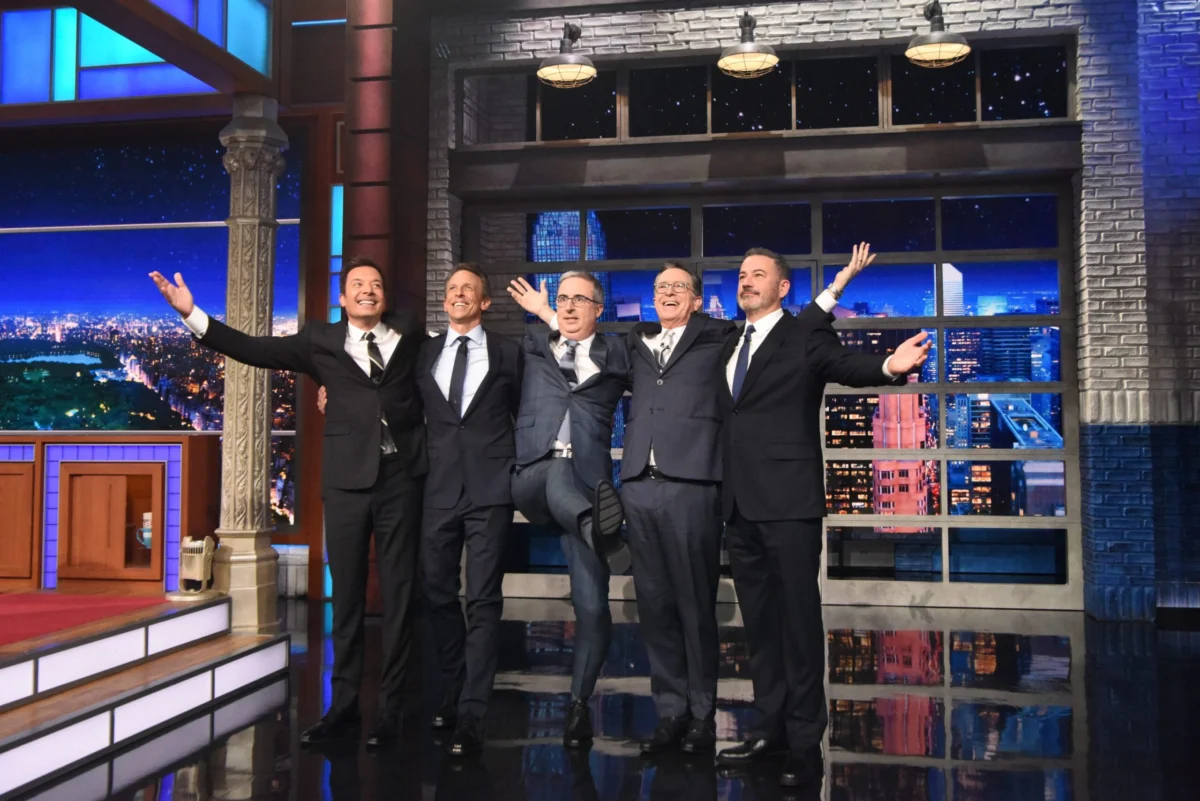
When the administration demanded the firing of late-night hosts Jimmy Kimmel, Stephen Colbert, and Jimmy Fallon for their satirical critiques, the hosts did not retreat. Instead, they used their platforms to defend one another. This culminated in a historic "triumphant collective send-off" during Stephen Colbert’s final episode, where his peers joined him on stage to signal that an attack on one was an attack on all.
The Pentagon and Oval Office Boycotts
When Pete Hegseth’s Pentagon attempted to restrict press credentials and limit coverage, major media organizations did not compete for the remaining spots. Instead, they collectively forfeited their Pentagon press passes. This solidarity forced the issue into the courts, where a federal judge ultimately ruled the restrictions illegal. Similarly, when the AP was threatened over the "Gulf of Mexico" terminology, The New York Times, The Washington Post, and Reuters joined the AP in a legal challenge, securing an injunction that preserved the right to use standard geographical terms.
The Disney/ABC Counter-Offensive
Under the leadership of new Disney CEO Josh D’Amaro and President Dana Walden, ABC launched an aggressive ad campaign urging viewers to push back against the FCC’s threats. This move won plaudits from across the industry, demonstrating that even the largest media conglomerates are willing to risk regulatory ire to defend their First Amendment rights.
Implications: The Future of Public Liberty
The current struggle is more than a professional dispute between reporters and politicians; it is a stress test for the American Republic. As the nation celebrates its 250th year, the stakes of this conflict involve the very survival of "reason" as a tool of governance.
The Newburgh Warning
In his 1783 Newburgh Address, George Washington warned that if citizens are intimidated into silence on vital matters, "reason is of no use to us; the freedom of Speech may be taken away, and, dumb and silent we may be led, like sheep, to the Slaughter."
The implications of the current "divide and conquer" tactics are clear: if the administration can successfully isolate and destroy a single outlet—whether it be the Times, ABC, or a local publisher—the precedent will be set for the total subjugation of the press. The weaponization of the DOJ and the FBI against journalists suggests a shift toward an authoritarian model of information control where "truth" is dictated by the state.
A New Era of Journalism
However, the silver lining of these "massive assaults" is the birth of a new, more courageous media leadership. The defense of Evan Gershkovich by The Wall Street Journal and the industry-wide support for reporters targeted by the DOJ show that the "good old days" of journalism might actually be now. Today’s media leaders are proving to be more resilient than their predecessors, recognizing that in an era of $15 billion lawsuits and physical raids, solidarity is not just a moral choice—it is a survival strategy.
As we look toward the next 250 years, the strength of the First Amendment will depend not on the words written on parchment, but on the willingness of media titans and individual reporters to stand their ground together. If they remain united, the "freedom of thought" that Franklin cherished will remain the cornerstone of American wisdom. If they falter, the "public liberty" he envisioned may become a relic of the past.