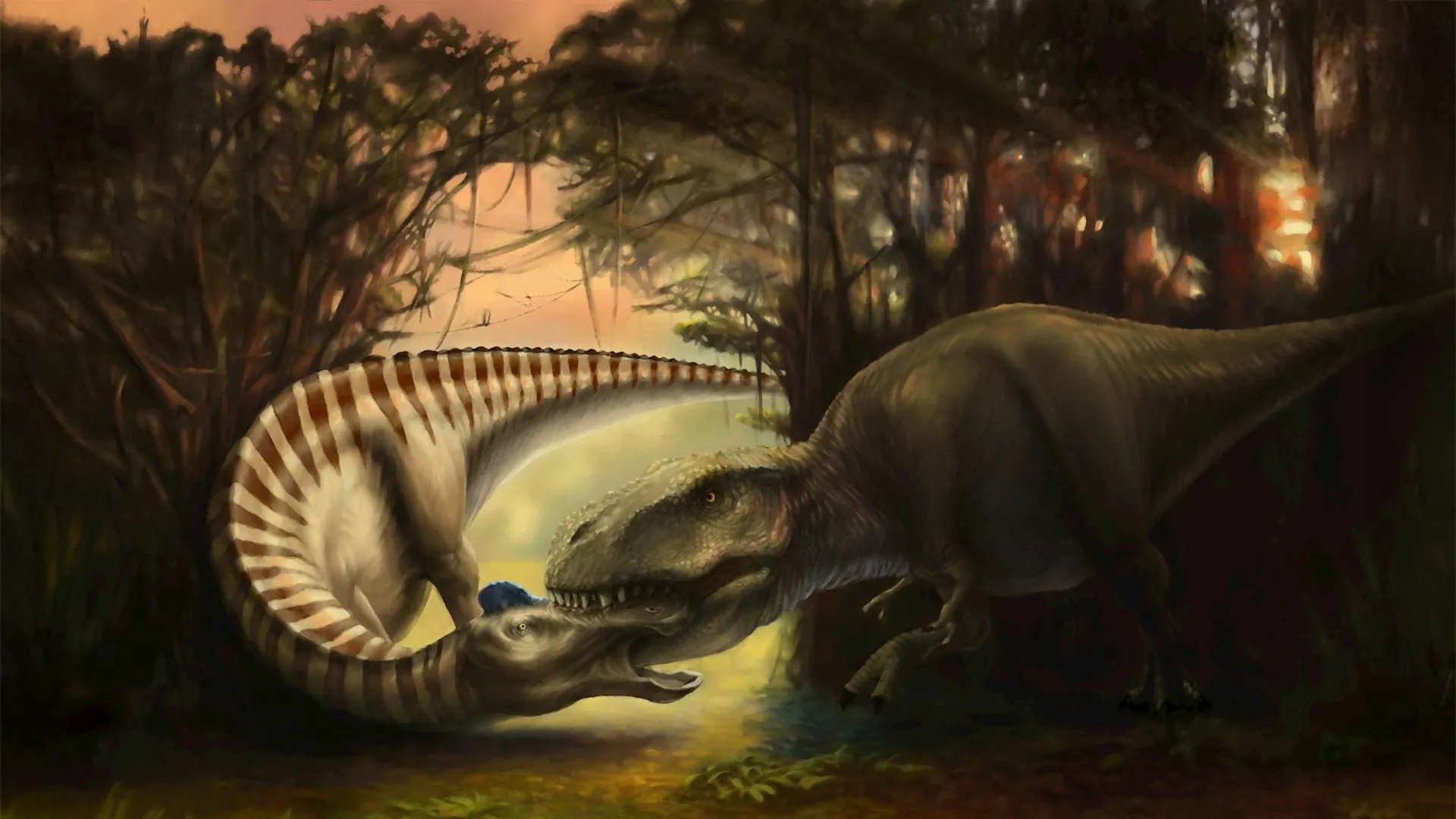
In the quiet, climate-controlled halls of the Museum of the Rockies in Bozeman, Montana, a singular fossil stands as a brutal monument to a violent encounter that occurred 66 million years ago. It is a fossilized Edmontosaurus skull—a duck-billed herbivore—but it is not the animal’s features that draw the most attention from researchers. Instead, it is the jagged, serrated tip of a Tyrannosaurus rex tooth, permanently lodged in the creature’s snout, that has provided paleontologists with one of the most vivid windows into the predatory behavior of the world’s most famous carnivore.
This discovery, the subject of a rigorous new study published in the scientific journal PeerJ, represents a rare confluence of luck and biological preservation. By utilizing advanced medical imaging and comparative anatomy, researchers from Montana State University and the University of Alberta have effectively acted as prehistoric crime scene investigators, reconstructing the final, terrifying moments of a Cretaceous-era interaction.
The Context: A World of Giants
To understand the significance of this find, one must look back to the Hell Creek Formation of eastern Montana, a site renowned for its dense concentration of Late Cretaceous fossils. Roughly 66 million years ago, this region was a lush, subtropical landscape defined by meandering river systems and vast coastal plains.
It was a world dominated by titans. The Tyrannosaurus rex, an apex predator of unparalleled mechanical power, navigated a landscape populated by formidable herbivores, including the heavily armored Triceratops and the agile, gregarious Edmontosaurus. For decades, the scientific community has been embroiled in a debate regarding the T. rex’s ecological role: was it a relentless, active hunter that pursued its prey, or a massive scavenger that relied on the carcasses of animals that died of natural causes? The specimen currently housed in the Museum of the Rockies provides critical, physical evidence that tilts the scale toward the former.
The Discovery: A Crime Scene in the Hell Creek Formation
The story of this fossil began in 2005, when field researchers working on land managed by the Bureau of Land Management stumbled upon the nearly complete skull of an Edmontosaurus. As the specimen was prepared and cleaned, curators noted an irregularity in the bone structure of the animal’s nasal region. Upon closer inspection, it was confirmed to be a broken fragment of a T. rex tooth, deeply embedded within the bone.
The fossil was eventually placed on display in the museum’s Hall of Horns and Teeth, where it caught the eye of Taia Wyenberg-Henzler, a doctoral student at the University of Alberta, and John Scannella, the Museum of the Rockies’ Curator of Paleontology. Recognizing the rarity of the find, the duo initiated a collaborative study to investigate the mechanics of the bite.
“Although bite marks on bones are relatively common, finding an embedded tooth is extremely rare,” Wyenberg-Henzler noted in the study’s press release. “The great thing about an embedded tooth, particularly in a skull, is it gives you the identity of not only who was bitten but also who did the biting. This allowed us to paint a picture of what happened to this Edmontosaurus, kind of like Cretaceous crime scene investigators.”
Chronology of an Ancient Encounter
The reconstruction of the event requires a step-by-step analysis of the physical evidence left behind. While the fossil record is often fragmented, the specificity of an embedded tooth allows for a high-fidelity timeline:
- The Approach: Based on the placement of the tooth in the nose of the Edmontosaurus, the attack was frontal. This suggests a direct confrontation between the predator and its prey, rather than an opportunistic scavenge of a long-dead carcass.
- The Impact: The T. rex clamped down on the Edmontosaurus with immense force. The structural integrity of the Edmontosaurus skull was compromised, and the tooth, subjected to intense lateral stress during the struggle, snapped off at the base.
- The Aftermath: Crucially, the researchers observed no signs of bone remodeling or healing around the site of the embedded tooth. In biological terms, this is a "smoking gun." If the Edmontosaurus had survived the bite, the bone would have begun to grow around the foreign object in an attempt to repair the trauma. The lack of healing indicates that the Edmontosaurus either died instantly from the trauma of the bite or was already deceased, though the geometry of the encounter strongly supports a lethal, active kill.
Supporting Data: CT Scans and Comparative Anatomy
To move beyond speculation, the research team employed modern medical technology. The fossil was transported to the Advanced Medical Imaging department at Bozeman Health Deaconess Hospital, where it underwent high-resolution CT scanning.
These scans allowed the team to view the tooth’s penetration depth and angle in three dimensions without damaging the fossil. By mapping the serrations and dimensions of the embedded fragment, the researchers were able to perform a comparative analysis against the known tooth morphology of every other large theropod species found in the Hell Creek Formation. The data consistently pointed to Tyrannosaurus rex.
The force required to lodge a tooth so deeply into the dense bone of a dinosaur’s snout is staggering. It confirms the biomechanical models that suggest T. rex possessed one of the strongest bite forces of any terrestrial animal in Earth’s history—a force capable of pulverizing bone and anchoring the predator to its struggling prey.
Official Responses and Scientific Implications
The study has been met with enthusiasm by the paleontological community. It serves as a definitive case study that bridges the gap between theoretical models of dinosaur behavior and physical, observable evidence.
“A fossil like this is extra exciting because it captures a behavior: a tyrannosaur biting into this duckbill’s face,” said John Scannella. “The skull shows no signs of healing around the tyrannosaur tooth, so it may have already been dead when it was bitten, or it may be dead because it was bitten.”
For Wyenberg-Henzler, the implications are even more visceral. "The amount of force necessary for a tooth to have become broken off in bone also points to the use of deadly force," she explained. "For me, this paints a terrifying picture of the last moments of this Edmontosaurus."
Debunking the Scavenger Myth
For years, a segment of the scientific community argued that the T. rex was primarily a scavenger, citing its massive size and the perceived lack of agility as barriers to active hunting. However, this fossil—along with other similar finds—adds to a growing body of evidence that the T. rex was an apex predator capable of complex hunting strategies. By confronting an Edmontosaurus face-to-face, the T. rex demonstrated the aggression and tactical capability expected of an animal at the top of the food chain.
The Role of Museum Collections
This research also underscores the vital importance of museum collections. Often, fossils are found, categorized, and stored, only to wait years for the right technology or the right researcher to unlock their secrets. The specimen at the Museum of the Rockies had been in the collection since 2005, yet it took nearly two decades for the full story of its final moments to be decoded. This reinforces the necessity of preserving fossil sites and maintaining rigorous archival standards for public and private research institutions.
Looking Forward: The Future of Paleontological Investigation
The collaboration between the University of Alberta and Montana State University is far from over. With the success of this study, researchers are now looking to apply similar CT-scanning methodologies to other specimens in the museum’s vast collection.
By analyzing the "bite profiles" of other fossils in the Hell Creek formation, the team hopes to build a more comprehensive database of predator-prey interactions. If more instances of embedded teeth or healed bite marks can be identified, it may eventually be possible to determine if certain T. rex individuals had specialized hunting techniques or if the species as a whole relied on consistent, predictable methods of dispatching prey.
As technology continues to advance, our ability to interrogate the past only grows sharper. We are no longer limited to describing the skeletons of the dinosaurs; we are beginning to describe their lives, their struggles, and their final, violent acts. The Edmontosaurus in the Museum of the Rockies is no longer just a skull on a pedestal—it is a narrative of survival, power, and the eternal, brutal cycle of life that once governed the plains of Montana.
In the final analysis, the embedded tooth serves as a silent witness to a moment of prehistoric history that has been frozen in stone for 66 million years. It reminds us that while the Tyrannosaurus rex has been elevated to the status of a cultural icon, it was, first and foremost, a living, breathing biological machine—one that was profoundly effective at what it did. Through the diligent work of researchers like Wyenberg-Henzler and Scannella, that machine is finally telling its own story.