In the rugged landscape of northern Shaanxi Province, China, lies the sprawling stone metropolis of Shimao—a monumental Neolithic settlement that has long captivated archaeologists. Once a thriving urban center between 4,200 and 3,700 years ago, Shimao’s four-square-kilometer expanse of stone walls and sophisticated urban planning suggests a society of immense complexity. Yet, for all the grandeur of its architecture, the true identity of its inhabitants remained locked in the silent earth until now.
A groundbreaking study published in Nature, led by Professor Qiaomei Fu of the Institute of Vertebrate Paleontology and Paleoanthropology (IVPP) at the Chinese Academy of Sciences, has finally decoded the genetic history of this ancient civilization. By analyzing the nuclear DNA of 169 individuals, researchers have unveiled a nuanced portrait of a society defined by deep local roots, vast cultural networks, and a highly stratified social order that practiced organized human sacrifice.
Unlocking the Genetic Archive: A 13-Year Endeavor
The project represents one of the most ambitious paleogenetic studies conducted in East Asia to date. Over a span of 13 years, an interdisciplinary team—comprising experts from the Shaanxi Provincial Academy of Archaeology and various global institutions—meticulously analyzed 144 unrelated individuals from Shimao and neighboring sites in southern Shanxi.
The goal was to move beyond mere speculation regarding the origins and social structure of the Shimao people. By utilizing high-resolution nuclear DNA sequencing, the team could peer through the veil of time, reconstructing not just population movements, but individual family lineages spanning up to four generations. This massive dataset has transformed Shimao from a mysterious collection of stone ruins into a living, breathing laboratory for understanding the birth of early states in China.
Chronology of a Neolithic Powerhouse
To understand Shimao, one must look at the timeline of the Loess Plateau. The settlement emerged during a period of significant transition in Chinese prehistory, roughly 4,200 to 3,700 years before the present.
- Pre-Shimao Roots (c. 5,200 BP): Genetic analysis confirms that the population of Shimao did not arrive as a sudden, exogenous force. Rather, they were the direct descendants of local groups that had occupied northern Shaanxi for at least a millennium prior to the city’s construction.
- The Rise of Shimao (c. 4,200 BP): As the settlement expanded into a monumental urban center, it integrated traditions from the Yangshao culture, a dominant Neolithic civilization of the Yellow River basin. This period marks the height of the site’s political consolidation.
- The Era of Complexity (c. 4,000–3,700 BP): This window represents the peak of Shimao’s stratified society, characterized by the construction of the East Gate, the solidification of patrilineal social hierarchies, and the implementation of large-scale ritualistic human sacrifice.
- The Legacy: The decline of Shimao eventually gave way to the centralized dynasties that would later define the Chinese historical consciousness, leaving behind a genetic and cultural footprint that linked the nomadic pastoralists of the steppes with the sedentary rice farmers of the south.
Supporting Data: Mapping the Social DNA
The findings offer a profound correction to previous archaeological assumptions, particularly regarding the social organization and burial practices of the Shimao elite.
Patrilineal Power and Residential Norms
The genetic reconstruction of family pedigrees provides a window into the inner workings of Shimao’s ruling class. The data strongly suggests a patrilineal society—where status, property, and lineage were passed down through the male line. Complementing this was a system of patrilocal residence, where women from outside the local kin group moved to the settlement to join their male partners. This suggests that the Shimao elite were likely using marriage alliances as a diplomatic tool to solidify their power and maintain control over a vast, multi-ethnic network.
The Riddle of the East Gate
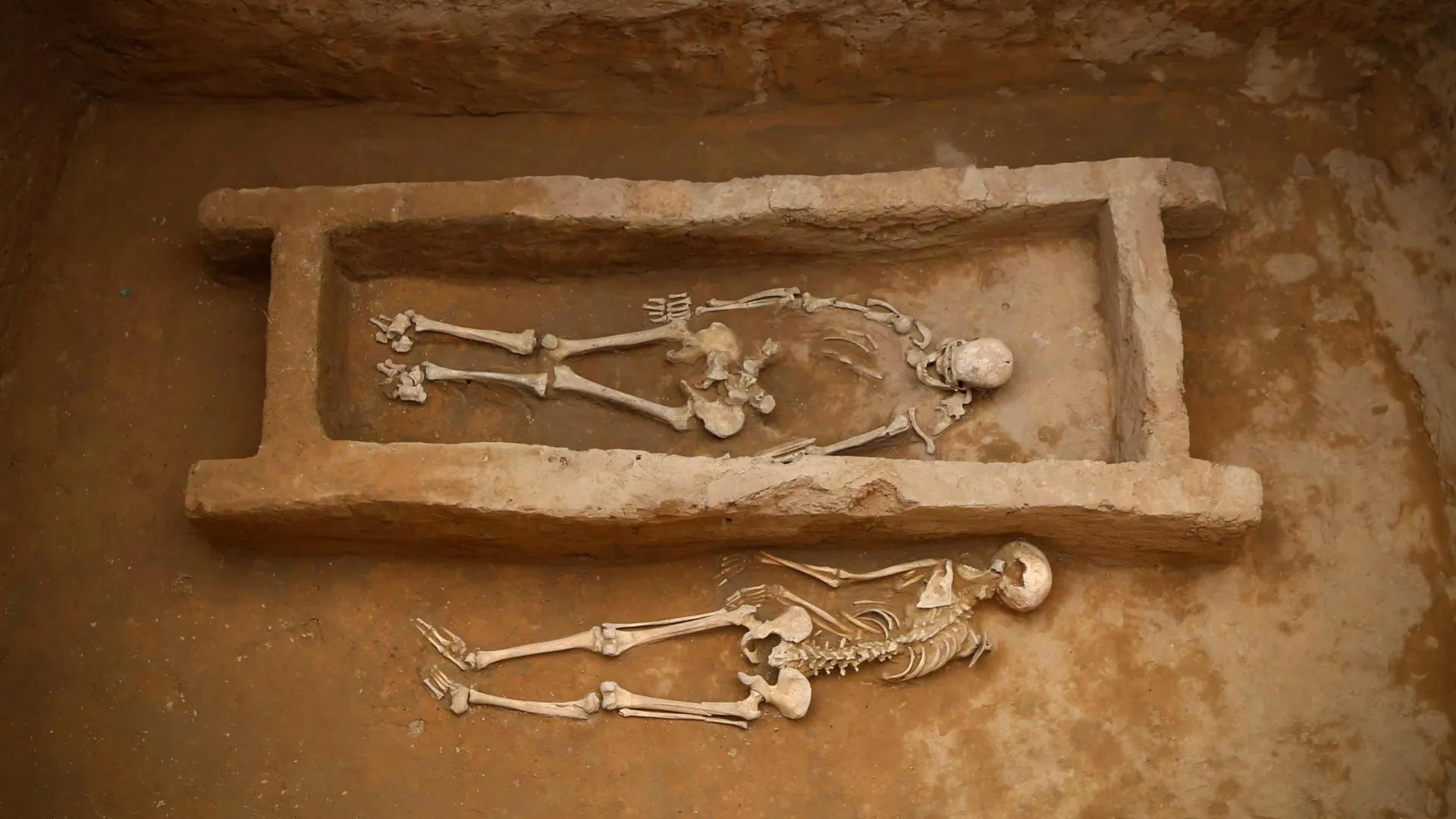
Perhaps the most striking revelation concerns the 80 human skulls recovered from near the East Gate. Historically, researchers hypothesized that these were primarily female victims. However, the genetic evidence tells a different story: 90% of the individuals tested in these mass burials were male.
This discovery forces a reassessment of ritual violence at the site. The spatial distribution of these remains—men near the East Gate and women in elite cemeteries like Huangchengtai—indicates that sacrifice was not a chaotic act of violence, but a highly regulated, gendered ritual. It appears that the purpose of the sacrifice dictated the selection of the victim, pointing to a society that viewed human life through a rigid, institutionalized lens of ritual hierarchy.
Perspectives from the Field: The Expert Consensus
Professor Qiaomei Fu and her colleagues emphasize that these findings do not merely document the "what," but explain the "how" of early Chinese state formation.
"The genetic data allows us to see the fluidity of the ancient world," notes the research team. "While the Shimao people were rooted in the local tradition of northern Shaanxi, they were far from isolated. The presence of genetic markers linking them to the Taosi culture, the steppe populations, and southern agriculturalists proves that Shimao was a nexus of prehistoric exchange."
The Shaanxi Provincial Academy of Archaeology has lauded the study, noting that the genetic evidence provides the "missing link" that aligns archaeological findings with historical social theory. By bridging the gap between genomic science and traditional archaeology, the team has provided a framework that can now be applied to other major sites across the Loess Plateau, potentially rewriting the history of East Asian state development.
Implications: The Emergence of the Early State
The implications of the Shimao study extend far beyond the borders of Shaanxi. For decades, historians have debated the factors that led to the rise of early states in East Asia. The Shimao evidence points to a model where social stratification was maintained through three key pillars:
- Ancestral Continuity: By rooting their legitimacy in the local population that had inhabited the region for 1,000 years, the Shimao elite were able to claim a "natural" right to rule.
- Strategic Connectivity: The ability to pull resources and people from as far as the southern rice-farming regions and the northern steppes suggests a political entity that exerted control over vast trade networks.
- Institutionalized Ritual: The ability to command the labor and lives of others—evidenced by the organized sacrifices at the East Gate—points to a state capable of enforcing its will through both physical power and religious authority.
As researchers continue to analyze the data, the story of Shimao serves as a reminder that the "cradle of civilization" was never a single, uniform place. Instead, it was a mosaic of interconnected communities, where local identity was constantly being negotiated through marriage, trade, and the heavy, often brutal hand of ritualized governance.
The study of Shimao is, in essence, the study of the transition from tribe to state. It shows us that as human settlements grew in size and complexity, so too did the methods by which they controlled their populations—methods that left a permanent, written-in-blood record in the genomes of the ancestors who built the stone walls of the past. As this research continues to influence the field, it is clear that our understanding of the origins of Chinese society will never be the same.