By [Your Name/Staff Reporter]
In the sweltering expanse of Irvine’s Great Park, the inaugural Daisy Chain Fields festival did more than just provide a day of music; it served as a defiant, sweat-drenched manifesto for the current state of pop culture. On August 29, 2026, 45,000 fans gathered under a relentless Southern California sun, enduring 95-degree heat and humidity levels that turned every attendee into a study in physical endurance. Yet, as the final notes of a collaborative performance of "Landslide" drifted over the gridlocked parking lot late Saturday night, the consensus was clear: this was the cultural event of the year.

Curated and headlined by global superstar Olivia Rodrigo, the festival—an all-female-led showcase—has already secured its place as an annual touchstone, with Rodrigo confirming that the "Daisy Chain" will return in 2027.
The Crucible of Heat and Harmony
The conditions at Great Park were, to put it mildly, brutal. With humidity topping 80%, the physical toll was palpable. The festival grounds, split between two high-energy stages, required a constant 12-minute trudge that forced attendees to choose between their hydration and their prime viewing spots. For over 10 hours, the crowd remained standing, a testament to the sheer magnetic pull of a lineup that prioritized artistic excellence over comfort.

Despite the meteorologically challenging conditions, the spirit of the day remained unflagging. There was a palpable sense of historical weight; this was a gathering that felt less like a commercial enterprise and more like a generational passing of the torch.
A Chronology of a Golden Era
The 14-act bill—bolstered by three surprise guest stars—offered a masterclass in pacing and curation. The afternoon began with a nod to the past, as legends of the 90s alt-rock scene shared the bill with the rising titans of the 2020s.

The Afternoon: Echoes of the 90s
The Marigold Stage became the festival’s "secret heart," hosting acts like The Breeders and Garbage. Kim Deal’s performance of "Cannonball" served as an early highlight, anchoring the set in the kind of raw, guitar-driven energy that defined the 90s. Shirley Manson of Garbage, ever the formidable frontwoman, engaged the crowd with passionate monologues, reflecting on the band’s early advocacy for LGBTQ+ themes—a reminder that the "language" of inclusion we use today was forged by these very artists decades ago.
Perhaps the most poignant moment occurred when Bikini Kill took the stage. Kathleen Hanna, a pioneer of the Riot Grrrl movement, appeared visibly moved by the sight of a massive, predominantly female audience singing along to every word. "When we played Orange County in the 90s, we were lucky if three women showed up," Hanna remarked, highlighting the seismic shift in the industry that Daisy Chain Fields sought to celebrate.

The Twilight Transitions
As the sun began to dip, the main Dandelion Stage saw a high-contrast transition between Mitski and Doechii. Mitski’s set was a masterclass in emotional intensity; she navigated her complex discography with a ferocity that demanded total attention. Following her, Doechii brought an aesthetic spectacle, clad in vibrant hues alongside dancers who mirrored her high-octane energy. Her performance provided a necessary rhythmic and sonic shift, proving that the festival’s curation was not merely about a singular "pop-rock" sound, but about the vast, diverse landscape of female-led music.
The Coronation: Roan and Rodrigo
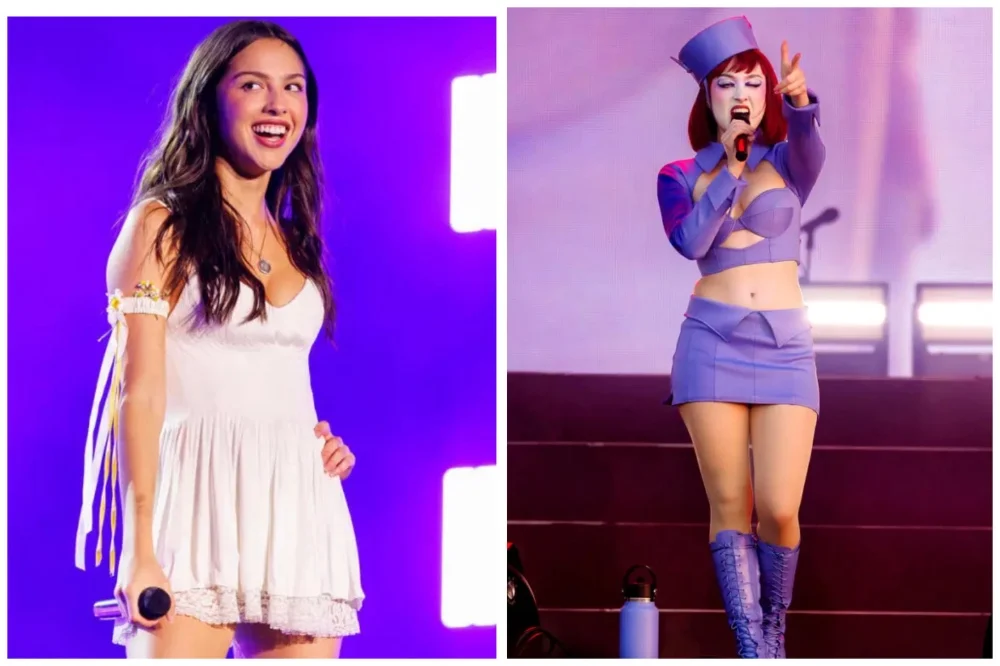
The penultimate set by Chappell Roan served as an indisputable declaration of a new pop vanguard. Sporting a 60s-inspired, TWA-stewardess-esque ensemble, Roan displayed a level of stage presence that bordered on athletic, delivering a hit-heavy set that cemented her status as one of the defining figures of the decade.

Rodrigo’s closing set, spanning 80 minutes, was the grand finale. She treated the audience to an array of tracks from her latest record, "You Seem Pretty Sad for a Girl So in Love," while seamlessly weaving in surprise appearances that elevated the evening into the realm of legend.
Supporting Data: The Power of Collaboration
The festival was defined by its cross-generational collaborations, which bridged the gap between the Lilith Fair era and the current digital-native generation of superstars.

- Alanis Morissette: The surprise guest of the day joined Rodrigo for a blistering rendition of "Ironic," a moment that felt like a spiritual communion between two of pop’s most potent songwriters.
- Sarah McLachlan: The founder of the Lilith Fair tradition graced the stage to perform "Building a Mystery" and "Angel," the latter dedicated to Dolly Parton. Her presence served as an implicit blessing for the festival’s mission.
- Stevie Nicks: The legendary singer-songwriter’s appearance for "Landslide" served as the emotional climax of the evening. Seeing Nicks—an ambassador of the 1970s—standing alongside Rodrigo was a powerful visual representation of the continuity of female artistic influence.
Official Responses and Philanthropy
Beyond the music, the festival was a major philanthropic event. Before her final set, Rodrigo brought Melinda French Gates onto the stage to announce a massive commitment to social causes. Gates matched Rodrigo’s $10 million donation, resulting in a $20 million infusion for 10 charity beneficiaries.
"This isn’t just about the music," said a spokesperson for the event. "It’s about building an ecosystem that supports the voices of the future." The philanthropic weight of the event added a layer of gravity to the proceedings, positioning Daisy Chain Fields as an organization as much as a concert series.

Implications: A New Cultural Touchstone
The success of Daisy Chain Fields poses an interesting question for the festival industry: Can the "all-female" format, once considered a niche or a novelty, become the new gold standard?
While festivals like All Things Go in the Eastern U.S. have been moving in this direction for years—often with a humorous wink at the inclusion of a "token dude"—Rodrigo has proven that a superstar-led, strictly curated lineup can command the same, if not greater, cultural capital than legacy festivals like Coachella.

The festival did not "topple the patriarchy" in a single day, as some might have joked in the heat of the afternoon. However, it accomplished something perhaps more lasting: it created a space where 45,000 people—most of them young women—could see themselves reflected in every single performer on stage.
Looking Toward 2027
As the sun set on the Great Park and the masses navigated the exit, the lingering sentiment was not one of exhaustion, but of anticipation. The 2026 edition of Daisy Chain Fields was, in many ways, a trial run for a much larger cultural movement. With a tour already on the horizon for Rodrigo, the festival served as a high-visibility proof of concept.

The organizers face a difficult task for 2027: replicating the magic of the debut while perhaps finding a more "meteorologically reasonable" date. Yet, if there is one thing this weekend proved, it is that the audience is willing to brave the heat, the humidity, and the gridlock to be part of something that feels genuinely, undeniably essential.
In 2026, the message from Irvine was loud and clear: the landscape of music is changing, and the women at the helm are not just leading the charge—they are building the very fields upon which the future of pop will be written.