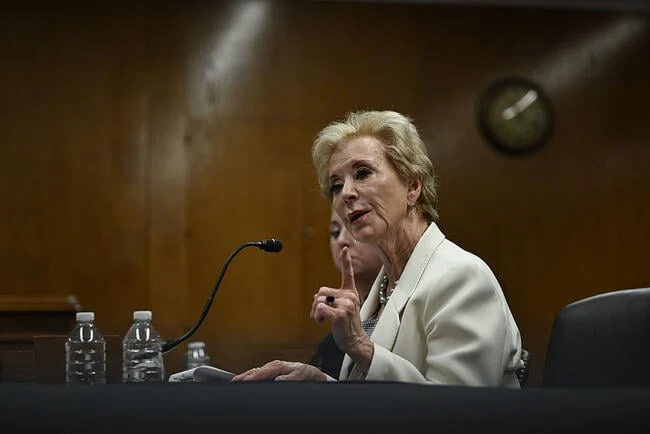
WASHINGTON — The escalating battle over the future of the federal role in American schooling reached a historic flashpoint this week. Representative Suzanne Bonamici (D-Ore.), a senior member of the House Committee on Education and the Workforce, announced a formal resolution to impeach Secretary of Education Linda McMahon. The move marks a dramatic escalation in the ongoing legislative standoff between the Trump administration’s efforts to streamline federal oversight and Democratic lawmakers who view the current restructuring of the Department of Education (ED) as an unconstitutional power grab.
At the heart of the controversy is a series of "interagency agreements" that have effectively offloaded core departmental responsibilities—ranging from civil rights enforcement to special education management—to other federal agencies. While the administration frames these actions as necessary administrative efficiency, critics argue they represent a clandestine effort to dismantle a cabinet-level department without the explicit consent of the legislative branch.
The Core Conflict: Executive Authority vs. Congressional Mandate
The catalyst for Representative Bonamici’s impeachment push was the administration’s announcement on Tuesday that the Department of Justice (DOJ) will assume primary responsibility for civil rights enforcement, while the Department of Health and Human Services (HHS) will take over the administration of special education programs.
For Bonamici and her Democratic colleagues, these transfers are not merely administrative adjustments; they are a subversion of the rule of law. "Congress created the Department of Education through an Act of Congress, and it would take a similar act to shutter or fundamentally alter it," Bonamici stated in her press release. "Secretary McMahon is effectively dismantling and demolishing the Department of Education without the authority to do so. I will not stand by and let her destroy the federal programs, funding, and research that are critical to public schools and the millions of students they serve."
The Democratic caucus argues that by hollowing out the Department of Education, McMahon is bypassing the legislative process, rendering the department a shell of its former self and stripping it of the capacity to execute its statutory mission.
A Chronology of the Department’s Restructuring
To understand the current tension, one must look back at the steady, methodical shift in departmental operations over the past eighteen months.
- Early 2026: The Department of Education begins signaling a shift toward "decentralized administration," citing the need to reduce overhead and improve inter-agency cooperation.
- March 2026: Reports emerge detailing the first wave of interagency agreements. Investigations reveal that ED has initiated 14 distinct agreements with agencies like the Department of Labor and the Department of Agriculture, moving oversight of various grant programs and research initiatives.
- May 2026: Tensions peak during a House Committee hearing where Secretary McMahon faces aggressive questioning from Democratic members regarding the legal basis for these transfers. McMahon maintains that the programs remain fully funded and operational, merely managed under a more "efficient" umbrella.
- June 17, 2026: The Department of Justice confirms its new role in overseeing civil rights cases previously handled by ED’s Office for Civil Rights (OCR).
- June 18, 2026: Representative Suzanne Bonamici formally announces the impeachment resolution, citing a violation of the Secretary’s oath of office and an overreach of executive authority.
Supporting Data: The Scope of the Shift
The administration’s strategy has been characterized by a "delegation-first" model. According to internal documents and public disclosures, the 14 agreements currently in place cover a broad spectrum of the department’s original 1980 charter.
Proponents of the administration’s strategy point to the sheer size and historical performance of the department as justification for the overhaul. Since its establishment in 1980, the Department of Education has overseen the expenditure of over $3 trillion in taxpayer funds. Yet, critics within the administration—and many conservative education policy analysts—point to stagnating test scores as evidence of the department’s institutional failure.
Current data provided by the administration to support their restructuring efforts highlights:
- Proficiency Gaps: Only one-third of American children demonstrate reading proficiency at their respective grade levels, a statistic the administration cites frequently to justify its "results-oriented" restructuring.
- Operational Failures: The administration points to the widely criticized rollout of the new FAFSA (Free Application for Federal Student Aid) form as a prime example of the department’s internal incompetence, arguing that administrative tasks are better handled by agencies with more robust IT and bureaucratic infrastructure.
The Official Response: Secretary McMahon’s Rebuttal
Secretary Linda McMahon has remained defiant in the face of the impeachment threat, dismissing the move as a partisan stunt. In a sharply worded statement released shortly after Bonamici’s announcement, McMahon reframed the debate from one of constitutional procedure to one of student outcomes.
"It speaks volumes that House Democrats think an impeachable offense is working to improve student outcomes and reduce the federal bureaucracy," McMahon said. "They seem more concerned with protecting a bloated, ineffective agency than with the historic low test scores, the failed FAFSA rollout, and the myriad ways our current system has left parents and students behind."
McMahon went on to enumerate her grievances with the status quo, citing the politicization of classrooms, the shuttering of schools during the COVID-19 pandemic, and debates over parental rights. "Washington spends billions annually, yet our children are falling further behind the rest of the world. To the Democrats in Congress: do better."
The Legal and Political Implications
The Unlikely Path to Impeachment
Political analysts note that the impeachment resolution faces near-insurmountable hurdles. With the Republican party maintaining control of the House of Representatives, the resolution is highly unlikely to be brought to a floor vote, let alone pass. However, the move is deeply significant as a signal of intent.
A Preview of the Fall Elections
The impeachment announcement serves as a strategic marker for the upcoming fall elections. Democrats are signaling that if they regain control of the House, they intend to use their subpoena and investigative powers to aggressively roll back the administration’s interagency agreements. The conflict has become a proxy war for two vastly different visions of government: the Democratic view of the federal government as a necessary guarantor of civil rights and equity in education, and the current administration’s view of the federal government as a bloated entity that should either be streamlined or entirely devolved to the states.
The Long-Term Administrative Impact
Regardless of the impeachment’s outcome, the legal questions surrounding the "outsourcing" of federal programs are likely to reach the courts. Legal scholars are divided on whether the Secretary of Education has the inherent authority to delegate statutory duties to other Cabinet members under existing executive power frameworks. If the courts eventually rule that these agreements lack the required legislative authorization, the administration could face a massive logistical crisis as it attempts to repatriate these programs to a department that has already begun shedding its staff and operational infrastructure.
Conclusion: A Department in Flux
The impasse between Secretary McMahon and the House Democrats represents more than just a bureaucratic turf war; it is a fundamental clash over the constitutional limits of executive power. As the administration continues to shift the gears of the Department of Education, the legislative branch finds itself increasingly marginalized, leading to the extreme measure of an impeachment resolution.
As the nation watches, the outcome of this dispute will likely define the federal government’s involvement in education for a generation. Whether the Department of Education is successfully transformed into a leaner, more focused agency, or whether it is preserved as a robust federal overseer, depends on the resolution of this high-stakes struggle between the executive’s mandate for efficiency and the legislature’s mandate for oversight. For now, the Department remains in a state of operational limbo, caught between the conflicting visions of those who lead it and those who oversee it.