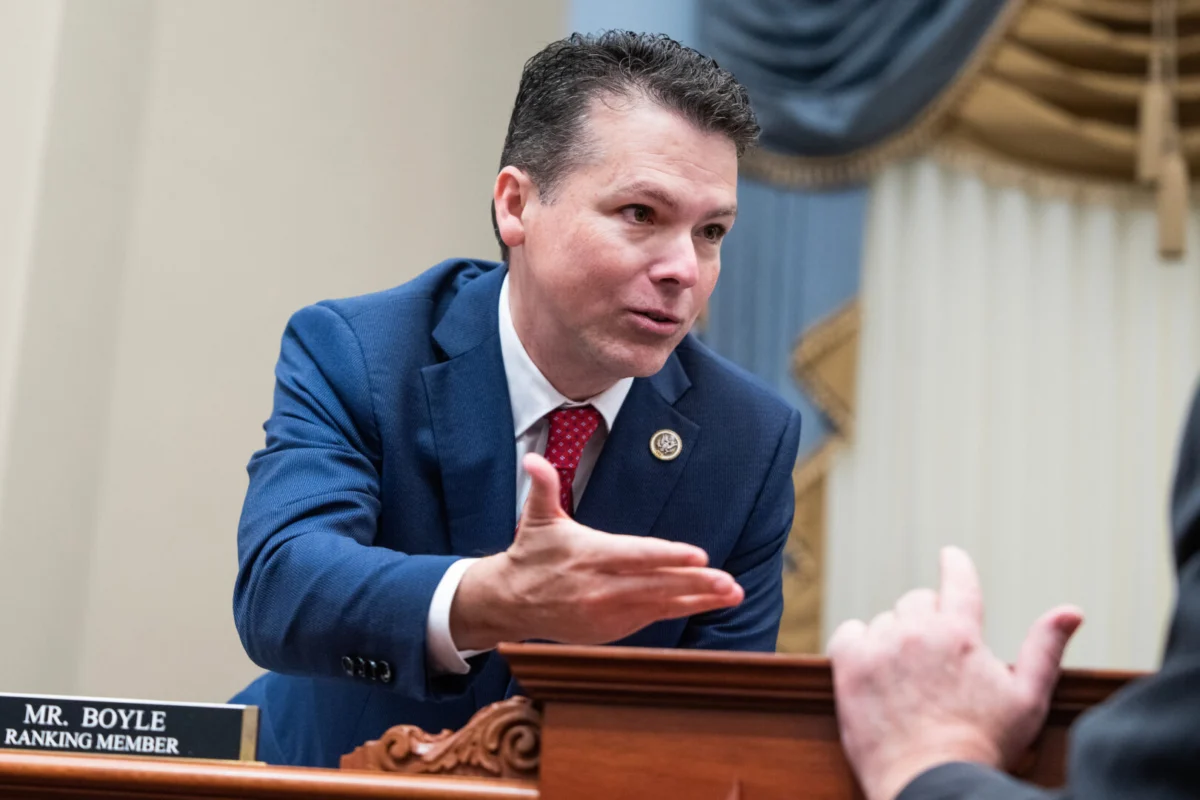
Philadelphia, PA – As the United States prepares to mark its monumental 250th anniversary, a significant and symbolically charged pilgrimage is underway. Members of Congress are set to journey back to the hallowed grounds where the nation’s foundational principles were forged: Independence Hall in Philadelphia. This ceremonial gathering, spearheaded by Pennsylvania Democratic Representative Brendan F. Boyle, aims to transcend the pervasive partisan gridlock that currently defines American politics, offering a rare moment of historical reflection and potential unity.
The event, scheduled for Thursday, July 2nd, will see lawmakers convene in Boyle’s hometown, a culmination of two years of meticulous planning and persistent advocacy. It is a deliberate effort to reconnect with the spirit of 1776, an endeavor Boyle describes as a defining moment in his legislative career. "This is going to be truly one of the highlights of my tenure in Congress, to be sitting there where our Founding Fathers sat exactly 250 years prior, to the exact day," Boyle stated, his voice resonating with a profound sense of historical awe. His overarching hope is that this unique occasion might foster a "unifying moment" in an increasingly polarized political landscape.
Commemorating the Semiquincentennial in Philadelphia
The return to Independence Hall is not merely a nostalgic trip but a carefully orchestrated act of remembrance, timed to coincide with a pivotal, yet often overlooked, date in American history. While the Fourth of July traditionally commands national attention as America’s birthday, Boyle and a growing number of historians advocate for July 2nd to receive its rightful recognition. It was on this day in 1776 that the Second Continental Congress, after fervent debate and impassioned speeches, formally voted to declare independence from Great Britain. Two days later, on July 4th, the Declaration of Independence was officially adopted, a document whose eloquent prose overshadowed the critical vote that preceded it.
Boyle passionately articulated this historical nuance, noting, "It was always the date that John Adams thought would be celebrated as America’s birthday. Unfortunately, this was another instance in which Adams lost to [Thomas] Jefferson – because Americans came to, of course, celebrate two days later the Fourth of July, which is the date Congress adopted the Declaration of Independence." This distinction underscores the event’s deeper purpose: to illuminate the intricate historical tapestry of the nation’s birth and to honor the comprehensive process that led to independence, not just its eloquent articulation.
The forthcoming gathering, though ceremonial and not a formal legislative session, carries immense symbolic weight. It aims to immerse modern-day lawmakers in the very environment where monumental decisions shaped the trajectory of a nascent nation. Independence Hall, a UNESCO World Heritage Site, stands as a tangible monument to the birth of American democracy, having witnessed the signing of the Declaration of Independence and the drafting of the U.S. Constitution. Its walls have absorbed the echoes of profound debates, the clash of ideals, and ultimately, the forging of a new form of governance. The presence of contemporary congressional members within these hallowed chambers serves as a potent reminder of the enduring legacy and the profound responsibilities inherited from the Founding Fathers.
The Unsung Day of Independence: July 2nd, 1776
The decision to focus on July 2nd rather than July 4th is a deliberate historical reclamation. For many Americans, the Fourth of July is synonymous with fireworks, parades, and the reading of the Declaration of Independence. However, historical records, particularly the extensive correspondence of figures like John Adams, reveal a different perspective on the true moment of independence.
Reclaiming John Adams’ Vision
John Adams, a tireless advocate for independence, firmly believed that July 2nd, 1776, was the day that truly deserved national commemoration. In a letter to his wife, Abigail, dated July 3, 1776, Adams famously wrote: "The Second Day of July 1776, will be the most memorable Epocha, in the History of America. I am apt to believe that it will be celebrated, by succeeding Generations, as the great anniversary Festival. It ought to be commemorated, as the Day of Deliverance by solemn Acts of Devotion to God Almighty. It ought to be solemnized with Pomp and Parade, with Shews, Games, Sports, Guns, Bells, Bonfires and Illuminations from one End of this Continent to the other from this Time forward forever more."
Adams’ prescient words capture the gravitas of the vote itself. It was the moment the colonies collectively severed ties with the British Crown, a decisive and irreversible act of rebellion. The Declaration, while a magnificent articulation of the philosophical underpinnings of this separation, was the document that explained the decision made on July 2nd. Boyle’s initiative seeks to bring this historical nuance to the forefront, encouraging a deeper understanding of the revolutionary period and the complex legislative processes that unfolded. By highlighting July 2nd, Congress members are invited to reflect not just on the ideals expressed in the Declaration, but on the courage and conviction required to cast that initial, momentous vote for freedom. This historical clarification serves not only as an educational moment but also as a powerful symbol of returning to the very roots of the nation’s self-determination.
Navigating Logistical Hurdles and Political Currents
Organizing an event of this magnitude, particularly one involving members of the United States Congress, is a monumental undertaking fraught with logistical complexities and significant security considerations. Moving a contingent of federal lawmakers away from the highly secured confines of the U.S. Capitol presents a unique set of challenges.
A Modern-Day Congressional Odyssey
Boyle himself underscored the "considerable" security concerns involved in assembling a group of lawmakers outside of Washington, D.C. Such an operation requires intricate coordination among various federal, state, and local law enforcement agencies, including the Capitol Police, Secret Service, and Philadelphia’s own police department. The precise details of security arrangements and the full list of expected attendees remained confidential, a testament to the sensitive nature of protecting high-profile officials in a public setting. This level of planning highlights the extraordinary effort behind what might appear to be a simple ceremonial event, underscoring its significance.
Boyle’s determination to bring this event to fruition reflects his deep personal connection to American history and his district. He described himself as a "one-man salesman," tirelessly reaching out to colleagues, distributing cards, sending text messages, and making phone calls to encourage attendance. "Look, I get it. There is such pressure on every member to be back in the district as much as possible," he acknowledged, recognizing the constant demands on lawmakers. Yet, he framed the Philadelphia trip as an opportunity "to be part of something that’s above yourself, that truly will be special and historic." His pitch was simple yet compelling: "If you can just delay going home by one day, then I think it’ll be well worth it."
Echoes of the Past: Previous Gatherings
The notion of Congress convening outside the Capitol is a rare occurrence, reserved for moments of profound historical significance or national emergency. The last time members of Congress gathered at Independence Hall in modern times was in 1987. That occasion marked the 200th anniversary of the "Great Compromise," a pivotal agreement reached during the Constitutional Convention that established the legislative branch as having two chambers: the House of Representatives, based on proportional representation, and the Senate, with equal representation for each state. This bicameral structure remains a cornerstone of American governance. The 1987 commemoration, much like Boyle’s current initiative, served to reinforce the historical foundations of the nation’s democratic institutions.
Boyle had initially envisioned an even grander occasion, seeking to authorize a formal joint session of Congress in Philadelphia. In February of the previous year, he introduced House Concurrent Resolution 16, which garnered bipartisan support from lawmakers like Rep. Robert B. Aderholt (R-Ala.) and other members of the America250 semiquincentennial commission. Despite this backing, the concurrent resolution never advanced, a testament to the procedural hurdles and the prevailing political climate that often resists such ambitious deviations from routine. While the current gathering won’t be a formal meeting, its ceremonial nature still aims to provide more than a simple history lesson; it seeks to evoke a spirit of shared heritage and purpose.
A Call for Unity Amidst Division
At its heart, Boyle’s initiative is a profound plea for unity, a concept that often feels elusive in contemporary American politics. He candidly acknowledged the pervasive partisanship that characterizes much of congressional work. "Ninety-nine percent of the time, when we do things [in Congress], it is of a partisan nature," Boyle observed, highlighting the exceptional nature of his vision for the Independence Hall event. His hope is that by physically returning to the wellspring of American identity, lawmakers might momentarily set aside their differences and remember the fundamental ideals that bind them as public servants of a single nation.
Boyle’s Vision for a Non-Partisan Moment
Boyle’s passion for America’s founding story is deeply personal, stemming from a childhood steeped in historical appreciation. "I’ve really been in love with the story of America’s founding from as early as I can remember," he shared, recalling formative field trips to Independence Hall and the Liberty Bell. These early experiences instilled in him a reverence for the nation’s origins and a profound belief in its enduring principles. He hopes that this event can rekindle a similar sense of shared heritage among his colleagues, allowing them to transcend the daily political battles, if only for a brief, poignant moment. "Besides the history of it, I hope that after this, the spirit of this event will live on," he emphasized, articulating a desire for a lasting impact beyond the immediate commemoration.
Contemporary Debates on American Identity
The timing of this historical commemoration is particularly resonant, unfolding against a backdrop of intense and often divisive national conversations about U.S. history, national identity, and who truly belongs in America. Just days before the Philadelphia gathering, the Supreme Court issued a ruling that upheld the constitutional right to birthright citizenship for children born in the United States, irrespective of their parents’ immigration status. This decision directly addressed a contentious issue that has fueled heated political debates for years.
Boyle, whose father immigrated to the U.S. from Ireland, found the timing "ironic" but noted that such debates are far from new. "It was the same fight that was happening 100 years ago in the 1920s, it was the same fight that was happening in the 1840s or even the late 18th century," he stated, drawing historical parallels to earlier periods of intense immigration and nativist sentiment. His own upbringing profoundly shaped his understanding of the American Dream. "Growing up with an immigrant father and immigrant maternal grandparents, I was raised in a deeply patriotic household that proudly flew the American flag and deeply believed in the American Dream," Boyle recounted. He credits this foundational experience as instrumental to his journey into public service: "I would not be sitting here as a member of Congress had I not had that sort of grounding." This personal narrative intertwines seamlessly with the broader historical themes of the event, offering a powerful, living testament to the ongoing evolution of American identity.
The Shadow of Legislative Turmoil
Even as Boyle championed this unifying historical event, the turbulent realities of congressional politics threatened to cast a shadow over its success. The House of Representatives recently canceled votes scheduled for Wednesday and Thursday, a direct consequence of ongoing infighting within the Republican caucus that has repeatedly derailed the legislative agenda. This unexpected disruption raised Boyle’s anxiety levels considerably.
House Infighting and Event Uncertainty
The cancellation of votes meant that lawmakers, freed from their legislative duties, might opt to return to their home districts earlier than anticipated, potentially skipping the northward journey to Philadelphia. Boyle had been keenly watching the legislative schedule, hoping that House Speaker Mike Johnson would keep members in Washington through Thursday morning to ensure attendance at his event. "I’m nervous. Let’s just say that right now, at the moment, I am very much a fan of Mike Johnson keeping the House in session through Thursday morning, so that way our plans for Independence Hall on July 2 aren’t negatively impacted," Boyle admitted before the cancellations were announced. This internal political strife underscores the constant tension between immediate legislative demands and the pursuit of broader, unifying historical commemorations. It highlights the immense challenge of persuading busy lawmakers to prioritize an event that, while deeply symbolic, does not directly involve policy-making or constituent service.
The pressure on members of Congress to be present in their districts, engaging with constituents and attending local events, is immense. Boyle’s "one-man salesman" efforts were a direct response to this reality, a recognition that for many, a trip to Philadelphia, even for a historic occasion, might be seen as an additional burden. His plea for lawmakers to "delay going home by one day" reflects the deep personal investment he has made in this event, believing its intrinsic value outweighs the immediate political pressures.
Beyond a History Lesson: The Enduring Significance
The gathering at Independence Hall on the eve of America’s 250th anniversary transcends a mere historical reenactment or a district-specific touting of Philadelphia’s heritage. It represents a profound statement about the enduring relevance of foundational principles and the ongoing quest for national cohesion.
Rekindling the American Spirit
This ceremonial return to the nation’s birthplace offers a powerful opportunity for reflection and renewal. It invites lawmakers, and through them, the American public, to contemplate the sacrifices made by the Founding Fathers, the ideals enshrined in the Declaration of Independence and the Constitution, and the continuous struggle to live up to those aspirations. In an era marked by deep ideological divides and a pervasive sense of national fragmentation, the symbolism of Congress reconvening in the very room where independence was declared is potent. It is a visual and visceral reminder of the shared origins that predate and, ideally, should supersede contemporary political squabbles.
The event aligns with the broader goals of the America250 semiquincentennial commission, which seeks to engage all Americans in commemorating the nation’s 250th birthday through a wide array of programs and initiatives. By centering a congressional event at Independence Hall, Boyle’s initiative amplifies the commission’s message, emphasizing the importance of civic education, historical literacy, and a renewed appreciation for the democratic experiment. It challenges both lawmakers and citizens to look beyond the immediate headlines and consider the long arc of American history, recognizing that the nation’s founding was not a singular event but an ongoing process of negotiation, compromise, and aspiration.
Ultimately, Boyle’s determined effort to bring Congress back to Independence Hall is more than just a nod to history; it is a hopeful, albeit symbolic, gesture in a divided nation. It aims to remind lawmakers and citizens alike of the fundamental principles upon which the nation was founded – liberty, equality, and self-governance – and to encourage a collective recommitment to the ideals that, for 250 years, have defined the American experiment. In doing so, it seeks to rekindle the American spirit, fostering a sense of shared purpose and a renewed understanding of what it truly means to be an American.