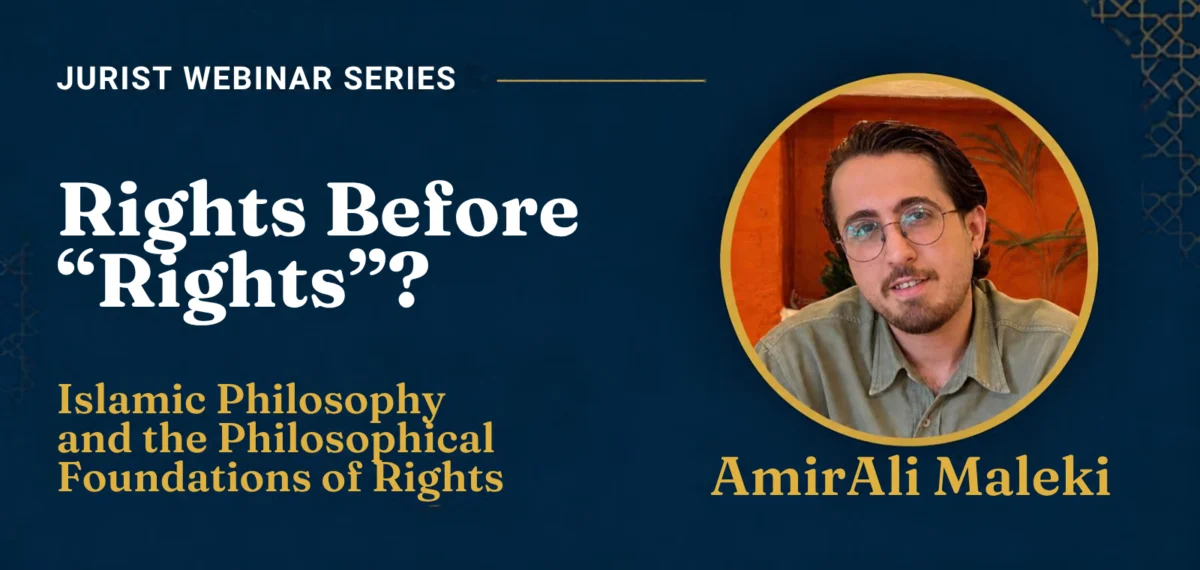
In an era defined by a globalized legal discourse, the intersection of ancient philosophical traditions and modern human rights frameworks has become a focal point of intense academic and professional scrutiny. On October 7, 2026, JURIST, the pioneering law student-powered legal news organization, will host a signature webinar titled, “Rights Before ‘Rights’? Islamic Philosophy and the Philosophical Foundations of Rights.”
The event promises to move beyond superficial comparisons, instead offering a deep dive into the intellectual history of Islamic thought to understand how concepts of agency, justice, and human dignity were articulated long before the modern nomenclature of “human rights” took hold in the West.
Main Facts: The Intersection of Jurisprudence and Philosophy
The webinar will feature AmirAli Maleki, JURIST’s Deputy Managing Editor for Global Commentary and a distinguished researcher in international law and the philosophy of law. The session is scheduled for Wednesday, October 7, 2026, from 1:00 PM to 2:00 PM ET (8:30 PM to 9:30 PM IRST).
The program is designed to challenge the contemporary tendency to view Islamic legal history through a narrow, modern-Western lens. Rather than attempting to find “pre-modern” iterations of the 1948 Universal Declaration of Human Rights, the discussion will focus on the internal logic of Islamic philosophical tradition. It will investigate the specific mechanisms—such as the relationship between the individual and the political community, the nature of property, and the moral obligations inherent in Islamic ethics—that functioned in the absence of modern “rights-based” language.
The webinar will be moderated by Ingrid Burke Friedman, JURIST’s Editorial Director, and will conclude with an interactive Q&A session, allowing attendees to engage directly with the complex intersection of classical theology, political theory, and modern international law.
Chronology: The Evolution of JURIST’s Global Commentary
The impetus for this webinar lies in the long-standing mission of JURIST. Since its founding in 1996, the organization has served as a bridge between the ivory towers of legal academia and the frontlines of global legal reporting.
- 1996: JURIST is established as a non-profit, student-driven news service, setting a precedent for transparent, non-partisan reporting.
- Early 2020s: JURIST expands its "Global Commentary" vertical, seeking to incorporate voices from the Global South and non-Western legal traditions to foster a more inclusive international discourse.
- 2026: AmirAli Maleki is named the recipient of the David M. Crane Rule of Law Award, recognizing his significant contributions to the philosophy of law and international legal discourse.
- October 7, 2026: The scheduled date for the webinar, marking a significant milestone in JURIST’s commitment to exploring the intellectual underpinnings of justice.
Supporting Data: Why Islamic Philosophy Matters for Modern Rights
The relevance of this discussion is underscored by the current state of international law, which faces mounting criticism for being insufficiently representative of diverse cultural and philosophical histories.
The Problem of "Rights-Centrism"
Modern international law is heavily grounded in Enlightenment-era liberalism, which prioritizes the individual as a discrete entity against the state. Scholars in the field of Islamic studies, such as Maleki, argue that this framework often overlooks the "relational" nature of rights in Islamic philosophy. In the classical Islamic tradition, justice is often discussed in terms of haqq (truth/right), which carries a dual meaning: it is both a claim one can make against others and a duty one owes to God and the community.
Key Philosophical Pillars to be Discussed:
- Human Agency and Dignity: How classical Islamic thinkers reconciled the concept of human responsibility (taklif) with the intrinsic dignity of the individual.
- Property and Ownership: Examining the Islamic perspective on stewardship (khilafah) versus absolute, individualistic property rights.
- Political Authority: The limits of the ruler’s power in relation to the individual and the law (Sharia), which served as a check on arbitrary authority centuries before the concept of constitutionalism became globalized.
- Obligation vs. Entitlement: A critical analysis of whether a society built on "duties" can provide more robust protections for the individual than one built solely on "rights."
Official Perspectives: Expert Insights on the Dialogue
AmirAli Maleki, who also serves as the Editor of PraxisPublication.com, brings a unique blend of hermeneutic analysis and legal rigor to the webinar. In his previous writings, Maleki has emphasized that the study of Islamic philosophy is not an exercise in nostalgia, but a necessary analytical tool for the modern legal professional.
"The goal," Maleki noted in preparatory materials for the event, "is not to force Islamic traditions into the Procrustean bed of Western legal theory. It is to recover the vocabulary—and the limitations—of that tradition so that we might see our own concepts of human rights with greater clarity and humility."
Ingrid Burke Friedman, who will moderate the discussion, stated that the webinar is part of JURIST’s broader mandate to provide more than just the "headlines" of the day. "Our readers and the next generation of legal professionals need to understand the why behind the what," Friedman said. "By exploring the foundations of rights, we are training our students and the public to be more critical thinkers in the face of complex global legal challenges."
Implications: The Future of Global Human Rights Discourse
The implications of this webinar extend far beyond a single hour of academic presentation. As the global legal order struggles with legitimacy, the inclusion of non-Western philosophical perspectives is becoming a survival imperative for international institutions.
De-centering Western Hegemony
If international law is to be truly "international," it must move beyond the unilateral assumption that Western liberal democracy is the only historical path to human dignity. By hosting this webinar, JURIST is facilitating a necessary conversation about pluralism. If legal professionals can understand that societies can derive robust protections for the individual from sources other than Enlightenment liberalism, they may be better equipped to engage in cross-cultural human rights advocacy that is effective rather than merely imperialistic.
The Role of Law Students
As a student-powered organization, JURIST is uniquely positioned to influence the next generation of legal practitioners. Students who attend this webinar will be introduced to the idea that law is not merely a set of statutes, but a reflection of deep-seated philosophical commitments. This training is essential for those who will eventually serve as international lawyers, judges, and policy advisors, as it encourages them to look beneath the surface of legal disputes to the ethical foundations that support them.
Encouraging Intellectual Rigor
In a media landscape increasingly dominated by soundbites and rapid-response commentary, JURIST’s dedication to a deep-dive, hour-long intellectual exploration is a bold stance. It signals that the organization remains committed to its mission of providing non-partisan, substantive analysis, even at the risk of challenging the status quo.
Conclusion: How to Participate
The webinar, “Rights Before ‘Rights’? Islamic Philosophy and the Philosophical Foundations of Rights,” is free and open to the public, reflecting JURIST’s commitment to democratizing access to high-level legal education.
The event is particularly relevant for:
- Law students and academics seeking to broaden their understanding of comparative legal history.
- Human rights practitioners looking for alternative theoretical frameworks to support their advocacy.
- Anyone interested in the intersection of religion, philosophy, and modern political discourse.
Participants are encouraged to register early via the official Zoom portal provided by JURIST.
By providing a platform for this dialogue, JURIST continues to fulfill its 30-year legacy as an essential hub for legal news and analysis. As the world navigates the complexities of the 21st century, the ability to engage with the philosophical heritage of different cultures will be an invaluable asset to any legal professional committed to justice. This event represents a significant opportunity to engage with the past to inform the future of human rights.