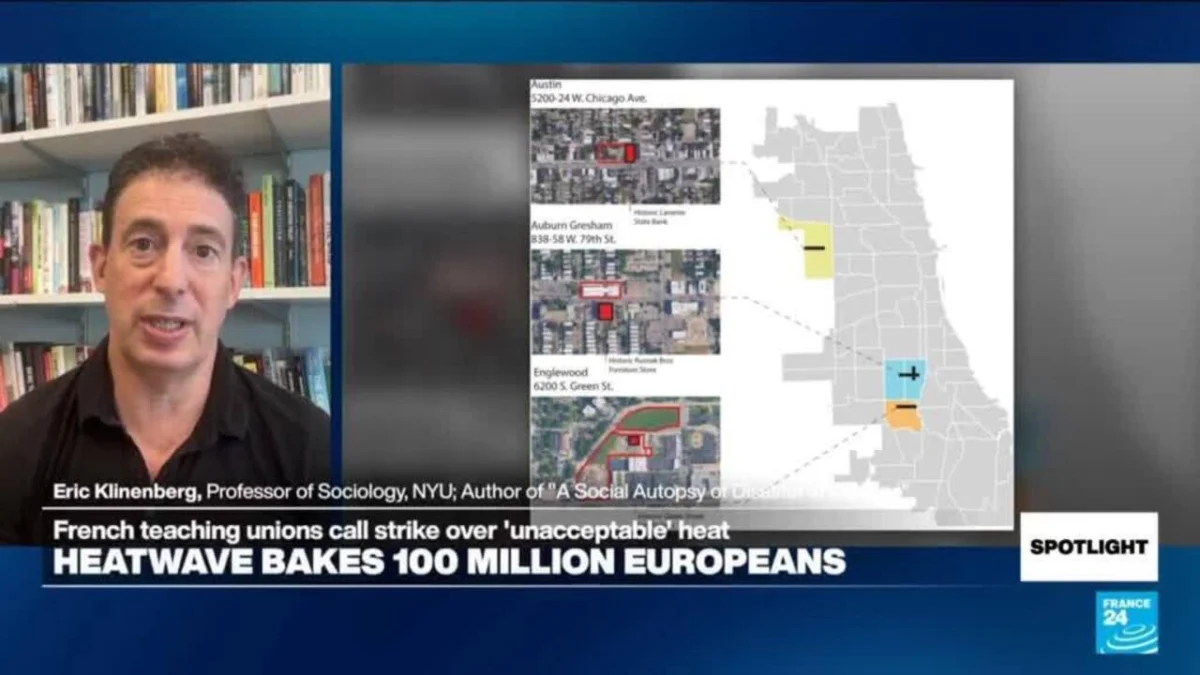
As global temperatures reach record-breaking levels, experts are shifting the focus from engineering solutions to the human element. In a recent interview with Spotlight, sociologist Eric Klinenberg argues that in the fight against climate-induced heatwaves, a knock on the door can be the difference between life and death.
The Illusion of Technological Resilience
For decades, urban planners and policymakers have viewed the escalating threat of climate change through the lens of engineering. The primary strategy has been the deployment of "hard" infrastructure: air conditioning, heat-resistant building materials, and advanced cooling centers. However, Eric Klinenberg, a Professor of Sociology at NYU and the author of the seminal work Heat Wave: A Social Autopsy of Disaster in Chicago, suggests this approach is fundamentally incomplete.
While technological adaptation is necessary, it is not a panacea. During his appearance on Spotlight, hosted by François Picard, Klinenberg challenged the dominant assumption that modern society can simply "cool" its way out of a changing climate. According to Klinenberg, we are witnessing a dangerous oversight where cities invest heavily in mechanical systems while neglecting the "social infrastructure" that sustains human life during periods of extreme thermal stress.
A Chronology of Crisis: From Chicago to the Present
To understand the current climate emergency, one must look at the historical markers that defined our modern understanding of heat-related mortality.
- 1995: The Chicago Heatwave: This event serves as the cornerstone of Klinenberg’s research. Chicago experienced a five-day heatwave where temperatures reached 106°F (41°C). The disaster resulted in over 700 excess deaths. Crucially, Klinenberg’s "social autopsy" revealed that mortality was not distributed evenly based on wealth or age alone, but on the presence of social networks. In neighborhoods with robust public spaces—libraries, parks, and thriving storefronts—the death rate was significantly lower than in isolated, neglected areas with identical poverty levels.
- 2003: The European Awakening: France experienced a catastrophic heatwave that claimed an estimated 15,000 lives. It was a national trauma that forced the French government to fundamentally overhaul its emergency response protocols, leading to the creation of the Plan Canicule (Heatwave Plan).
- 2026: The Current Reality: Today, as record-shattering heat becomes an annual occurrence rather than a once-in-a-generation event, Klinenberg warns that the pace of climate change is beginning to outstrip the adaptation efforts implemented in the early 2000s. We are currently in a cycle where the frequency and intensity of these events are exposing the limitations of previous institutional responses.
Supporting Data: The "Social Autopsy" of Inequality
The relationship between social connectivity and survival is supported by granular data. In his research, Klinenberg identified that the most vulnerable populations are not merely those with pre-existing health conditions, but those who are socially isolated.
The Role of Public Space
Public infrastructure functions as a critical buffer. When a neighborhood has places where people interact daily—cafes, community centers, or well-maintained sidewalks—residents form "weak ties." These are the acquaintances who notice when a neighbor doesn’t pick up their mail or hasn’t been seen on the porch. In the context of a heatwave, this observational network acts as an informal, decentralized early-warning system.
The Geography of Isolation
Data from the 1995 Chicago disaster showed that neighborhoods with high rates of crime or disinvestment saw residents retreat indoors. Fear, combined with a lack of social institutions, effectively severed the human links that might have otherwise ensured the safety of the elderly or the housebound. Consequently, when the heat peaked, those living in "socially bankrupt" areas died at significantly higher rates, regardless of their economic status.

Official Responses and Institutional Adaptation
In the wake of past disasters, governments have adopted varying strategies to mitigate risk.
In France, the official response has been largely top-down. The Plan Canicule utilizes television alerts, national hotlines, and mandatory registration for vulnerable individuals in municipal databases. While these measures have saved countless lives, experts like Klinenberg argue that they are essentially reactive.
"The state cannot be everywhere," Klinenberg notes. "An official alert or a phone call from a social worker cannot replicate the immediate, life-saving intervention of a neighbor who happens to be checking in because they know you live alone."
Official responses are increasingly attempting to incorporate community-based approaches. Cities like Paris have begun "greening" the urban environment, not just for aesthetic reasons, but to provide cooler outdoor spaces that encourage social gathering. However, the integration of these physical changes with genuine community-building remains a secondary priority in most urban planning budgets.
The Implications: Resilience as a Social Mandate
The shift from viewing climate change as an engineering problem to a social one has profound implications for the future of urban policy.
1. Re-evaluating Urban Design
Urban design must move beyond efficiency. A resilient city is one designed for "social friction"—the type of healthy, everyday interaction that builds trust. This means prioritizing walkable neighborhoods, public libraries, and community gardens. These are not merely amenities; they are survival infrastructure.
2. The Invisibility of the Vulnerable
The most significant hurdle remains the "invisibility" of the vulnerable. Many people who perish in heatwaves are not on any government list. They are often men living alone, or individuals whose social circles have shrunk due to age or disability. Resilience policies must be designed to reach those who have "opted out" of traditional social networks, requiring a more aggressive community-outreach model.

3. Climate Change as a Multiplier of Inequality
Klinenberg warns that climate change acts as a "threat multiplier." It exacerbates existing societal fractures. If a city is already segregated, isolated, and unequal, a heatwave will amplify those conditions until they become lethal. Therefore, addressing climate change requires a concurrent commitment to social equity.
Conclusion: The Architecture of Care
As we look toward a future of warming, the message from the academic and policy community is clear: technology can provide the tools for survival, but society provides the will.
We must stop treating resilience as a matter of individual survival or mechanical mitigation. Instead, we must begin to view our neighborhoods as part of our essential infrastructure. When we invest in public spaces, we are investing in the fabric of human connection. When we encourage our neighbors to know one another, we are creating a safety net that no government program can replicate.
Ultimately, the most sophisticated climate adaptation strategy may be the simplest one: looking out for the person next door. As Klinenberg aptly puts it, "The ability to recognize vulnerability in others, and the willingness to act on it, is the true test of a resilient society."
In the face of an unpredictable climate, the strength of our social infrastructure is the only barrier between a manageable crisis and a humanitarian catastrophe. The time to build that infrastructure—not with steel and glass, but with empathy and community participation—is now.