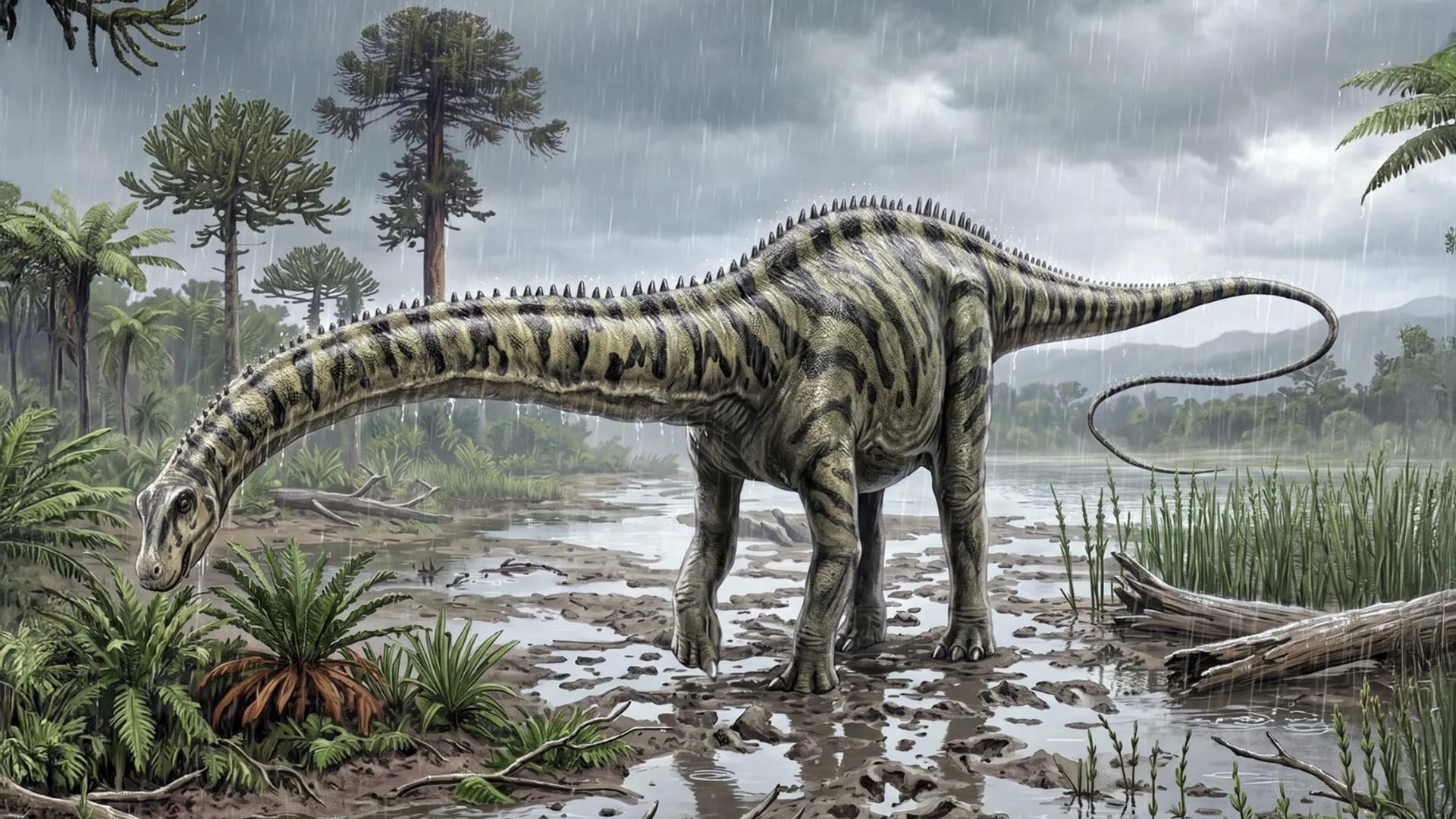
For over a century, the Diplodocus has stood as an icon of the prehistoric world. With its elongated, whip-like tail, pillar-like limbs, and modest, peg-toothed head, this sauropod has defined our collective image of the Late Jurassic. Until recently, however, this behemoth was exclusively a North American phenomenon. Every confirmed specimen had been unearthed within the rugged strata of the Morrison Formation in the western United States.
That narrative has now been permanently rewritten. In a landmark study published in the Journal of Vertebrate Paleontology, researchers from the Fundación Conjunto Paleontológico de Teruel-Dinópolis have confirmed the discovery of the first Diplodocus specimen ever identified outside of North America. Unearthed in the La Tejerìa site in El Castellar, Teruel, Spain, this discovery does more than add a new pin to a map; it fundamentally alters our understanding of paleobiogeography and the interconnectedness of Jurassic continents.
A Discovery at the Crossroads of Time
The story of this breakthrough began at the La Tejerìa site, a location that has increasingly become a focal point for paleontological study in the Iberian Peninsula. During intensive excavations, a team led by the Fundación Dinópolis recovered 14 remarkably well-preserved caudal (tail) vertebrae, accompanied by several associated chevron bones.
The preservation of these bones was, by all accounts, exceptional. While many dinosaur fossils are found fragmented or crushed by geological pressures, these vertebrae retained the anatomical fidelity necessary for high-level classification. "It was an exciting and continuous process of seeing the pieces of the puzzle gradually fall into place," says Sergio Sánchez Fenollosa, a PhD student in biodiversity and evolutionary biology at the Fundación Dinópolis and lead author of the study.
As the osteological study progressed, the team began to notice a pattern. Initial morphological observations revealed strong affinities with known diplodocine sauropods. However, it was only after rigorous anatomical scrutiny—identifying the precise combination of features characteristic of the Diplodocus genus—that the researchers realized the magnitude of their find. "As we carried out different evolutionary analyses, they kept pointing in the same direction," Fenollosa explains. "With each new result, the picture became clearer: we were looking at a Diplodocus."
Chronology of a Scientific Paradigm Shift
The discovery of the Spanish Diplodocus is the culmination of decades of systematic exploration in the province of Teruel. The site, situated in the eastern region of Spain, has long been recognized for its rich fossil deposits, but the transition from identifying local sauropod species to confirming a North American giant required a meticulous, multi-year verification process.
The Phases of Verification:
- The Excavation (2010s–2020s): Initial discovery of the caudal elements at the La Tejerìa site, followed by careful extraction and laboratory stabilization.
- Anatomical Assessment: Comparative analysis against the standard morphotypes established by the Morrison Formation specimens. Researchers focused on the morphology of the neural arches and the specific articulation of the chevron bones.
- Phylogenetic Modeling: To ensure the classification was robust, the team employed both maximum parsimony and Bayesian inference methods. These computational approaches placed the Spanish specimen securely within the Diplodocus genus, identifying it as a close relative of Diplodocus hallorum.
- Peer Review and Publication (2024): Following exhaustive cross-referencing with global experts, the findings were submitted to the Journal of Vertebrate Paleontology, marking the formal recognition of the specimen.
Supporting Data: Anatomical and Phylogenetic Evidence
The classification of the specimen rests on the integration of traditional comparative anatomy and modern evolutionary statistics. By comparing the caudal vertebrae to the known anatomy of Diplodocus hallorum, researchers identified diagnostic traits that exclude the specimen from other, similar diplodocid sauropods known in Europe, such as the Turiasaurus.
The use of Bayesian inference in this study allowed researchers to assess the probability of different evolutionary relationships. The results provided high statistical confidence that the Teruel specimen belongs to the Diplodocus clade. This was a critical step, as the European Jurassic was home to a variety of sauropods; differentiating between them requires a granular understanding of skeletal architecture that only high-quality fossil preservation can provide.
Furthermore, the specimen is confirmed to be approximately 25 meters in length. This places the Spanish Diplodocus squarely in the same size category as its American counterparts, suggesting that environmental conditions in the Iberian region were perfectly suited to support such gargantuan herbivores during the Late Jurassic, roughly 150 million years ago.
Official Responses and Expert Commentary
The reaction from the global paleontological community has been one of significant intrigue. Dr. Alberto Cobos, managing director of the Fundación Dinópolis and a co-author of the study, views the discovery as a testament to the region’s importance. "The Diplodocus from El Castellar is another of the giant sauropods of the Spanish Jurassic," Dr. Cobos noted. "It stands alongside other giants like Turiasaurus and Losillasaurus. These fossils make Teruel a reference place for understanding the great diversity of sauropod dinosaurs."
Beyond the local pride, the scientific implications are profound. Fenollosa emphasizes the geopolitical significance of the find: "The outcome of the dig is some of the strongest paleontological evidence for episodes of dispersal and faunal exchange between the two continents across the proto-Atlantic Ocean during the Late Jurassic."
By finding a Diplodocus in Spain, the team has provided a tangible link between North American and European ecosystems. This effectively validates hypotheses that had previously relied solely on geological, rather than biological, data.
Implications: The Proto-Atlantic Bridge
The presence of Diplodocus in Spain necessitates a re-evaluation of the barriers that existed during the Jurassic period. Historically, the proto-North Atlantic Ocean was considered a formidable barrier to the dispersal of large terrestrial megafauna.
However, researchers now posit that the presence of these dinosaurs in Europe suggests the existence of temporary land bridges. These bridges likely appeared during "regressive phases"—periods when sea levels fell significantly, exposing continental shelves and creating corridors that allowed for the migration of dinosaur populations.
This discovery implies a much more dynamic, interconnected world than previously imagined. If Diplodocus could cross from North America to Europe, it is highly probable that other species did as well. This shifts the focus of paleontological research toward identifying "biogeographic bridges" and mapping the migration patterns of the Late Jurassic with greater precision.
A Legacy of Public Education
The newly identified Diplodocus does not remain hidden in a laboratory drawer. It is currently on display at the Museo Aragonés de Paleontología at Dinópolis in Teruel. For the general public, this represents a unique opportunity to see a piece of history that effectively connects two continents.
The Diplodocus has long been a cultural touchstone. Since its first discovery in the United States in 1878, it has become the quintessential dinosaur. From the turn-of-the-century museum casts that fascinated the public to modern cinematic depictions, the animal has captured the human imagination. By anchoring a real specimen in a Spanish museum, the Fundación Dinópolis is continuing the tradition of bringing paleontological science to the masses, turning the abstract study of evolution into a visceral, educational experience.
Conclusion: The Future of Iberian Paleontology
The discovery of the Spanish Diplodocus serves as a reminder that the field of paleontology is far from stagnant. Every time a site like La Tejerìa is explored with modern rigor, our understanding of the ancient world undergoes a necessary calibration.
As researchers continue to analyze the diverse ecosystem of the Spanish Jurassic—an environment that supported theropods, stegosaurs, and ornithopods alongside these massive sauropods—the narrative of Earth’s history becomes increasingly complex and vibrant. The Diplodocus of Teruel is not just a skeleton; it is a key to unlocking the mysteries of ancient migration, environmental shifts, and the long, evolutionary dance between the continents of North America and Europe.
As the study of the specimen continues, scientists hope to learn more about the specific environmental pressures that drove these creatures to migrate, and perhaps, uncover further evidence of the faunal exchange that once defined the Jurassic world. For now, the "giant of Teruel" stands as a monumental bridge between our current knowledge and the secrets that still lie buried beneath the earth.