The hallowed stage of Nashville’s Ryman Auditorium has hosted countless iconic moments, but few were as emotionally charged or as unexpectedly profound as the scene that unfolded this Wednesday night at the Americana Music Honors & Awards.
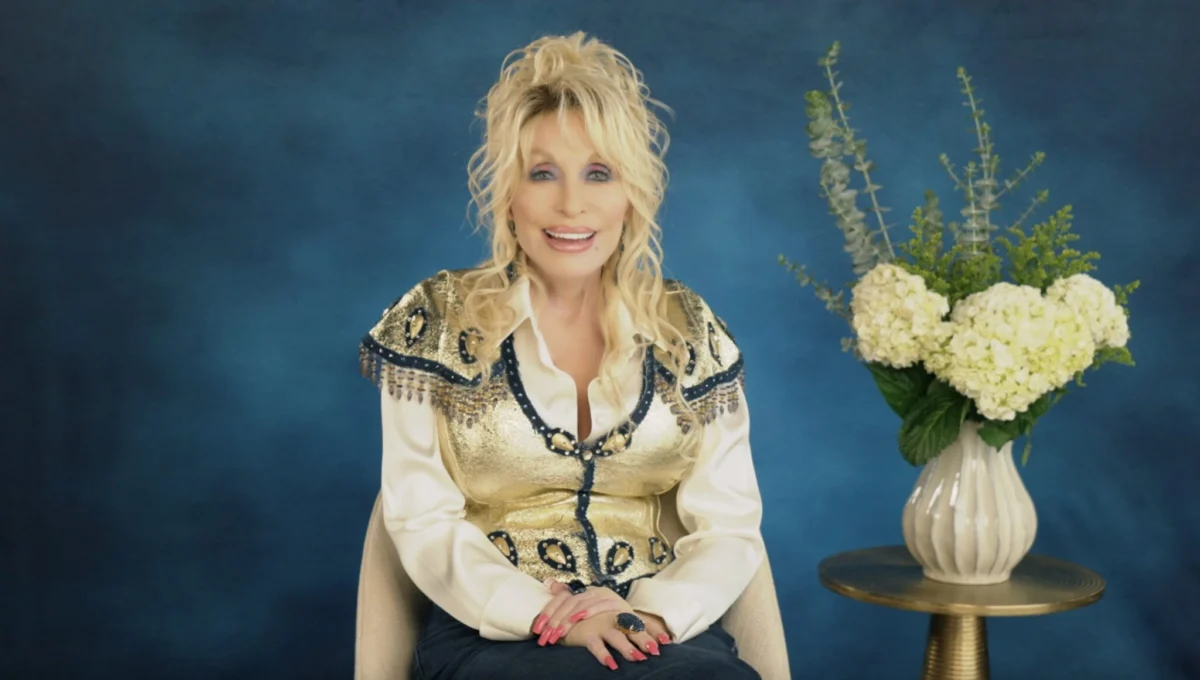
For many in the audience, the announcement of a Lifetime Achievement Award for Dolly Parton—an icon whose influence on American music is as vast as the Smoky Mountains she called home—felt like a formal capstone to a career that had recently drawn to a close with her passing. Yet, as the house lights dimmed and the room fell into a heavy, anticipatory silence, the collective mood shifted from somber reflection to absolute astonishment. A video screen illuminated, and there was Dolly: vibrant, vivacious, and seemingly timeless.
The audience, caught between the reality of her absence and the flickering, high-definition presence of her spirit, let out an audible gasp. It was a moment of profound artistic closure, as the industry gathered to honor a woman who had, in the final months of her life, ensured that her last public words would be one of grace, gratitude, and a love that transcended the physical world.
The Chronology of a Final Performance
The evening’s structure was designed to be a celebration of roots music, but it quickly became an intimate meditation on legacy. The sequence of events on Wednesday underscored the deep interconnectedness of the Americana community.
Following a heartfelt introduction by long-time friend and collaborator Emmylou Harris, the program transitioned into the pre-recorded segment. While the precise date of the filming remains undisclosed, experts and attendees suspect it was recorded during the summer. Seeing the 80-year-old superstar looking so remarkably at ease served as a bittersweet reminder of her enduring spirit.
Following the video, the atmosphere shifted to one of musical reverence. Brandi Carlile, an artist who has frequently cited Parton as a primary influence, took the stage alongside the acclaimed trio I’m With Her. Their rendition of "Coat of Many Colors"—perhaps the most autobiographical and evocative of Parton’s signature anthems—served as a bridge between the generations of storytellers Parton had inspired.
The night was not limited to the Parton tribute, however. The three-and-a-half-hour program acted as a sweeping survey of musical history. Earlier, the evening opened with a thunderous set by Chris Stapleton, who joined surviving members of Tom Petty and the Heartbreakers—Mike Campbell, Benmont Tench, Ron Blair, and Stan Lynch, joined by Steve Ferrone and Scott Thurston—to mark the band’s 50th anniversary. The show concluded with a mass-ensemble finale paying tribute to the late Raul Malo, rounding out an evening defined by both the weight of loss and the endurance of song.
Dolly Parton’s "Musical Renaissance": An Official Perspective
In the video address, Parton’s voice was as clear and melodic as ever, carrying the familiar warmth that defined her public persona. She spoke with specific intent about the trajectory of her later years, reframing her return to roots music not as a retrospective, but as a deliberate evolution.
"Well, hey, it’s Dolly," she began, her trademark humor cutting through the solemnity of the room. "I am so honored to receive the Lifetime Achievement Award from the Americana Music Association. I mean, roots music, or what is now called Americana music, is what I grew up playing back in the Smoky Mountains. It’s that same music that drew me back to East Tennessee back in 1997 to write and record my album Hungry Again."
Parton’s message served as a masterclass in artistic self-awareness. She described the 1997 project as a catalyst, noting, "That project really opened the door to a series of bluegrass and acoustic albums that changed the course of my career in so many ways. Now, new fans discovered these albums, new Americana music communities embraced them, and now, looking back at it all, I see this era of my career as a musical renaissance of sorts."
Her final words to the association were simple yet resonant: "And I want to thank everybody at the AMA for recognizing me with this award. It’s a great honor, truly. And just know that I will always love you."
The Weight of the "Coat of Many Colors"
The choice of "Coat of Many Colors" for the tribute performance was far from accidental. While Parton’s discography is littered with global hits, the song remains the bedrock of her identity. It is a narrative of poverty transformed into pride—a metaphor that defined her transition from a rural upbringing to a global pop-culture phenomenon.
On the red carpet prior to the ceremony, Brandi Carlile expressed the gravity of the honor. "Dolly’s being honored this year, and that makes me feel really good to be able to be there and bear witness to that," she told Variety. For performers like Carlile, the Americana Music Association’s recognition of Parton is not merely about honoring a legend; it is about acknowledging the foundational blueprints Parton provided for those who would follow.
The Americana genre, by its very nature, relies on the preservation of heritage. By honoring Parton, the association solidified her role not just as a country icon, but as an Americana architect—a woman who spent her final years ensuring that the acoustic traditions of the Appalachian Mountains were never lost to the gloss of modern production.
Implications for the Americana Movement
The events at the Ryman have several long-term implications for the music industry. First, the success of the evening highlights the growing stature of the Americana Music Association. By attracting the likes of Chris Stapleton and the remaining Heartbreakers, the event has effectively cemented itself as the premier venue for honoring the intersection of rock, country, and folk.
Second, the posthumous nature of the award ceremony signals a shift in how we handle the "final bow" of aging legends. Rather than a mourning service, the industry is increasingly moving toward integrated tributes that allow the artist’s own voice—recorded in advance—to participate in the celebration. This provides fans and peers with a sense of closure, effectively allowing the artist to "attend" their own final accolades.
Furthermore, Parton’s specific commentary on her "musical renaissance" provides a new framework for music historians to view her late-career output. Rather than viewing her pivot to bluegrass and acoustic music as a niche detour, it is now officially categorized as the most defining era of her creative maturity. The success of these albums, as Parton noted, proved that her appeal was not limited to the radio airwaves of the 70s and 80s but had successfully bridged the gap to the modern, digital-native Americana audience.
A Legacy Etched in Sound
As the curtain fell on the Ryman Auditorium, the lingering sentiment was one of profound gratitude. The Americana Music Honors & Awards successfully navigated the thin line between celebration and eulogy.
Dolly Parton’s life was defined by an uncanny ability to connect with people on an individual level. Whether through the lyrics of a song written in 1971 or a video message recorded in the twilight of her life, she maintained a consistency of character that is rare in the modern entertainment landscape.
The Americana Music Association has done more than just bestow a trophy; they have curated a moment that will be remembered as the definitive farewell to one of the most significant musical figures of the 20th and 21st centuries. For the fans in attendance, and for the global audience watching from home, the image of Dolly—smiling, speaking, and singing—will remain the enduring final chapter of a book that, while closed, will continue to be read for generations to come.
In the words of the legend herself, the music lives on. And as she so famously promised, she will, indeed, always love us.