The legacy of Abel Ferrara’s 1992 neo-noir masterpiece Bad Lieutenant is one of visceral, unflinching moral decay. Anchored by a career-defining performance from Harvey Keitel, the film serves as a brutal meditation on redemption, corruption, and the spiritual bankruptcy of the American police force. When Werner Herzog revisited the concept in 2009 with Bad Lieutenant: Port of Call New Orleans, he infused it with his own idiosyncratic brand of fever-dream nihilism, turning Nicolas Cage’s descent into a surrealist descent into madness.
Now, the mantle has been passed to the prolific Japanese auteur Takashi Miike. However, Bad Lieutenant: Tokyo—a loose reimagining penned by Daisuke Tengan—fails to capture the harrowing gravity of its predecessors. Instead, it offers a paradox: a film that feels simultaneously overstuffed with narrative ambition and entirely devoid of momentum.
The Narrative Architecture: A Study in Stagnation
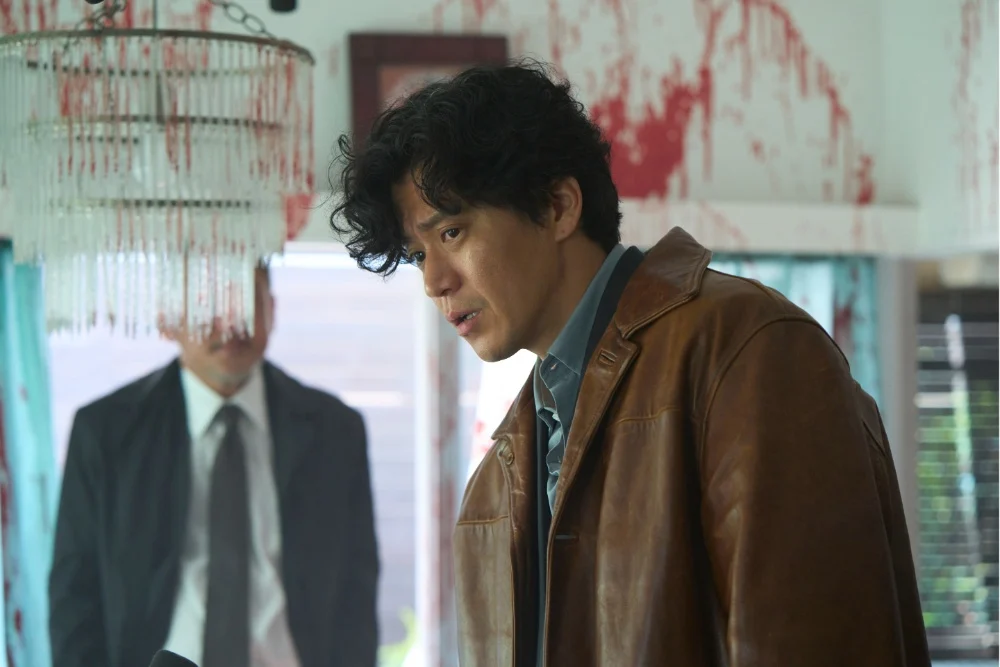
At the heart of Bad Lieutenant: Tokyo is Yabuki (Shun Oguri), a detective whose life is defined by divorce, severe drug dependency, and an utter lack of professional integrity. The film’s opening sequence serves as a jarring thesis statement: Yabuki drops his children off at school, only to snort cocaine in full view of their peers. It is a moment of dark, jarring hilarity that briefly promises a provocative exploration of a man truly beyond the pale.
Yet, this energy is almost immediately extinguished. Shortly after this introduction, Yabuki is summoned to a gruesome crime scene involving a Yakuza member whose body has been contorted into a macabre, unnatural shape. Rather than engaging with the investigation, Yabuki uses his knowledge of the scene to tip off a bookie, hoping to settle his mounting gambling debts.
From this point forward, the film enters a cycle of stop-start storytelling. Subplots are introduced with reckless abandon—gang members released from prison, secret histories tied to orphanages, and the presence of international law enforcement—yet none are allowed to breathe. The screenplay suffers from an inability to prioritize, leading to a 108-minute runtime that feels less like a cohesive narrative and more like a collection of disjointed vignettes stitched together by neon lighting and cigarette smoke.
A Chronology of Disconnect
The film’s pacing is its most significant adversary. The first act, which establishes the foundational stakes, effectively stretches through nearly two-thirds of the movie.
- The Introduction: We meet Yabuki, a man defined by his vices, operating in a Tokyo that feels strangely hollow despite its dense geography.
- The Catalyst: The discovery of the twisted Yakuza body suggests a larger conspiracy, but Yabuki’s passivity ensures that the investigation never gains traction.
- The Arrival of the FBI: Lily James enters the fray as Gwen Birgssen, an FBI agent whose character is undermined by an inconsistent southern drawl and dialogue that frequently crosses the line from noir-tribute into unintentional parody.
- The Secondary Investigation: Birgssen is in Japan hunting for Megan (Liv Morgan), an American culinary student and politician’s daughter. Her integration into Yabuki’s world feels forced, a narrative device designed to inject urgency into a story that refuses to be urgent.
- The Final Act: Only in the final 15 minutes does the film hint at the thematic complexity it should have possessed all along. By then, however, the audience’s investment has been thoroughly depleted by a string of disconnected sequences.
Supporting Data: The Visual and Thematic Void
Takashi Miike is a director renowned for his ability to craft atmosphere—his work on films like Audition and Ichi the Killer demonstrates a mastery of the lurid and the visceral. Yet, Bad Lieutenant: Tokyo feels strangely sterile. Despite being set against the vibrant, chaotic backdrop of Tokyo’s nightlife, the film fails to utilize its setting to create a sense of place.
The scenes are often static. Characters—both Japanese and American—frequently engage in conversations that revolve around their opaque pasts, yet these dialogues rarely result in any meaningful character development. The "meatball" incident, where a vengeful ex-convict turns his victims into ground meat, stands out as the only moment in the film that manages to evoke a genuine visceral reaction.
Furthermore, the investigative aspect of the film is functionally non-existent. Yabuki is not a detective who "solves" crimes; he is a spectator. In both the Yakuza murder case and the disappearance of the American student, the solutions are provided via telephone calls from third parties. Yabuki remains a passive observer, wandering through clubs and interacting with mob bosses, but never taking an active role in the resolution of the film’s central conflicts.
Official Responses and Industry Context
The film has faced significant scrutiny from critics who were expecting a more rigorous engagement with the Bad Lieutenant brand. While the production team has defended the project as an "experimental departure" from the established canon, the consensus remains that the film lacks the spiritual weight required to justify the title.
Industry analysts suggest that the project was hampered by a fundamental disconnect between its Western source material and its Eastern execution. By attempting to marry the grit of the original 1992 classic with a sprawling Yakuza procedural, the film ends up losing the identity of both. The attempt to broaden the scope by adding an FBI perspective—specifically the character of Gwen Birgssen—appears to have been an attempt to appeal to international markets, yet it serves only to clutter the narrative further.
Implications: The Dangers of the "Re-imagining"
The failure of Bad Lieutenant: Tokyo raises broader questions about the current cinematic trend of "re-imagining" established cult classics. When a film relies on the broad strokes of a predecessor—the corrupt cop, the addiction, the neon-lit urban decay—without understanding the thematic core of the original, it risks becoming a hollow shell.
In the original Ferrara film, the "Bad Lieutenant" was a man in the throes of a profound, agonizing spiritual crisis. He was searching for a god that had long since abandoned him. Herzog’s iteration traded this for a nihilistic comedy of errors. Miike’s version, however, avoids both spiritual agony and nihilistic humor, settling instead for a bland, plotless meander.
The implication for future projects is clear: a title as potent as Bad Lieutenant carries a heavy burden of expectation. If a director chooses to adapt it, they must be willing to commit fully to a perspective—whether that is a deep-dive into the human soul or a radical, genre-defying experiment. Attempting to sit in the middle, as Miike has done here, results in a film that is neither a successful homage nor a compelling piece of original art.
Conclusion
Bad Lieutenant: Tokyo is a puzzling entry in Takashi Miike’s vast filmography. It is a film that demands much from its audience—108 minutes of attention—while offering very little in return. It fails to provide the visceral thrill of a crime thriller, the emotional depth of a character study, or the stylistic flair of a true auteur’s vision.
While there are brief, flickering moments of what could have been—a haunting memory of a betrayed partner, a sudden burst of extreme violence, or the occasional sharp-witted line of dialogue—these are not enough to salvage the film. Ultimately, the movie remains a series of loosely interconnected scenes that echo an underdeveloped idea of what a Japanese Bad Lieutenant might look like. It is a missed opportunity, a film that drifts through the neon-lit streets of Tokyo without ever finding a reason to stop, to fight, or to exist.