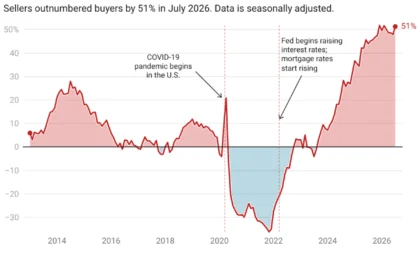
For millions of Americans, the dream of homeownership currently feels like a game of musical chairs where the music has stopped, but no one has a seat. Buyers are sidelined by the dual pressures of stubborn, high-interest rates and elevated home prices, while sellers remain frozen, unwilling to trade their ultra-low pandemic-era mortgage rates for current market realities.
The resulting stagnation—characterized by sluggish sales, frequent price cuts, and a rise in de-listings—has fueled a growing public anxiety. Is the housing market on the brink of a 2008-style collapse? Or is the current malaise merely the growing pains of a necessary economic transition?
According to experts and data analysts, the answer lies not in a "crash," but in a long-term, uneven correction. While the market feels cold, the structural foundation of the U.S. real estate sector remains fundamentally different from the era of the Great Recession.
The Anatomy of a Market: Crash vs. Correction
To understand why economists remain cautiously optimistic, one must first distinguish between a "crash" and a "correction."
A housing market crash is defined by a sudden, violent, and widespread drop in property values. Historically, these events are triggered by external economic shocks—such as speculative lending bubbles, rampant unemployment, or a total collapse in banking liquidity. In such scenarios, forced liquidations (foreclosures) saturate the market, driving prices into a downward spiral that destroys equity for homeowners across the board.
In contrast, a housing market correction is a period of adjustment. It is a slow, often frustrating process where the market "breathes out" after a period of unsustainable growth. We are currently seeing signs of this: price growth has decelerated to a modest 2%, inventory is gradually increasing as "locked-in" homeowners finally decide to sell, and buyers are regaining some leverage in negotiations. This is not a sudden death of the market; it is a recalibration.
A Chronology of the Modern Housing Cycle
To grasp the current environment, we must look at the timeline of the last five years:
- 2020–2021: The Pandemic Frenzy. As remote work became the norm and interest rates hit historic lows, demand surged. Prices climbed at an unprecedented pace, particularly in "Sun Belt" migration hubs like Austin and Nashville.
- 2022–2023: The Inflationary Shock. Faced with record inflation, the Federal Reserve hiked interest rates aggressively. Mortgage rates tripled, effectively ending the buying frenzy and creating a "lock-in" effect for homeowners with 2–3% mortgage rates.
- 2024–2025: The Standstill. The market entered a state of paralysis. Sellers refused to list, fearing they couldn’t afford a new home at 7% rates, and buyers were priced out by the combination of high interest and high home values.
- 2026: The Slow Reset. We are currently in a phase of uneven recovery. While certain overheated markets are experiencing price drops, others (particularly in the Midwest and Northeast) remain resilient due to chronic inventory shortages.
Supporting Data: Why the Foundation Holds
Economists point to several key indicators that distinguish 2026 from the 2008 financial crisis.
1. The Labor Market Resilience
The single most dangerous ingredient for a housing crash is mass unemployment. In the Great Recession, homeowners lost their jobs and, subsequently, their homes. Today, despite concerns regarding AI-driven labor shifts and a cooling tech sector, the job market remains historically stable. As long as the majority of homeowners are employed, the risk of a wave of distressed foreclosures remains low.
2. Stricter Lending Standards
The shadow of 2008 led to the implementation of rigid "Qualified Mortgage" rules. Unlike the subprime era, where borrowers were granted loans with little to no documentation, today’s borrowers have higher credit scores and more equity in their homes. Banks are required to hold significant reserves, making them far more resilient to fluctuations in home values.
3. Supply and Demand Dynamics
While the market is "slow," it is not "over-supplied." A crash requires an excess of inventory that sellers are desperate to offload. Currently, the U.S. still faces a long-term deficit of affordable housing. While inventory is slowly creeping up, it is not reaching the levels of the mid-2000s, preventing the type of price-crushing glut that defines a bubble burst.
Official Perspectives: Insights from Redfin
Daryl Fairweather, Chief Economist at Redfin, suggests that the market is finally moving toward a more sustainable path. "We’re in the middle of an uneven and long-term housing market correction," Fairweather notes. "After the pandemic-era frenzy sent prices soaring, the market needed a reset. What we’re seeing now is not a sudden collapse but a yearslong comedown."
Chen Zhao, Head of Economics Research at Redfin, echoes this sentiment, emphasizing that the fear of a crash is a psychological response to a "seismic shift." "The idea that there’s a crash just around the corner is a narrative that forms whenever the economy goes through a seismic shift," says Zhao. "But today, signs are pointing to a long-term reset: prices are leveling out, wages are climbing, and affordability is slowly improving."
The Commercial Real Estate Divergence
While residential housing remains stable, the Commercial Real Estate (CRE) sector is indeed in a state of crisis. The convergence of the work-from-home revolution and the rise of AI has decimated the demand for traditional office space.
Unlike residential housing, which is supported by a desperate need for shelter, commercial properties are facing structural obsolescence. Office vacancy rates remain at record highs, and the cost of converting these buildings into residential units is often prohibitive due to outdated zoning laws and structural engineering challenges. While this is a significant economic issue, experts argue it is "siloed" within the CRE market and is unlikely to trigger a systemic collapse of the residential home market.
Implications for Buyers and Sellers
For the average American, the current environment demands a shift in strategy.
- For Buyers: The days of bidding wars and "sight-unseen" offers are fading. Buyers now have the space to perform inspections and negotiate concessions. While mortgage rates are high, the cooling of price growth means that some markets are finally becoming accessible to those who were previously priced out.
- For Sellers: The "easy money" period of the pandemic is over. Properties that are overpriced or poorly maintained are lingering on the market, leading to a rise in delistings. Sellers must now be realistic about their listing price and understand that the "hot" market of 2021 is a relic of history.
The Bottom Line
The housing market is currently undergoing a painful, long-term correction. While it is characterized by high costs and economic uncertainty, the data does not support the theory of a looming crash.
As we look toward 2030, the most likely outcome is a return to a "new normal." With wage growth continuing to outpace house price inflation in many regions, the gap between income and housing costs is expected to narrow. The market is not falling apart; it is simply growing up—shedding the volatile highs of the pandemic and slowly maturing into a more balanced, albeit expensive, landscape.
For those waiting for a crash to enter the market, the wait may be in vain. Instead, the focus should shift to the fundamentals: a stable job, a solid credit score, and a realistic expectation of the current, evolving economic reality.