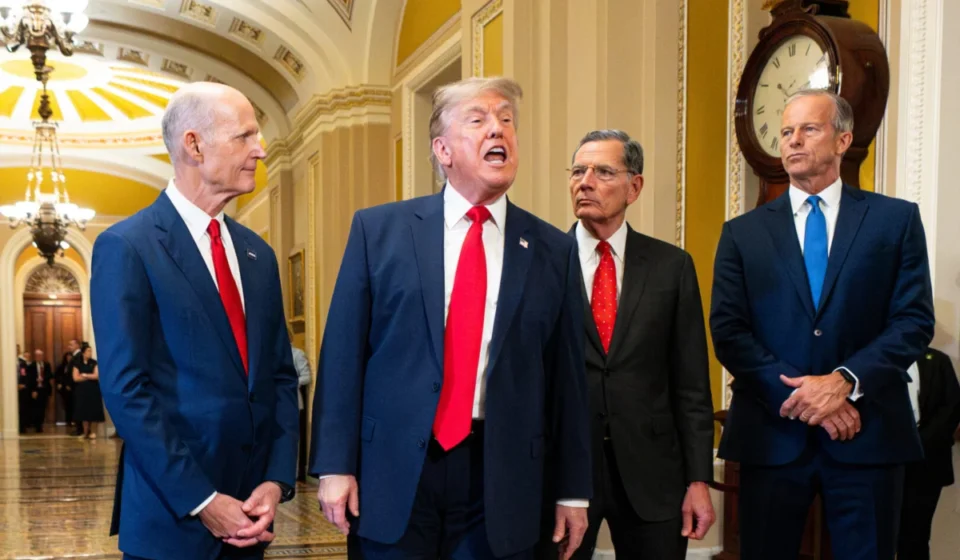

WASHINGTON D.C. – A highly anticipated visit by former President Donald Trump to Capitol Hill on Wednesday, intended to rally Senate Republicans, instead devolved into a fiery clash that torpedoed a rare bipartisan legislative victory and laid bare deep fissures within the party. Trump’s growing anger, fueled by perceived disloyalty and a stalled legislative agenda, dramatically undermined Republican hopes of touting legislative achievements ahead of the summer recess and the upcoming midterm elections.
The day’s events, marked by an abrupt cancellation of a major housing bill signing and a contentious in-person meeting, painted a stark picture of deteriorating communication between the former president and the congressional wing of his party. Republicans, who had been eager to celebrate a bipartisan housing package, found their efforts overshadowed by Trump’s insistence on unwavering loyalty and his singular focus on his "SAVE America Act," a controversial election security and voter ID measure.
The tumultuous visit signals potential further turmoil for a party already navigating complex political terrain. While Trump declared the meeting a "great" success and spoke of party unity, the accounts from numerous senators painted a picture of a combative exchange, leaving many questioning the path forward for the GOP’s legislative agenda and its internal cohesion.
A Capitol Hill Collision Course: Trump’s Unifying Visit Turns Contentious
The stage was set for a day of celebration, with Republicans on Capitol Hill preparing to highlight a significant bipartisan achievement: a sweeping housing package. This legislation, crafted with input from both sides of the aisle, represented a crucial victory, particularly as lawmakers sought to address affordability concerns and present a united front ahead of the midterms. However, the celebratory atmosphere was shattered by an unexpected declaration from Donald Trump, transforming a potential moment of unity into a public display of internal discord.
The Abrupt Cancellation and Mounting Tensions
Hours before he was scheduled to sign the housing package into law from the Capitol, Trump abruptly canceled the event. His reasoning was clear and uncompromising: he would not sign the bill until Congress passed his "SAVE America Act," a measure he unilaterally declared a "National Emergency." This sudden move caught many lawmakers completely off guard, instantly upending a carefully planned victory lap that senators desperately needed to take back to their constituents.
"It was a complete surprise," stated Senator Susan Collins (R-Maine), expressing the widespread sentiment among her colleagues. Collins added, "to try to make this into a political issue is wrong," highlighting the frustration over the political maneuvering impacting a broadly supported bill. The cancellation was not merely a logistical inconvenience; it was a deliberate political maneuver, forcing a wedge into a bipartisan accomplishment and demonstrating Trump’s willingness to leverage legislative victories for his own priorities. It also echoed past instances where Trump had threatened to withhold his signature, though he had not held firm to such threats until Wednesday.
A Stormy Senate Luncheon
The day’s tensions culminated in a Senate GOP lunch, where Trump descended upon the Capitol to meet with Republican senators. The atmosphere inside the closed-door meeting was anything but convivial. Trump, known for his direct and often confrontational style, vented his frustrations on two primary fronts: the recent passage of an Iran war powers resolution, which garnered bipartisan support including from some Republicans, and the continued stall of his "SAVE America Act."
This was not the first time Trump had diverted attention from senators’ legislative agendas to demand unyielding loyalty. His visit underscored a persistent theme of his post-presidency influence: a demand for fealty that often clashes with the pragmatic legislative strategies of congressional Republicans. The communication channels between Trump and the legislative branch had been steadily deteriorating, and Wednesday’s events served as a stark public manifestation of this growing chasm.
The Iran Resolution Rift
A significant point of contention was the Iran war powers resolution, which had recently passed the Senate with the help of a few Republicans. The resolution aimed to halt any further military action against Iran not explicitly authorized by Congress, reflecting a desire among some lawmakers to reassert congressional authority over declarations of war. Trump, however, viewed this as a betrayal and an undermining of his administration’s foreign policy efforts, particularly amid ongoing, sensitive negotiations.
During the lunch, Trump directly challenged the senators, asking how anyone could vote for the resolution. This question led to a heated exchange with Senator Bill Cassidy (R-La.), who had been primaried out of his seat with Trump’s endorsement. Cassidy, known for his independent streak, directly confronted the former president, asking if his question was "rhetorical."
Cassidy Stands His Ground
Senator Cassidy recounted the exchange to reporters afterward, emphasizing the lack of transparency from the administration regarding the ongoing peace deal with Iran. "Well, we’ve not been briefed on how it’s going," Cassidy stated, summarizing his attempt to elicit more information. "At which point I think the president said something negative about me." The situation quickly escalated, with Cassidy later revealing that Trump "threw his primary loss in his face: ‘You lost the election,’ that sort of thing.”
Cassidy, undeterred, defended his position, stating, "I’m not going to be bullied when I feel like I’m asking a question the American people need to know. It began to escalate.” His defiance highlighted a growing willingness among some Republicans to push back against Trump’s demands, even at the risk of political repercussions. Despite the confrontation, Cassidy described the moment as "gratifying," noting that "several senators came up afterwards, very encouraging," suggesting an undercurrent of support for his stance within the caucus.
Divided Reactions from GOP Senators
Other senators present offered varying accounts of the dramatic luncheon. Senator Tommy Tuberville (R-Ala.), a staunch Trump ally, described the scene on Fox News as Trump "calling people out." Tuberville defended Trump’s actions, asserting, "But people need to be called out if you’re not going to vote for this country." He echoed Trump’s frustration with the timing of the war powers vote, arguing it weakened the U.S. negotiating position: "The Iranians see what’s going on, so what’s going on? Your Senate just passed ‘no war against Iran’ right in the middle of negotiations."
Senate Steering Committee Chairman Rick Scott (R-Fla.), who had extended the invitation to Trump, described the former president as "disappointed" in those Republicans who voted for the resolution. Senator Jim Justice (R-W.Va.) offered a more tempered assessment of the Cassidy-Trump exchange, describing it as "not super combative, but very passionate. Very passionate."
Despite Trump’s insistence on party unity at the conclusion of the meeting, his actions and rhetoric contradicted this message. Senator John Cornyn (R-Texas), another senator who Trump had successfully primaried out of his seat, observed that Trump "closed by preaching unity. But he spent the entire hour talking about things which were not exactly unifying." Senator Kevin Cramer (R-N.D.) summed up the sentiment of many: "I think everybody walked out with the very same opinion they had before he came in. But you know, but we heard him out."
The Stalemate Over SAVE America Act
Beyond the immediate confrontations, the central theme of Trump’s visit and his primary demand remained the passage of the "SAVE America Act." This marquee voter ID bill, a cornerstone of his post-presidency political agenda, has become a persistent thorn in the side of Senate Majority Leader John Thune and a symbol of the legislative challenges facing the GOP.
Trump’s Unwavering Demand
Trump’s passion for the "SAVE America Act" was palpable during the luncheon. He pressed senators relentlessly on how to get the bill signed into law, portraying it as essential for election integrity. The bill’s core provisions would mandate that voters prove citizenship to register and present photo identification at the polls – measures that proponents argue are necessary to prevent voter fraud and ensure secure elections.
However, Democrats vehemently oppose the bill, arguing it constitutes voter suppression and disproportionately impacts minority groups and low-income individuals who may struggle to obtain required documentation. Crucially, a handful of Republicans also harbor reservations about the bill’s feasibility and potential impact, further complicating its path.
Legislative Roadblocks and Realities
The "SAVE America Act" faces an uphill battle in the Senate due to the chamber’s stringent procedural rules. It has little to no chance of overcoming the 60-vote cloture threshold required to advance most legislation. This procedural hurdle, often referred to as the legislative filibuster, allows a minority of senators to block a bill from coming to a final vote. Trump, in his characteristic style, has expressed a willingness to "blow up the filibuster" to pass the bill, a radical proposal that has consistently met resistance from within his own party.
The complexities of Senate procedure were a recurring theme in discussions. Majority Leader John Thune (R-S.D.) has repeatedly conveyed to Trump that the legislation simply does not have the votes to pass. Furthermore, his members are not willing to abolish the legislative filibuster, a move that would fundamentally alter the character of the Senate and could backfire on Republicans when they are in the minority. Senator Cramer acknowledged, "I can’t say it was surprising… He’s strongly committed to the Save America Act, and blowing up the filibuster."
Leadership’s Dilemma
Thune’s "math problem"—the inability to secure 60 votes—was a message reiterated by several attendees during the luncheon. Despite Trump’s forceful demands, the legislative realities of the Senate remain. Senator Rick Scott, while conveying options to Trump, acknowledged the practical limitations. These options included forcing Democrats through a "talking filibuster" (where senators must continuously speak to delay a vote), attempting to break the legislation into smaller, more palatable pieces, or exploring a "reconciliation package."
However, the reconciliation process, which allows certain budget-related legislation to pass with a simple majority, is also fraught with challenges. Under the Senate’s "Byrd Bath" rule, reconciliation provisions must have a direct budgetary impact that is not "merely incidental" to the larger purpose of the measure. Many senators view using reconciliation for election security as a nonstarter, as its primary purpose is clearly policy-oriented, not budgetary. The Senate had already largely abandoned an extended debate on the legislation last month after it yielded lackluster floor time, further underscoring the lack of a viable path forward. Senator Scott, a former businessman, pragmatically stated, "I’m a business guy. You have to live in reality."
Housing Package Held Hostage
Trump’s decision to hold the bipartisan housing package hostage to his "SAVE America Act" created immediate political fallout, overshadowing a legislative success that both parties had hoped to leverage.
A Bipartisan Victory Derailed
The housing package represented a significant legislative achievement, garnering support from across the political spectrum. Both parties intended to use it as a cornerstone of their midterm messaging, highlighting efforts to address the critical issue of housing affordability. The bill was designed to benefit a wide range of Americans, from first-time homebuyers to renters, seniors, and expanding families, making its sudden cancellation particularly frustrating for lawmakers.
The dramatic dismantling of the stage prepared for the signing event in Statutory Hall across the Capitol served as a visual metaphor for the derailed victory. Rep. Suhas Subramanyam (D-Va.) posted a video showing the stage being taken apart, lamenting, "It was gonna be one of the best things we could do on lowering costs but then he canceled it at the last minute because he wanted some MAGA stuff to happen instead. Instead, we have a bunch of empty chairs here."
Political Fallout and Democratic Backlash
Democrats were quick to seize on Trump’s actions, portraying him as indifferent to a pressing national concern. Senator Elizabeth Warren (D-Mass.), a key architect of the housing bill, passionately described the situation as a "housing crisis." She emphasized the broad benefits of the legislation: "It’s good for urban America, rural America, first-time homebuyers, renters, seniors, families that are expanding. It’s a bill about doing good things, and Donald Trump says he just doesn’t care."
House Minority Whip Katherine M. Clark (D-Mass.) highlighted the procedural options available, noting that Speaker Mike Johnson could formally present the bill to the president at any time, initiating a 10-day clock (excluding Sundays) for Trump to act. If Trump leaves it unsigned, the bill could still become law without his signature. "Mike Johnson could, right now, at any time, formally present this bill to the president and make the president choose: Will he veto it or will it become law in 10 days?" Clark challenged.
While Senator Tuberville supported Trump’s move as creating "leverage," the political cost was evident. Democrats were eager to contrast their focus on tangible solutions to everyday problems with what they depicted as Trump’s self-serving political demands.
The Bill’s Uncertain Future
As of Wednesday, Trump had not explicitly stated he would veto the housing bill, leaving its ultimate fate in limbo. The 10-day clock mechanism provides a path for the bill to become law even without his active signature, but the political drama surrounding it has significantly dampened its intended impact. The incident transformed what was meant to be a moment of bipartisan collaboration and legislative success into another flashpoint in the ongoing battle for political dominance and ideological purity within the Republican party.
Implications for a Fractured Party and Future Agenda
Wednesday’s blowup signals a potentially turbulent path ahead for Republican senators as they attempt to advance their legislative agenda and present a cohesive front in the lead-up to the fall midterms. The visit laid bare the deep-seated tensions between Trump’s uncompromising demands and the practical realities of governing in a divided Congress.
Unity Preached, Division Sown
Despite Trump’s closing remarks about "unity" and his assertion that he "doesn’t like a few people. That’s OK," the immediate aftermath of his visit painted a different picture. His public grievances, particularly against those who voted for the Iran resolution, and his unyielding stance on the "SAVE America Act" clearly sowed division rather than fostering cohesion. The episode underscored a critical challenge for the Republican Party: how to reconcile the former president’s powerful influence with the need for legislative effectiveness and internal harmony.
Midterm Messaging and Legislative Hurdles
The disruption of the housing package signing also has significant implications for midterm messaging. Both parties had hoped to campaign on tangible legislative achievements addressing affordability. Trump’s actions have inadvertently provided Democrats with potent talking points, allowing them to portray him and, by extension, parts of the GOP, as indifferent to the economic concerns of ordinary Americans.
Looking ahead, the incident suggests that achieving bipartisan legislative success, already a rarity, will become even more challenging if Trump continues to exert such direct and uncompromising pressure. Senators face a delicate balancing act: demonstrating loyalty to the party’s de facto leader while also fulfilling their responsibilities as legislators and appealing to a broader electorate.
The Ongoing Power Dynamic
Ultimately, Wednesday’s events highlighted the enduring and often disruptive power dynamic within the modern Republican Party. Trump’s continued influence, even out of office, remains a potent force that can unilaterally derail legislative efforts and expose internal fractures. As Senator Cramer noted, despite the contentious meeting, "everybody walked out with the very same opinion they had before he came in." This suggests that while Trump may stir the pot, he may not be fundamentally altering the underlying political calculus of many senators, leaving the party in a state of perpetual tension between allegiance and legislative pragmatism. The question remains whether the party can navigate these internal divisions to achieve its broader political objectives, or if such public clashes will continue to define its trajectory.
Jacob Fulton, Ariel Cohen, and Mark Schoeff Jr. contributed to this report.