
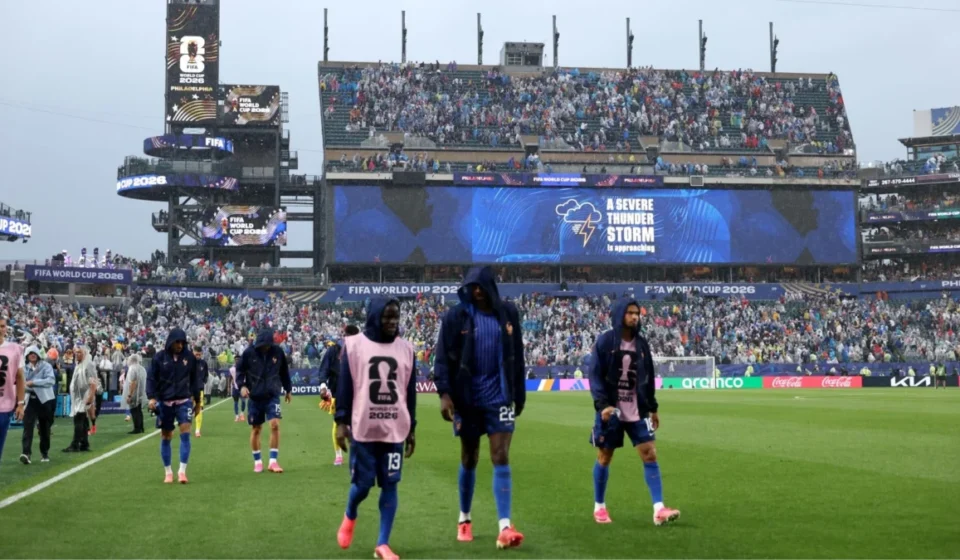
Storms Over Lincoln Financial: World Cup Match Between France and Iraq Halted by Severe Weather

PHILADELPHIA — The 2026 FIFA World Cup, a tournament designed to showcase the pinnacle of global football in the heat of an American summer, faced its most significant logistical challenge to date on Sunday. A high-stakes Group Stage clash between defending powerhouse France and the resilient squad from Iraq was abruptly suspended at Lincoln Financial Field, as severe weather conditions forced officials to prioritize player and spectator safety over the flow of the game.
With France holding a narrow 1-0 lead thanks to a clinical strike from superstar Kylian Mbappé, the halftime whistle signaled the start of an unexpected and lengthy intermission. What was intended to be a standard 15-minute break turned into a grueling two-hour and 11-minute wait as a line of volatile thunderstorms, characterized by heavy rainfall and dangerous lightning, descended upon Philadelphia.
The Chronology of the Stoppage
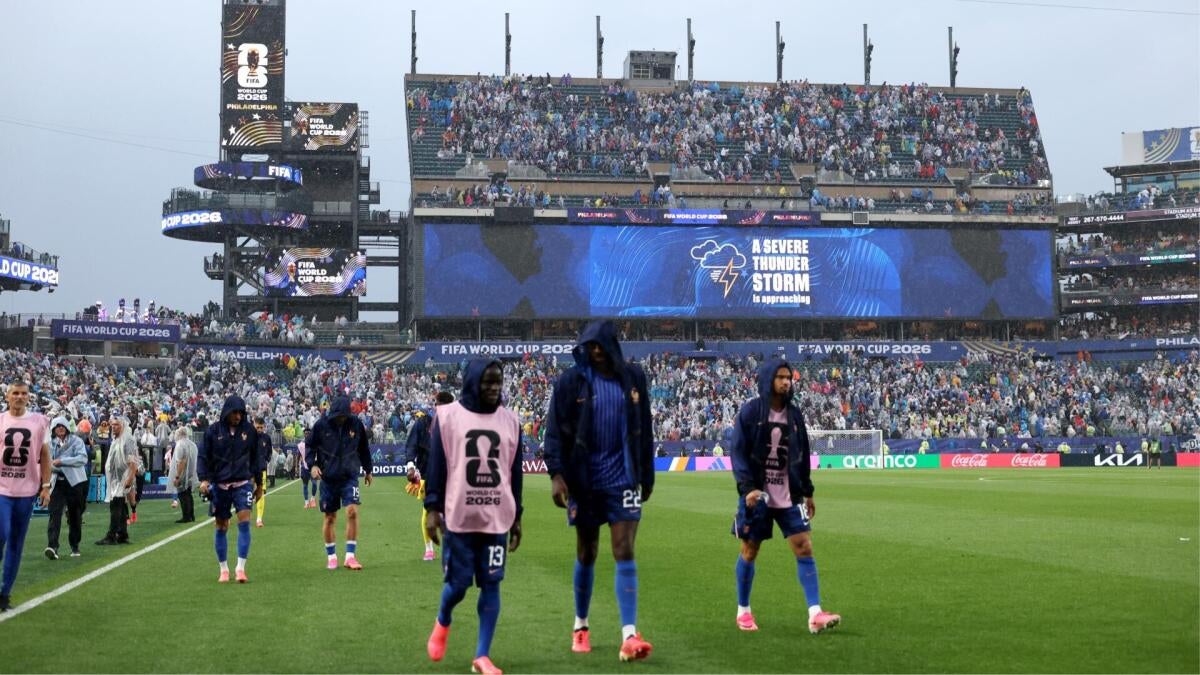
The disruption began at 5:49 p.m. ET. As the halftime whistle blew, the atmosphere inside the stadium shifted from electric anticipation to tactical uncertainty. FIFA officials, acting in accordance with established safety protocols, signaled that the second half would be postponed indefinitely.
For the thousands of fans in attendance, the experience was one of sudden displacement. Safety personnel instructed the bowl of the stadium to be cleared, prompting a mass exodus of spectators into the concourses and covered areas of the venue. The scene was one of orderly chaos, with supporters from both nations huddling together to escape the deluge.
The delay was not a mere inconvenience but a calculated adherence to weather safety mandates. FIFA’s official announcement indicated an initial 30-minute hold, but as atmospheric data showed persistent lightning strikes in the vicinity, the wait time began to compound. It wasn’t until just after 8:00 p.m. ET that officials finally cleared the teams to return to the pitch. Even then, the logistical hurdles remained, as players—having sat idle for over two hours—required an abbreviated warm-up period to prevent injury before the match could officially resume.
Understanding the Lightning Protocol
The decision to pause the match was dictated by strict FIFA safety guidelines designed specifically for open-air venues. The core of these regulations is the "eight-mile rule."
If lightning is detected within an eight-mile radius of the stadium, the game must be immediately suspended for a minimum of 30 minutes. The critical aspect of this protocol is the "reset" mechanism: every time a new strike is recorded within that eight-mile danger zone, the 30-minute clock restarts. This creates a psychological and physical "wait-and-see" game that can stretch on indefinitely, as was the case in Philadelphia.
This rigorous adherence to safety reflects a shift in modern sports management. Historically, football culture often dictated that the "show must go on," regardless of conditions. For instance, the 1974 World Cup semifinal between West Germany and Poland remains a legendary example of a match played under near-impossible conditions. Played at the Waldstadion, the field was transformed into a waterlogged swamp due to monsoon-like rains. While that game was delayed by only 30 minutes, it was played in a way that would be considered a major liability risk by today’s standards. The 2026 iteration of the tournament, by contrast, prioritizes the health of the athletes above the traditional "mud-battle" aesthetic.
Official Responses and FIFA’s Stance
In the immediate aftermath of the suspension, FIFA released a formal statement to address the mounting frustrations of fans and the global viewing audience. The statement read:
"Due to adverse weather conditions in Philadelphia, including the risk of lightning in the vicinity of the stadium, the FIFA World Cup match between France and Iraq has been suspended. A 30-minute break has been announced; however, this situation is still being observed to determine if further delays occur. FIFA will follow the safety protocols established by the local authorities, and the match will resume as soon as it is safe to do so. The safety and security of all individuals is FIFA’s priority. We thank all fans for their understanding and cooperation."
This statement highlights the complex intersection of sports governance and local municipal oversight. During major international events, FIFA must coordinate with local meteorological services and emergency management teams. The delay in Philadelphia was not merely a FIFA decision but a reflection of the city’s broader emergency management strategy regarding severe weather in crowded outdoor venues.
A Growing Trend: Weather in the 2026 World Cup
The delay in Philadelphia is not an isolated incident in the context of recent high-level football matches held in the United States. During the lead-up to the 2026 tournament, specifically during the Club World Cup, fans witnessed several weather-related interruptions.
One notable instance involved a high-profile matchup between Chelsea and Benfica. That encounter was halted for an hour and 53 minutes. Because that match was stopped in the 86th minute, the players faced the daunting prospect of finishing a high-intensity game after sitting idle for nearly two hours. The match eventually bled into extra time, with the total duration from kickoff to the final whistle exceeding four hours.
These precedents underscore a significant reality for the 2026 World Cup: playing a tournament in the American summer, particularly in regions prone to humidity and afternoon convective storms, creates an inherent volatility. The use of open-air stadiums, while providing an iconic atmosphere, leaves the tournament schedule vulnerable to the unpredictable nature of the climate.

Implications for the Remainder of the Tournament
The delay has immediate implications for the teams involved and the broader tournament structure. For France, a team built on rhythm and high-intensity pressing, the long layoff can be disruptive. Players must manage their muscle temperature and mental focus, which can lead to a sluggish start when the game finally resumes. Conversely, the delay can serve as a tactical reset for an underdog like Iraq, allowing coaching staff to adjust their defensive schemes based on the first half’s tactical developments.
Beyond the specific match, the Philadelphia delay serves as a warning for tournament organizers. With dozens of games left to play across various climate zones, FIFA’s ability to manage scheduling "compression" will be tested. If multiple matches are delayed in a single day, the broadcast schedule, travel logistics for teams, and the recovery time for players will all be impacted.
Furthermore, the fan experience is being reshaped. For supporters who have spent thousands of dollars to attend these matches, the uncertainty of a weather delay adds a layer of stress. The requirement to evacuate the stands into crowded concourses tests the infrastructure of even the most modern stadiums.
Conclusion: The New Reality of International Football
As the 2026 World Cup progresses, the events in Philadelphia will likely be viewed as a turning point in how tournament organizers approach environmental safety. The tension between maintaining a professional athletic schedule and ensuring the absolute safety of thousands in an era of more extreme, unpredictable weather patterns is a challenge that will persist.
For now, the world waits for the final whistle in Philadelphia. Kylian Mbappé’s goal remains the sole difference on the scoreboard, but the real story of the day has been the battle between the world’s elite athletes and the atmospheric forces of the American East Coast. As the sport continues to grow, it is becoming increasingly clear that the pitch is not just a stage for skill, but a place where the environment itself dictates the terms of the game.
As the skies over Lincoln Financial Field finally begin to clear, the players head back onto the pitch, ready to finish what they started. The 2026 World Cup continues, proving that even in the most tightly controlled sporting environments, Mother Nature remains the ultimate referee.