
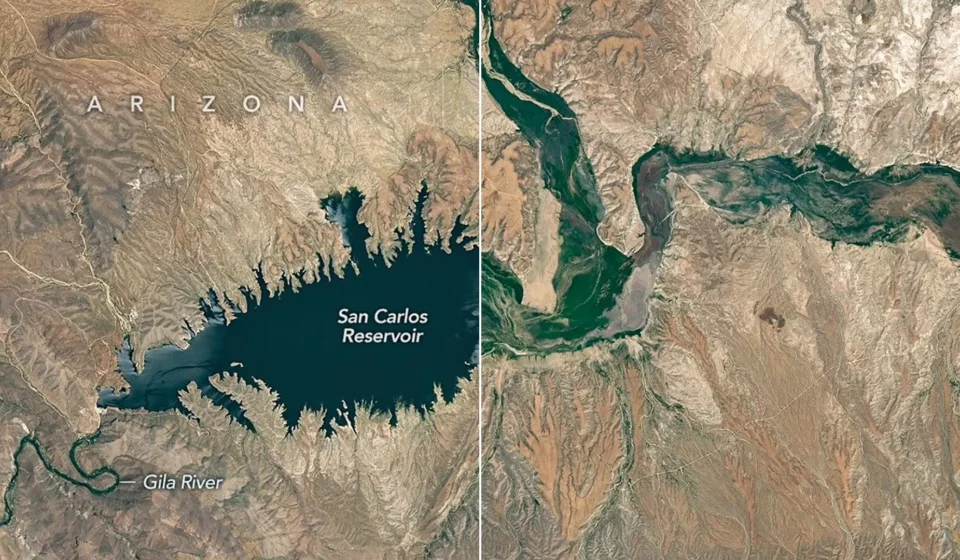

The Gila River serves as the lifeblood of the American Southwest, a serpentine artery that bridges the stark, snow-dusted peaks of southwestern New Mexico with the sun-scorched desert expanses of Arizona. For generations, this waterway has sustained agricultural empires, thriving tribal communities, and a fragile desert ecosystem. However, in 2026, the Gila became the site of a profound ecological collapse, as the San Carlos Reservoir—one of Arizona’s most vital storage facilities—withered to less than one percent of its capacity.
The crisis, fueled by a catastrophic failure of winter snowpack, has transformed a once-vibrant aquatic hub into a desiccated basin, sparking environmental alarms and forcing the indefinite closure of a primary recreational and economic engine for the region.
The Chronology of a Collapse
The seeds of the 2026 crisis were sown long before the first signs of decay appeared on the shoreline. In a healthy year, the Mogollon Mountains and the Black Range act as a natural water tower, collecting winter snow that feeds the Gila’s spring runoff. This seasonal pulse is essential for the San Carlos Reservoir, created by the historic Coolidge Dam. When the reservoir is full, it ranks among the largest bodies of water in Arizona, serving as a critical buffer against the volatility of the desert climate.
However, the winter of 2025–2026 provided no such reprieve. By March 2026, the snowpack in the Gila River watershed had plummeted to a staggering 2 percent of the 1991–2020 median. The absence of this frozen reservoir meant that when the spring thaw arrived, the mountains remained dry. By April, streamflow levels had struggled to reach even 39 percent of the historical average.
As the calendar turned toward the summer months, the pressure on the system intensified. With downstream agricultural commitments requiring steady water releases, the reservoir was drained from both ends: negligible inflows from the mountains and high outflows to farms. By June, the situation had reached a breaking point. The reservoir, which had held roughly 60 percent of its capacity just three years prior in June 2023, was reduced to a mere 389 acre-feet of water—a puddle in an expansive desert landscape.
Supporting Data: A Visual and Statistical Catastrophe
The degradation of the San Carlos Reservoir is perhaps best captured through the lens of satellite imagery. Comparison studies utilizing Landsat data provide a stark visual narrative: the June 2023 images reveal a healthy, blue-hued reservoir cradled by verdant shorelines of cottonwood, willow, and tamarisk. By May 22, 2026, that same landscape had been stripped of its luster. The water had receded so dramatically that the lakebed lay exposed, revealing nothing but dry silt, mud, and the struggling remains of riparian vegetation.
Hydrological data confirms the severity of this shift. An acre-foot is typically enough to supply a household for a year; to have the entire reservoir system drop to 389 acre-feet is to effectively render a massive engineering project useless. The disappearance of the water column led directly to a catastrophic environmental chain reaction: as the volume of water shrank, the remaining liquid became increasingly stagnant and warm.
The drop in water level caused a plummet in dissolved oxygen levels, triggering widespread hypoxia. This oxygen-deprived environment proved lethal for the reservoir’s inhabitants. Largemouth bass, black crappie, bluegill, and various catfish species—both native and stocked—began to die in mass quantities. The loss also extended to recreational favorites, including rainbow and brown trout, effectively wiping out the reservoir’s established aquatic population in a matter of weeks.
Official Responses and Public Health Warnings
The response from regional authorities was swift and necessarily drastic. On June 5, 2026, the San Carlos Recreation and Wildlife Department announced the indefinite closure of the reservoir. The decision was twofold: first, to protect the public from the biological hazards of the massive fish kill, and second, to acknowledge the lack of any viable recreational activity in a dry basin.
Officials issued stern warnings to the public, emphasizing that the decomposition of millions of fish posed a significant health risk. Pathogens thriving in the stagnant, warm pools could lead to outbreaks of waterborne illness, while the sheer stench and decay made the shoreline a hazardous environment for any would-be anglers or boaters. The closure acts as a grim acknowledgment that the ecosystem has shifted from a place of life to a site of environmental recovery.
A Legacy of Drought: The Historical Context
While the 2026 crisis is profound, it is not an anomaly in the context of the American Southwest’s volatile history. Since the Coolidge Dam was completed in 1930, the San Carlos Reservoir has run completely dry at least 20 times. The region is no stranger to the irony of its own geography; indeed, the history of the reservoir is marked by moments of biting humor amidst disaster.
During the original dedication ceremony for the dam, conditions were so parched that the lakebed was already covered in grass. The famous American humorist Will Rogers, present at the event, famously quipped to President Calvin Coolidge, "If that was my lake, I’d mow it."
Furthermore, mass mortality events for fish are part of a repeating, painful cycle. A massive kill in 1976 claimed an estimated 5 million fish, and it took five years of careful management and favorable weather for the ecosystem to return to a state of equilibrium. Another significant event occurred in 2018, serving as a precursor to the current catastrophe. These historical markers illustrate a pattern of instability that suggests the current drought is not a one-time event, but rather a recurring structural reality of managing water in a warming, arid climate.
Implications: The Future of the Gila River
The implications of this event extend far beyond the immediate loss of fish and recreation. The Gila River’s headwaters, currently tracked by the U.S. Drought Monitor, remain locked in a cycle of severe drought. The lack of mountain runoff has forced a re-evaluation of how water is allocated between tribal, agricultural, and municipal interests.
As the region moves deeper into the summer, the question becomes one of survival for the local ecosystem. Can the reservoir recover as it did in the late 1970s? The answer lies in the atmospheric patterns of the coming season. NOAA’s seasonal monsoon outlook for mid-2026 offered a glimmer of hope, estimating a 33 to 50 percent chance of above-average rainfall. Additionally, the strengthening of El Niño conditions in the equatorial Pacific—a phenomenon historically associated with increased precipitation in the Southwest—could provide the relief the basin so desperately needs.
However, relying on the weather is an increasingly precarious strategy. The 2026 crisis serves as a stark reminder that the water infrastructure of the Southwest was built for a climate that may no longer exist. As communities, farmers, and wildlife managers look to the sky for rain, they are also forced to confront a future defined by the "new normal" of water scarcity. Whether the San Carlos Reservoir can regain its former status or if it will become a symbol of the permanent desertification of the region remains the defining question for the Gila River basin.
For now, the gates remain closed, the lakebed remains dry, and the residents of the Southwest wait to see if the monsoon will provide the grace needed to bring this landscape back to life.