The ground beneath Southern California, often perceived as solid and stable, acts as a pressurized vessel of kinetic energy. According to a groundbreaking study published in the Journal of Geophysical Research: Solid Earth, the tectonic stress accumulated within two of the region’s most significant fault systems—the San Andreas and the San Jacinto—has reached levels unseen in the past millennium. This discovery, centered on the geologically volatile Cajon Pass, suggests that the region is primed for a seismic event of potentially historic proportions.
Led by Dr. Liliane Burkhard of the University of Bern’s Physics Institute, an international team of scientists has utilized advanced, four-dimensional modeling to peer into the past and predict the precarious future of the California crust. Their findings introduce a new conceptual framework for understanding how massive earthquakes propagate, warning that the "earthquake gate" at Cajon Pass may be on the verge of swinging open.
Main Facts: The Pressure Cooker of Southern California
Earthquakes are the Earth’s way of balancing a checkbook of tectonic debt. As massive tectonic plates grind against one another, they do not slide smoothly; they catch, lock, and accumulate elastic strain energy over decades, centuries, and sometimes millennia. When the friction is finally overcome, the sudden release of this energy creates the violent ruptures we recognize as earthquakes.
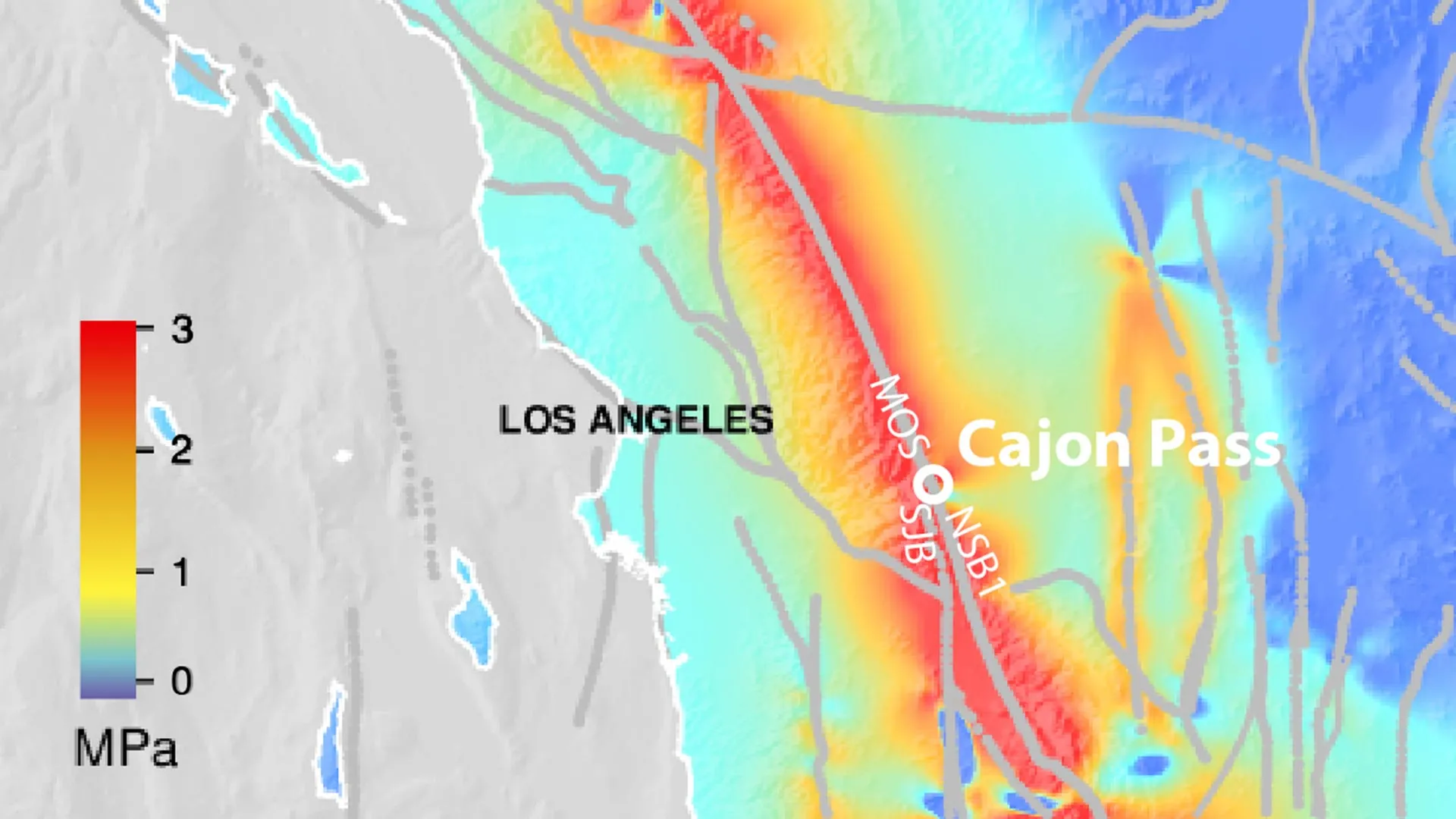
In Southern California, the San Andreas and San Jacinto fault systems are the primary conduits for this tectonic motion. North and east of Los Angeles, these two colossal structures converge at Cajon Pass—a narrow, geologically complex corridor that acts as a junction point. The primary concern for geologists has long been the "quiet period" following the massive 7.9-magnitude Fort Tejon earthquake of 1857. This unusually long stretch of relative dormancy has allowed stress to build to levels that exceed any recorded in the last 1,000 years.
The study indicates that stress has reached 3.6 MPa (megapascals) on the San Jacinto-Bernardino section and 2.8 MPa on the Mojave South section of the San Andreas. Individually, these numbers are high; collectively, they represent a systemic vulnerability that could allow a rupture to "jump" from one fault to another, resulting in a multi-fault, high-magnitude disaster.
Chronology of a Thousand Years
To arrive at these findings, Dr. Burkhard’s team did not rely on modern seismology alone. They reconstructed a 1,000-year history of the region’s seismic activity, integrating radiocarbon dating of soil samples, dendrochronology (tree ring analysis), and historical records of ground surface ruptures.
By feeding this millennial data into a physics-based 4D earthquake cycle model, the team simulated how stress is distributed, transferred, and dissipated over time. The model accounts for the "relaxation" of deeper crustal layers, which occurs long after a major earthquake, providing a continuous view of how energy fluctuates in the subsurface.
The historical record utilized by the researchers highlights the erratic nature of these faults. For instance:
- 1812 (The Wrightwood Event): An earthquake that successfully breached the Cajon Pass junction, propagating through both the San Andreas and San Jacinto systems simultaneously.
- 1857 (The Fort Tejon Event): A massive rupture that, while devastating, remained confined to a single system, effectively stopping at the "gate" of Cajon Pass.
The new model suggests that these disparate outcomes are not merely matters of chance but are dictated by the specific stress configuration present at the time of the rupture.
Supporting Data: The Physics of the "Earthquake Gate"
The core innovation of the research is the definition of Cajon Pass as an "earthquake gate." Rather than viewing the pass as a static geographic feature, the team characterizes it as a dynamic junction that responds to the internal stress states of the surrounding faults.
"Cajon Pass doesn’t simply block or channel earthquakes," Dr. Burkhard explains. "It responds to stress conditions, and those conditions change over centuries."
The study identifies a critical threshold for multi-fault ruptures: the parity of stress levels between the two systems. When the San Andreas and the San Jacinto faults are loaded with similarly high levels of stress, the mechanical barriers at the junction are significantly weakened. This creates a "favorable" environment for a rupture to propagate from one fault to the other.
Current data shows that both the San Jacinto-Bernardino section and the Mojave South section are currently in a state of high-stress equilibrium. This specific configuration has, in the past, acted as a precursor to large-scale, multi-fault events. The researchers are careful to emphasize that while the conditions for such an event are present, the model is not a crystal ball for temporal prediction.
Official Responses and Scientific Context
The research team, which included experts from the University of Hawai‘i at Mānoa, the U.S. Geological Survey (USGS) Earthquake Science Center, and the Scripps Institution of Oceanography, has received significant attention from the global scientific community.
Dr. Burkhard’s team maintains that their work is intended for hazard assessment and infrastructure planning rather than alarmism. "The study is not a prediction of when an earthquake will occur," she reiterated. "What we can say is that the system is critically stressed and that physics-based models like ours give a clearer picture of the range of scenarios we should be prepared for."
The USGS has long identified the Southern San Andreas Fault as the most likely source of a "Big One" in Southern California. By quantifying the stress levels at the Cajon Pass junction, this study provides urban planners with a more refined understanding of potential rupture scenarios, allowing for more precise modeling of ground motion and structural impacts in the event of a simultaneous multi-fault rupture.
Implications: A Looming Regional Challenge
The potential for a multi-fault rupture is not merely a theoretical concern for geologists; it carries massive implications for the millions of people living in the Southern California basin. A rupture that spans both the San Andreas and San Jacinto systems would produce a seismic event with significantly longer duration and a wider geographical footprint than a single-fault rupture.
Infrastructure and Urban Density
The Cajon Pass is a critical artery for the region. It hosts major interstate highways, high-voltage power lines, fiber-optic communication cables, and vital rail lines that connect the ports of Los Angeles and Long Beach to the rest of the nation. A major earthquake centered here could sever these lifelines, paralyzing supply chains and complicating emergency response efforts.
Societal Preparedness
The implications extend to the densely populated urban centers of the Inland Empire, San Bernardino, Riverside, and the Coachella Valley. These regions have seen explosive growth in the decades since the last major seismic activity, increasing the number of structures and people potentially at risk.
For emergency managers, the "earthquake gate" findings serve as a reminder that the current standard for disaster preparedness—which often assumes single-fault scenarios—may be insufficient.
Global Applicability
Finally, the framework developed by the University of Bern team is not limited to California. The concept of "earthquake gates" can be applied to complex fault junctions in other high-risk zones, such as the North Anatolian Fault in Turkey or the Alpine Fault in New Zealand. By providing a physics-based methodology to assess how these junctions behave, the study offers a new tool for global seismic hazard mitigation.
In conclusion, while the Earth remains stubbornly unpredictable, the work of Dr. Burkhard and her colleagues has brought us closer to understanding the mechanical triggers of the next great earthquake. The "gate" at Cajon Pass is closed for now, but the pressure behind it is mounting, serving as a stark reminder of the necessity for continued vigilance and robust, science-led disaster preparedness.