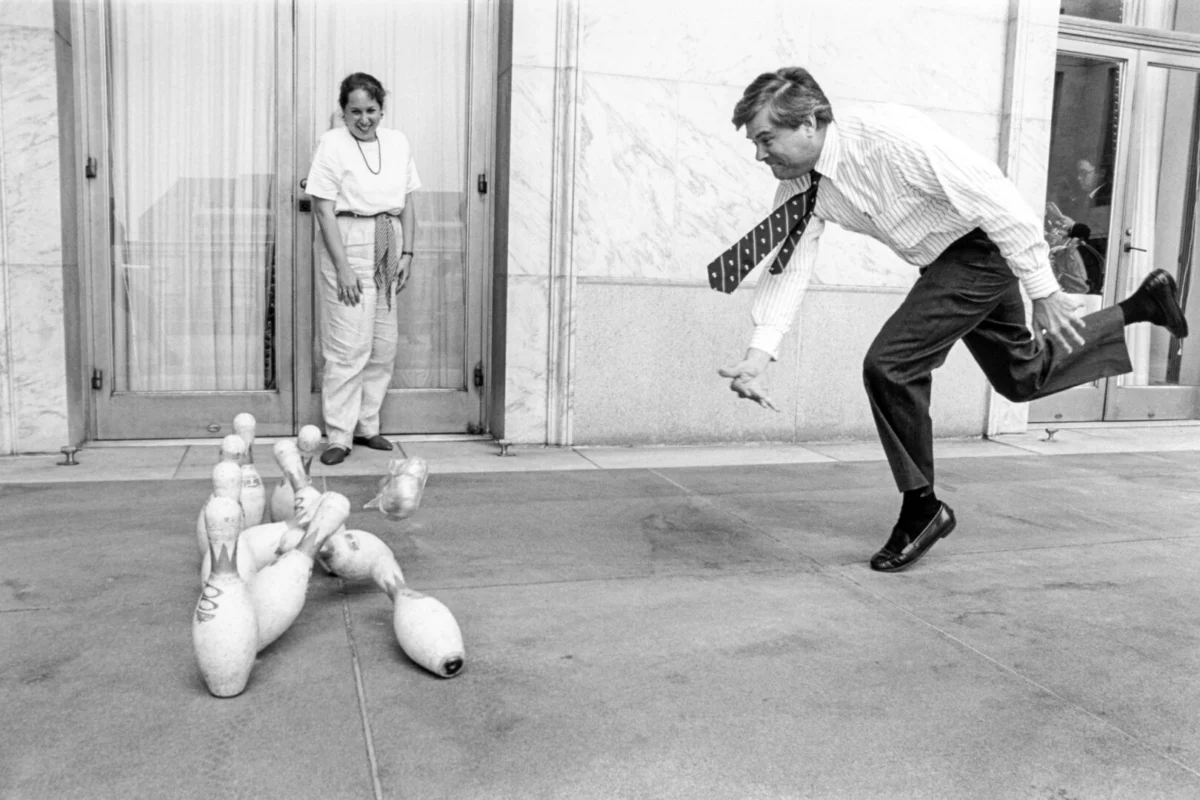
June 16, 2026 – Washington D.C. – Thirty-two years ago today, the hallowed halls of the Rayburn House Office Building witnessed one of the more unusual — and surprisingly impactful — acts of political theater in recent memory. On June 16, 1994, then-California Democratic Representative Richard H. Lehman, a figure known for his pragmatic approach to legislative issues, exchanged his customary legislative briefs for a frozen chicken and a bowling lane. This seemingly bizarre spectacle, sponsored by the California Poultry Industry Federation, was no mere frivolity; it was a pointed, public protest against a then-controversial United States Department of Agriculture (USDA) policy that allowed frozen chicken to be labeled and sold as "fresh."
The image, an archival snapshot now resurfacing on its anniversary, captures Lehman mid-delivery, a solid, ice-hard poultry projectile hurtling towards pins, symbolizing the deep-seated frustration felt by segments of the poultry industry and consumer advocacy groups alike. What began as a quirky media stunt quickly morphed into a national conversation, forcing a closer examination of food labeling integrity, consumer deception, and the opaque processes of federal regulatory bodies. This retrospective piece delves into the "Frozen Fowl Fiasco," exploring its origins, the intense debates it sparked, and its lasting implications on food labeling standards in America.
Main Facts: The Icy Core of the Controversy
The central issue that brought a frozen bird onto the congressional bowling alley was the USDA’s proposed (and later implemented) policy defining "fresh" poultry. Traditionally, "fresh" had implied never having been frozen below 26 degrees Fahrenheit. However, under pressure from certain sectors of the poultry industry seeking broader market access and extended shelf life, the USDA considered, and eventually adopted, a new standard. This new interpretation permitted poultry that had been frozen and subsequently thawed to be labeled as "fresh," provided it had not been held below 0 degrees Fahrenheit. For many, this was a semantic sleight of hand, fundamentally misleading consumers who associated "fresh" with poultry that had never experienced freezing temperatures.
Representative Richard H. Lehman, representing California’s 19th congressional district, became a vocal proponent of consumer clarity and industry fairness. His district, a significant agricultural hub, included numerous poultry producers who specialized in genuinely fresh, unfrozen products. They argued that the USDA’s relaxed definition would put them at an unfair disadvantage, confusing consumers and eroding the perceived quality of their truly fresh offerings. The California Poultry Industry Federation, representing these producers, saw the USDA’s stance as a direct threat to their market share and reputation.
The bowling stunt itself, held in the bustling Rayburn House Office Building, was orchestrated with precision. A makeshift bowling lane was set up, complete with pins. Lehman, dressed in a business suit, demonstrated the impracticality and inherent contradiction of the policy by attempting to bowl with a rock-solid, frozen chicken. The visual was undeniably powerful: a Congressman literally throwing a frozen chicken to highlight the absurdity of calling it "fresh." The event served as a prelude to a critical congressional hearing, scheduled immediately afterward, which aimed to scrutinize the controversial USDA policy. This dual approach – leveraging both political theater and formal legislative proceedings – ensured maximum public and media attention.
Chronology: Unpacking the "Fresh" Fowl Timeline
The "Frozen Fowl Fiasco" was not an isolated incident but the culmination of years of evolving consumer expectations, industry lobbying, and regulatory challenges.
Pre-1994 Context: The Rise of Food Labeling Debates
The late 20th century witnessed a significant shift in consumer awareness regarding food. Driven by growing concerns about health, nutrition, and food safety, there was an increasing demand for transparent and accurate food labeling. The Nutrition Labeling and Education Act of 1990 (NLEA) had already mandated comprehensive nutrition facts panels, setting a precedent for greater clarity. Against this backdrop, the definition of "fresh" for perishable goods like poultry became a focal point. Consumers increasingly relied on labels to make informed choices, and any perceived ambiguity or deception was met with skepticism.
The Genesis of the "Fresh" Chicken Policy
The USDA’s consideration of redefining "fresh" for poultry was largely driven by industry pressures. Processors utilizing freezing technologies argued that maintaining a strict "never frozen" definition for "fresh" limited their logistical capabilities, increased waste, and prevented them from efficiently distributing poultry across broader markets. They contended that modern freezing techniques preserved quality and safety, and that the previous definition was outdated and overly restrictive. Certain large-scale producers, with extensive distribution networks, saw the revised definition as a way to streamline operations and offer consumers a wider variety of products under a desirable "fresh" label. They lobbied the USDA extensively, presenting technical arguments about flash-freezing and rapid thawing methods that, in their view, maintained product integrity.
Industry Concerns and Advocacy
However, this perspective was vehemently opposed by other segments of the poultry industry, particularly smaller, regional producers who specialized in truly fresh, never-frozen chicken. Organizations like the California Poultry Industry Federation argued that the proposed policy constituted blatant consumer deception. They highlighted that consumers intuitively understood "fresh" to mean unfrozen, and that conflating frozen-then-thawed products with genuinely fresh ones would erode trust and create unfair competition. They launched extensive public awareness campaigns, detailing the differences in texture, taste, and shelf life that often accompany frozen poultry, even after thawing. Their advocacy efforts sought congressional intervention to safeguard consumer interests and protect the market for truly fresh products.
June 16, 1994: The Rayburn House Event
The morning of June 16, 1994, was abuzz with anticipation in the Rayburn House Office Building. News crews and print journalists gathered, cameras poised, to witness the promised "Frozen Fowl Fiasco." Representative Lehman, flanked by representatives from the California Poultry Industry Federation, delivered impassioned remarks about consumer rights and the integrity of food labeling. He then proceeded to the makeshift bowling lane, picked up a solidly frozen broiler, and attempted to bowl. The image of the Congressman struggling to grip and release the icy bird, which often slid awkwardly or veered off course, perfectly underscored the absurdity of the "fresh" label. "You can’t call this fresh!" Lehman declared, holding up the chicken, "It’s as fresh as a block of ice!" The event was a masterclass in visual communication, instantly conveying the core argument to a national audience.
The Subsequent Hearing
Immediately following the bowling stunt, the House Agriculture Subcommittee on Livestock, Dairy, and Poultry convened a hearing on the USDA’s proposed policy. The hearing room was packed, a direct result of the preceding media spectacle. Witnesses included USDA officials defending their stance, industry representatives from both sides of the debate, and consumer advocacy groups. USDA presented technical data, arguing that their definition was based on scientific parameters for product safety and quality post-freezing. They emphasized that proper thawing procedures would ensure a product comparable to "fresh" in many respects.
However, consumer groups, spearheaded by organizations like the Consumer Federation of America, presented compelling testimony on public perception and the inherent misleading nature of the label. They cited surveys indicating that an overwhelming majority of consumers defined "fresh" poultry as never having been frozen. Industry opponents, including the California Poultry Industry Federation, provided detailed accounts of potential market confusion and economic harm to producers of genuinely fresh poultry. They argued that the policy would allow lower-cost, frozen-then-thawed products to compete unfairly with premium, never-frozen chicken, thereby driving down prices and quality across the board.
Post-Event Fallout and Policy Evolution
While the USDA initially pushed forward with its revised "fresh" definition, the public outcry and congressional scrutiny generated by Lehman’s stunt and the subsequent hearing were undeniable. The policy did go into effect, allowing poultry frozen to 0 degrees Fahrenheit or below to be labeled as "fresh" after thawing. However, the controversy continued to simmer, leading to ongoing consumer education efforts and persistent lobbying. The public attention sparked a broader debate about food labeling transparency. Over subsequent years, and partly influenced by this incident, the USDA eventually refined its stance. While the technical definition wasn’t immediately reversed, consumer pressure and continued advocacy led to increased clarity in labeling, often requiring additional descriptors or caveats for products that had been previously frozen. This incident laid the groundwork for later, stricter interpretations and a greater emphasis on consumer understanding in food labeling regulations.
Supporting Data: The Broader Landscape of Food Labeling
The "Frozen Fowl Fiasco" was more than just a political stunt; it tapped into deeper currents of consumer sentiment, economic realities, and regulatory challenges.
Consumer Sentiment and Public Opinion
Multiple surveys conducted around the time, and even retrospectively, consistently showed that consumers held a clear and intuitive understanding of "fresh." For poultry, this unequivocally meant "never frozen." A 1993 study by the Consumer Federation of America, for instance, found that over 85% of respondents believed "fresh" chicken meant it had never been frozen. This stark disconnect between regulatory definitions and public perception was at the heart of the controversy. Consumers felt misled and often expressed frustration at what they perceived as regulatory bodies siding with industry interests over consumer clarity. This erosion of trust in food labels had broader implications for the credibility of federal oversight.
Economic Impact on the Poultry Industry
The proposed "fresh" labeling policy had significant economic ramifications. For large-scale processors with advanced freezing and thawing capabilities, it represented an opportunity to expand their market reach, reduce spoilage, and manage inventory more efficiently. They could ship frozen products nationally and label them "fresh" upon thawing at retail, potentially cutting logistics costs. Conversely, for smaller, regional producers who primarily focused on genuinely fresh, never-frozen chicken, the policy threatened their premium market. They faced the prospect of having their distinct product category diluted and undervalued, potentially leading to reduced sales and profit margins as consumers, confused by the label, might opt for cheaper, previously frozen alternatives. The debate highlighted the tension between industrial-scale efficiency and traditional, often regional, production methods.
Precedent in Food Labeling
The "fresh" chicken debate was not unique in the history of food labeling controversies. Similar battles have been fought over terms like "natural," "organic," "free-range," and even the very definition of "milk" or "meat" for plant-based alternatives. Each of these disputes underscores the inherent difficulty in translating complex agricultural and processing realities into simple, understandable, and non-misleading terms for consumers. They also highlight the powerful influence of industry lobbying on regulatory definitions and the constant tension between promoting commerce and protecting consumer rights. The "fresh" chicken debate served as an early, high-profile example of these ongoing struggles.
Legislative Landscape in 1994
In 1994, the political climate was characterized by an increasing focus on regulatory reform and consumer protection, especially in the wake of significant legislative changes like NLEA. While healthcare reform dominated much of the congressional agenda, food safety and labeling were consistently present issues, often championed by bipartisan coalitions. The House Agriculture Committee, in particular, played a crucial oversight role for the USDA. The committee’s hearings were often arenas for vigorous debate between agricultural interests, consumer advocates, and federal agencies. Rep. Lehman’s stunt, therefore, landed in a fertile ground for legislative attention, leveraging existing congressional interest in food policy.
Official Responses: Voices from All Sides
The "Frozen Fowl Fiasco" elicited a range of responses from various stakeholders, reflecting the deep divisions and strong convictions surrounding the issue.
USDA’s Defense of the Policy
The USDA maintained that its revised definition was technically sound and did not deceive consumers. Officials argued that the freezing process, when conducted properly, preserved the inherent quality and safety of the poultry. They also emphasized that the new definition provided flexibility for the industry while ensuring product integrity. In congressional hearings, USDA representatives often cited scientific data on bacterial growth inhibition at freezing temperatures and the efficacy of modern thawing methods. They suggested that consumer perception was often based on outdated notions of freezing and that the new policy simply reflected advancements in food technology and processing.
Congressional Reactions
While Rep. Lehman was the most visible proponent of stricter labeling, his efforts garnered significant, albeit not universal, support within Congress. Many members of the House Agriculture Committee expressed concerns about consumer confusion and the potential for unfair competition. Some colleagues praised Lehman for his innovative approach to raising awareness. However, other members, particularly those from districts with large-scale poultry processors benefiting from the new definition, voiced support for the USDA’s policy, emphasizing industry efficiency and economic benefits. The debate cut across party lines, often aligning members based on the specific agricultural interests of their constituencies.
Industry Spokespeople
The California Poultry Industry Federation, alongside other regional "fresh" poultry producers, were the primary instigators and beneficiaries of the media attention generated by Lehman’s stunt. They articulated a clear message: "Fresh means never frozen." They argued that the USDA’s policy fundamentally undermined consumer trust and created a dishonest playing field. On the other side, major national poultry producers and their trade associations defended the USDA’s definition, emphasizing the safety, quality, and logistical advantages of their freezing and thawing processes. They often highlighted that freezing was a legitimate preservation method and that strict quality controls were in place to ensure product excellence.
Consumer Advocacy Groups
Consumer advocacy groups, such as the Consumer Federation of America and Public Citizen, were staunch allies of Rep. Lehman and the "fresh" poultry producers. They viewed the USDA’s policy as a clear example of regulatory capture, where industry influence trumped consumer protection. These groups mobilized public opinion, released reports detailing consumer confusion, and testified passionately about the right of consumers to accurate and transparent information. They argued that the word "fresh" carried a specific, deeply ingrained meaning for consumers, and that regulators had a duty to uphold that meaning, rather than redefine it to suit industrial convenience.
Implications: A Legacy of Transparency and Political Theater
The "Frozen Fowl Fiasco" may seem like a quaint historical footnote in the grand tapestry of American politics, but its implications resonated far beyond the Rayburn House Office Building.
Legacy of the "Frozen Chicken Bowling" Stunt
Rep. Lehman’s unconventional stunt proved remarkably effective in drawing attention to a complex and otherwise obscure regulatory issue. It transformed a bureaucratic dispute into a relatable, even humorous, public spectacle, making it accessible to a broader audience. The image of a Congressman bowling with a frozen chicken became an iconic symbol of the fight for clear food labeling. It demonstrated the power of political theater to cut through legislative jargon and capture public imagination, effectively forcing the USDA and Congress to address the issue more seriously than they might have otherwise. While the immediate policy change wasn’t a full reversal, the public pressure it generated certainly influenced subsequent debates and regulatory adjustments.
Evolution of Food Labeling Standards
The controversy surrounding "fresh" chicken was a significant stepping stone in the ongoing evolution of food labeling standards in the U.S. While the USDA initially held its ground, the enduring consumer demand for clarity and the persistent advocacy from industry segments and consumer groups eventually led to greater transparency. Today, while some nuances remain, there is a much stronger emphasis on providing consumers with clearer information about whether a product has been previously frozen. This incident contributed to a broader regulatory shift towards more descriptive and less ambiguous labeling, paving the way for more stringent rules on terms like "organic," "cage-free," and "non-GMO," which require verifiable standards and often third-party certification.
The Role of Political Theater
The "Frozen Fowl Fiasco" stands as a testament to the enduring power of political theater in influencing policy and public opinion. In an increasingly saturated media landscape, creative and memorable stunts can effectively bypass traditional news filters and directly engage the public. Lehman’s stunt was not just about drawing attention; it was about simplifying a complex regulatory issue into an easily digestible and visually compelling narrative. It proved that sometimes, a frozen chicken can be more persuasive than a hundred pages of legislative text, forcing a conversation that might otherwise remain confined to committee rooms.
Enduring Lessons for Consumers and Regulators
The 1994 "Frozen Fowl Fiasco" offers enduring lessons. For consumers, it highlights the critical importance of scrutinizing food labels and understanding that regulatory definitions can sometimes diverge from common understanding. It underscores the power of collective consumer voice in demanding transparency and accountability from both industry and government. For regulators, it serves as a cautionary tale about the perils of creating policies that are perceived as misleading or deceptive, even if technically justifiable. It emphasizes the need for regulations to not only be scientifically sound but also intuitively understandable and aligned with public expectations. The incident reminds us that in the realm of food, trust is paramount, and preserving that trust often requires more than just technical definitions – it demands genuine clarity and honesty in every label.