Main Facts: Commemorating a Quarter-Century of Resilience and Bipartisanship
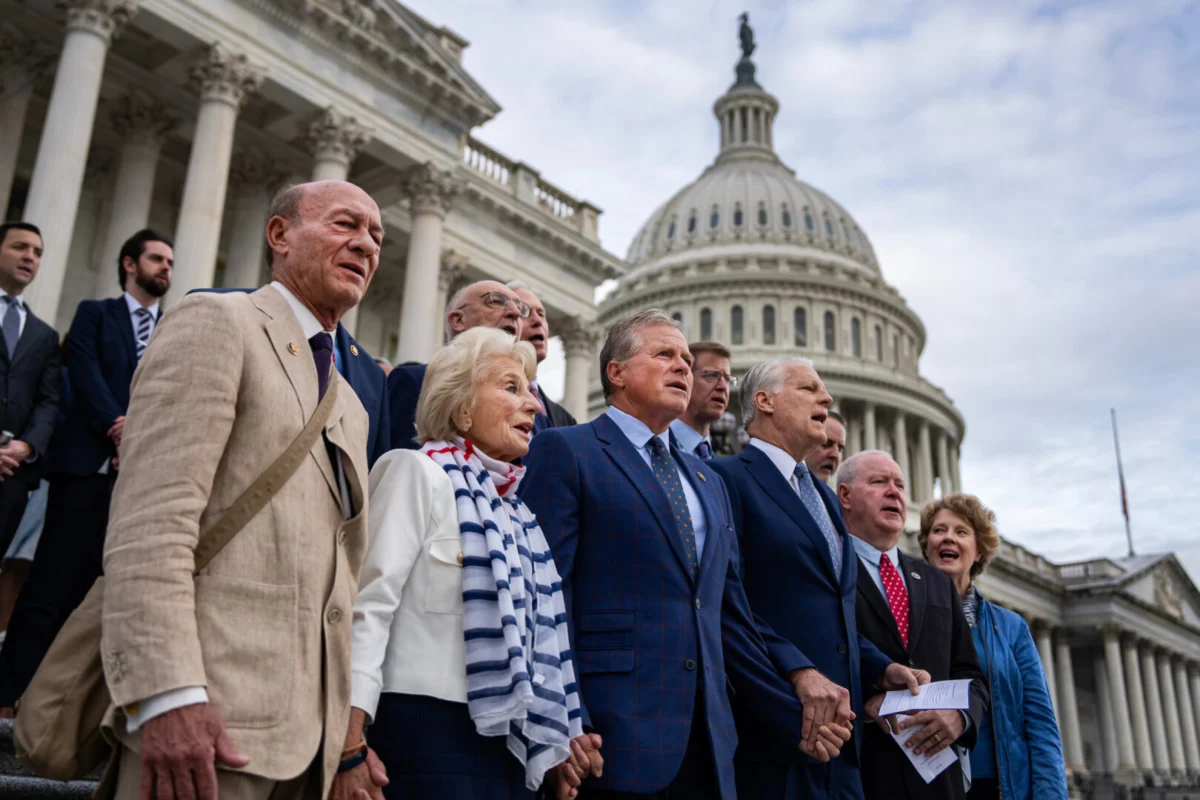
WASHINGTON — Standing under a blanket of silver clouds on the front steps of the United States Capitol on Friday morning, a bipartisan group of former and current lawmakers gathered to mark the 25th anniversary of the September 11, 2001, terrorist attacks. The solemn commemoration, organized by the Association of Former Members of Congress (FMC), served as both a memorial to the nearly 3,000 lives lost a quarter-century ago and an urgent plea for political reconciliation in an increasingly polarized nation.
The ceremonial gathering brought together key figures who served during and after the 2001 tragedy, alongside current congressional representatives. Among those in attendance were former Reps. Jane Harman (D-Calif.), Tim Roemer (D-Ind.), Larry Bucshon (R-Ind.), Derek Kilmer (D-Wash.), Mike Kopetski (D-Ore.), Charlie Dent (R-Pa.), and Susan Brooks (R-Ind.), as well as current Rep. Glenn F. Ivey (D-Md.).
Participants mirrored a famous, spontaneous moment from the evening of September 11, 2001, by joining hands on the House steps to sing "God Bless America." Throughout the ceremony, speakers emphasized that the cross-party unity forged in the immediate aftermath of the attacks was essential not only to national recovery, but to the creation of vital security architecture—including the Department of Homeland Security (DHS), the Transportation Security Administration (TSA), and the bipartisan 9/11 Commission.
The overarching message of the day focused on the national security risks posed by modern political hyper-partisanship. Speakers argued that internal division weakens the country’s strategic defense capabilities and undermines democratic institutions, urging current leaders to rediscover the collaborative spirit that defined Congress in late 2001.
Chronology: From Terror to Extraordinary Legislative Cooperation (2001–2026)
The history commemorated on the Capitol steps spans twenty-five years of evolving national security policy, legislative action, and shifting political dynamics.
September 11, 2001: The Day of the Attacks
- 8:46 a.m. EDT: American Airlines Flight 11 strikes the North Tower of the World Trade Center in New York City.
- 9:03 a.m. EDT: United Airlines Flight 175 strikes the South Tower of the World Trade Center.
- 9:37 a.m. EDT: American Airlines Flight 77 crashes into the West wall of the Pentagon in Arlington, Virginia.
- 9:45 a.m. EDT: The U.S. Capitol complex and White House are evacuated amid fears of incoming hijacked aircraft. Members of Congress and staff evacuate to the surrounding streets and secure off-site facilities.
- 10:03 a.m. EDT: United Airlines Flight 93 crashes in a field near Shanksville, Pennsylvania, after passengers and crew attempted to retake control of the aircraft from four al-Qaeda terrorists. Subsequent federal investigations confirmed the Capitol was the intended target.
- Evening of Sept. 11, 2001: In a landmark display of national solidarity, dozens of House and Senate members from both parties assemble on the Capitol steps, holding hands and singing "God Bless America" to demonstrate government continuity and national resolve.
Post-9/11 Legislative Epoch (2001–2004)
- November 2001: Congress passes the Aviation and Transportation Security Act, creating the Transportation Security Administration (TSA) to institutionalize federal airport security.
- November 2002: The Homeland Security Act of 2002 is signed into law, consolidating 22 federal agencies into the cabinet-level Department of Homeland Security (DHS)—the largest federal reorganization since the National Security Act of 1947.
- November 2002: Congress establishes the National Commission on Terrorist Attacks Upon the United States (the 9/11 Commission), co-chaired by former New Jersey Governor Thomas Kean (R) and former Indiana Congressman Lee Hamilton (D). Former Rep. Tim Roemer serves as one of its key commissioners.
- July 2004: The 9/11 Commission releases its final report, outlining critical intelligence failures and laying the groundwork for the Intelligence Reform and Terrorism Prevention Act of 2004, which established the Office of the Director of National Intelligence (ODNI).
September 11, 2026: The 25th Anniversary Commemoration
- 8:46 a.m. EDT: A bell alert sounds across the U.S. Capitol Police emergency broadcast system, marking the exact moment the first plane hit the North Tower. The Capitol campus observes a solemn moment of silence.
- Morning Ceremony: Former and current lawmakers address attendees on the House steps, delivering speeches on continuity of government, national security vulnerabilities, and legislative civility.
- Conclusion: Members of Congress clasp hands on the House steps to sing "God Bless America," closing the 25th-anniversary ceremony.
Supporting Data: The Legislative Legacy of 9/11 and Persistent Governance Vulnerabilities
The legislative response following September 11, 2001, remains one of the most prolific periods of swift, bipartisan policymaking in modern American history. However, historical data and ongoing policy analyses highlight both the achievements of that period and persistent unresolved vulnerabilities facing the federal government.
       HISTORICAL COMPARISON OF MAJOR POST-9/11 LEGISLATION VOTES
┌──────────────────────────────────────┬──────────────────────┬──────────────────────┐
│ Legislation                          │ U.S. House Vote      │ U.S. Senate Vote     │
├──────────────────────────────────────┼──────────────────────┼──────────────────────┤
│ Aviation & Transport Security (TSA)  │ Passed (Voice Vote)  │ 100 - 0              │
│ Homeland Security Act of 2002 (DHS)  │ 295 - 132            │ 90 - 9               │
│ 9/11 Commission Authorization        │ 366 - 3              │ Passed (Unanimous)   │
│ Intel Reform & Terrorism Prevention  │ 336 - 75             │ 89 - 2               │
└──────────────────────────────────────┴──────────────────────┴──────────────────────┘
Institutional Continuity Challenges
Despite the rapid legislative output in 2001–2004, experts note that critical gaps remain regarding the "Continuity of Government" (COG).
- The Flight 93 Target: Flight 93 was roughly 20 minutes of flight time away from Washington, D.C., when it crashed in Shanksville. Had it struck the Capitol building while lawmakers were present or gathering outside, a significant portion of the legislative branch could have been killed or incapacitated.
- Constitutional Gap: Article I, Section 2 of the U.S. Constitution mandates that vacancies in the House of Representatives can only be filled through special elections, a process that typically takes three to six months. Unlike the Senate—where state governors can immediately appoint interim replacements—a mass-casualty event involving the House would leave Congress without a constitutionally mandated quorum, halting federal legislation and emergency appropriations.
- Stalled Reforms: Despite multiple bipartisan commission recommendations over the past 25 years urging a constitutional amendment to allow emergency interim replacements in the House, Congress has repeatedly stalled on passing continuity legislation.
Official Responses and Reflections: Lawmakers Sound the Alarm on Division
During Friday’s event, speakers offered stark warnings regarding the state of American politics, drawing direct contrasts between the unity of late 2001 and contemporary ideological polarization.
Jane Harman on National Vulnerability and Continuity
Former Rep. Jane Harman (D-Calif.), who was present at the Capitol on September 11, 2001, reflected on the physical proximity of threat that day and the fragile nature of democratic continuity.
“Had this target been hit, many of us were milling outside here, right here,” Harman said, pointing toward the Capitol plaza. “There would have been a continuity of government crisis. And it is worth reflecting how lucky we were, in certain bizarre ways, to have avoided that.”
Harman underscored the nonpartisan nature of the immediate response: “I didn’t check whether the guy next to me was a Democrat or a Republican. I actually don’t know. And that was the point on 9/11. We all worked together.”
Tim Roemer on National Defense and Truth
Former Rep. Tim Roemer (D-Ind.), who served on the 9/11 Commission and later as U.S. Ambassador to India under President Barack Obama, emphasized that national defense relies fundamentally on political cohesion and shared reality.
“When we are divided, when we can’t agree on the facts, we can’t agree on the vulnerabilities, we can’t agree on our defense, and we become a more vulnerable nation as a result,” Roemer stated.
"When we are divided, when we can't agree on the facts, we can't agree on the vulnerabilities, we can't agree on our defense, and we become a more vulnerable nation as a result."
— Tim Roemer, Former U.S. Representative & 9/11 Commissioner
Larry Bucshon on Rank-and-File Bipartisanship
Former Rep. Larry Bucshon (R-Ind.), who retired from Congress in early 2025 after seven terms, pushed back against perceptions that Capitol Hill is entirely consumed by partisan warfare, distinguishing public political rhetoric from private legislative work.
“I can tell you, amongst the rank-and-file members of Congress, in contrast to what you see on TV, everybody wants to work together,” Bucshon noted. “Most of the people here on both sides of the aisle really are truly here trying to help their constituents. People want, fundamentally, to work together.”
Derek Kilmer on Proactive Unity
Former Rep. Derek Kilmer (D-Wash.), who also departed Congress in 2025 after leading the House Select Committee on the Modernization of Congress, emphasized that national unity should not require a national catastrophe to surface.
“I think an event like this, where you saw Democrats and Republicans on the House steps singing ‘God Bless America’ and holding hands is a reminder that there are moments we can come together,” Kilmer reflected. “And it shouldn’t take national crises for that to happen.”
Implications: National Security, Political Polarization, and the Call for Shared Truth
The 25th anniversary of September 11 comes at a critical juncture for U.S. domestic and foreign policy. The reflections offered on the Capitol steps highlight several broader implications for the future of American governance and national security.
1. Redefining National Security Beyond Traditional Threats
In 2001, the primary national security priority was counterterrorism and preventing foreign actors from executing physical attacks on U.S. soil. Twenty-five years later, intelligence officials and former lawmakers agree that threat vectors have expanded into:
- Cybersecurity and Infrastructure Security: Attacks targeting electrical grids, financial networks, and government data systems.
- Information Warfare: Foreign disinformation campaigns engineered to exploit domestic political divisions.
- Domestic Extremism: Internal political polarization escalating into violence against public institutions.
As former Commissioner Tim Roemer observed, when internal political factions fail to agree on fundamental facts, national defense structures become fractured, making the country vulnerable to modern hybrid warfare strategies.
2. The Institutional Cost of Hyper-Partisanship
While former members like Bucshon insist that rank-and-file lawmakers retain a desire to collaborate, the public perception and operational reality of Congress are often dictated by high-profile ideological conflict. Hyper-partisanship leads to:
- Legislative Gridlock: Inability to pass routine reauthorizations for national security, intelligence, and emergency management agencies.
- Erosion of Public Trust: Lower public confidence in Congress’s ability to respond decisively during a major emergency.
3. Unresolved Governance Protocols
The failure of Congress to pass comprehensive continuity legislation over the last 25 years remains a systemic risk. Should a mass-casualty event or severe biological threat paralyze Congress today, the lack of an immediate replenishment mechanism for the House could create constitutional challenges, potentially leaving the executive branch to govern without legislative oversight during a national emergency.
Conclusion: A Call for Daily Governance
As the final notes of "God Bless America" faded over the Capitol plaza on Friday morning, the gathering delivered a clear message to current and future leaders: the spirit of unity displayed on September 11, 2001, must not remain a rare exception reserved only for tragedy. For Congress to safeguard the nation over the next quarter-century, bipartisan cooperation must evolve from a reactive crisis response into a foundational principle of daily governance.