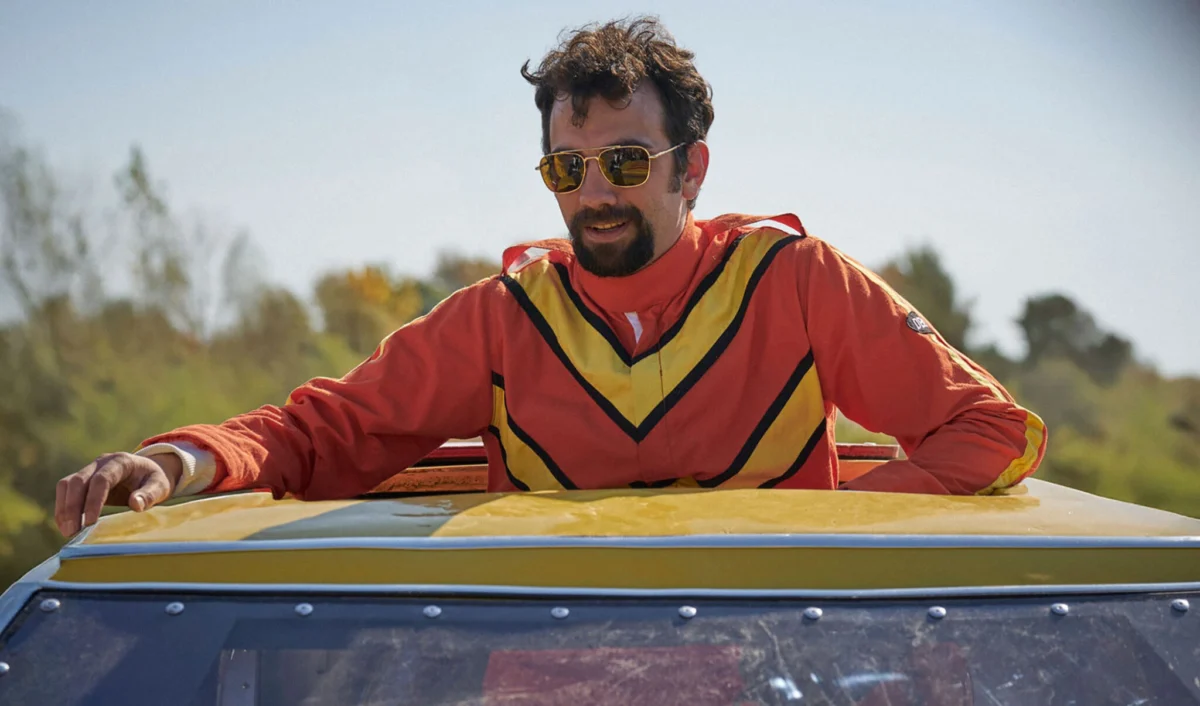
In the annals of daredevil history, few figures loom as large—or as tragically—as Ken Carter. Known to the world for the jump he ultimately failed to execute, Carter’s five-year obsession with clearing a mile-long stretch of the St. Lawrence River in a rocket-powered car remains a definitive study in human hubris. Now, director Michael Dowse, reuniting with his Goon collaborator Jay Baruchel, has attempted to translate this high-stakes obsession into a feature film titled The Stunt Driver.
While the film serves as a technically dazzling love letter to the 1981 cult documentary The Devil at Your Heels, it ultimately finds itself trapped in the shadow of its source material, struggling to justify its own existence as a narrative retelling.
The Myth and the Man: A Chronology of Obsession
To understand the weight of The Stunt Driver, one must understand the timeline of Ken Carter’s fixation. The documentary The Devil at Your Heels captured the raw, unvarnished reality of a man desperate for validation. Carter was not a stuntman in the traditional, calculated sense; he was a performance artist of gravity, defined by his ability to survive the impossible.
The narrative arc of both the documentary and Dowse’s film begins with a jarring, visceral hook: Carter is introduced mid-stunt, his body broken and bleeding on the pavement, yet his focus remains solely on the audience. Even from a stretcher, his primary concern is the crowd’s attention. He begs them not to leave, a moment that encapsulates his central pathology. As the film progresses, we see the assembly of his "enabler" team: the pragmatic engineer Dick Keller (played with grounded weariness by Ed Helms), the opportunistic sports agent Bill Wilkins (Dan Bakkedahl), and the exuberant Quebecois protégé Danny Lafortune (Marc Beaupré).
The film meticulously tracks the construction of the massive 90-foot ramp—a monument to a man who lived by the mantra, "I gotta jump, people like me." Yet, unlike the documentary, which allowed the absurdity to speak for itself, Dowse’s iteration attempts to inject a modern psychological layer, often at the expense of the story’s natural rhythm.
Behind the Lens: Technical Mastery and Visual Experimentation
If The Stunt Driver fails in its emotional resonance, it succeeds as a masterclass in cinematography and period recreation. Director of Photography Sara Mishara has achieved something remarkable here, utilizing a hybrid of digital capture, 16mm, and 35mm film stock to mirror the eras of the production.
The film’s structure is a meta-commentary on the nature of truth in cinema. For the first 80 minutes, Dowse toggles between the academy ratio (4:3) to mimic the archival footage of the 1981 documentary, and a sprawling widescreen format when providing his own "additional context." This visual shift is meant to suggest that the documentary captured only part of the truth, while the film offers a wider, glossier perspective.
The climax of the film even introduces a third aspect ratio, a stylistic choice intended to heighten the sense of anxiety and claustrophobia that consumed Carter in his final, ill-fated preparations. While the visual language is sophisticated, it often feels like a technical exercise in search of a soul. The audience is treated to a seamless intercutting of archival footage and high-fidelity recreations, but the polish often strips away the grit that made the original documentary so compelling.
The Performance: Baruchel and the Nixonian Shadow
The central anchor of the film is Jay Baruchel’s portrayal of Ken Carter. It is a bold, high-wire act of a performance, yet it remains one of the film’s most divisive elements. Baruchel plays Carter as an eccentric showboater, frequently veering into grandiose, elaborate dialogue that feels at odds with the more understated, low-key man depicted in the archival interviews.
The performance takes a particularly strange turn when Baruchel leans into the darker, more desperate aspects of Carter’s psyche. At moments, the actor’s cadence and mannerisms evoke a bizarre, unintentional resemblance to Richard Nixon—a choice that muddies the emotional waters of the film. When the script tries to frame Carter’s class-based resentment as a driving force for his stunts, the Nixonian parallels turn the character from a tragic hero into something far more sinister and harder to empathize with.
The final scene, which employs a slow-motion dissolve from Baruchel to the real Ken Carter, serves as a jarring reality check. Instead of bridging the gap between actor and subject, it highlights the artificiality of the performance, leaving the audience to wonder if the "real" Carter is actually further away than he was before the credits rolled.
Implications: The Politics of the Stunt
One of the more curious additions in The Stunt Driver is its overt focus on the geopolitical climate of the 1970s. Dowse frames Carter not just as a daredevil, but as a zealous Canadian patriot. By casting him in opposition to the American legend Evel Knievel—whom Carter derides as a "yankee doodle dandy"—the film attempts to tap into contemporary trade-war tensions.
However, the film’s handling of the "American antagonist" trope is inconsistent. In a notable departure from history, the film replaces the real American stuntman who eventually took over Carter’s jump—Kenny Powers—with a fictionalized Quebecois character named Lafontaine. While this change was likely made to avoid confusion with the famous Eastbound & Down character of the same name, it represents a missed opportunity to lean further into the film’s anti-American subtext. By removing the American successor, the film inadvertently weakens the very narrative conflict it spent the first hour establishing.
Supporting Data: A Comparison of Perspectives
While The Stunt Driver benefits from access to previously unused interviews and, most importantly, a rediscovered radio interview in which Carter was hypnotized, it struggles to synthesize this new information. The hypnosis recordings offer a window into a level of vulnerability the 1981 documentary never touched, yet the film never quite knows what to do with this "artifact."
The supporting cast, particularly Laurence Lebouef as Gloria Carter, is relegated to the background, serving as the necessary, suffering foil to Ken’s ego. It is a standard biopic trope that feels tired in the face of the documentary’s more candid, albeit brief, depictions of the people in Carter’s orbit. Conversely, the film features a standout performance by Joe Coben as the documentary director Bob Fortier. His vocal mimicry is so precise and chillingly accurate that it momentarily elevates the entire production into a more nuanced, documentary-style meditation on the medium itself.
Conclusion: The Verdict
The Stunt Driver is an ambitious, handsomely lit, and technically proficient film that is fundamentally hampered by its own insecurity. By choosing to expand upon a documentary that is already considered a masterpiece of the genre, it sets an impossible bar for itself.
The film captures the look of the era and the mechanics of the jump, but it fails to capture the intangible, desperate electricity that made Ken Carter a legend. It is a slow, methodical study of a man who lived at 100 miles per hour, yet the film itself rarely picks up the pace. For those unfamiliar with the original The Devil at Your Heels, this film may serve as an interesting introduction to a fascinating life. For those who know the source, however, The Stunt Driver is a reminder that some stories are best told by the cameras that were there when the dust was actually settling.