The landscape of civil disobedience and legal accountability in the United Kingdom shifted dramatically this week as the Court of Appeal issued a landmark ruling regarding the status of the advocacy group Palestine Action. In a unanimous decision handed down on Monday, the court upheld the government’s 2025 designation of the group as a “terrorist” organization, affirming that the state’s counter-terrorism powers can be applied to direct-action activism when such activities involve significant property damage and the subversion of law enforcement.
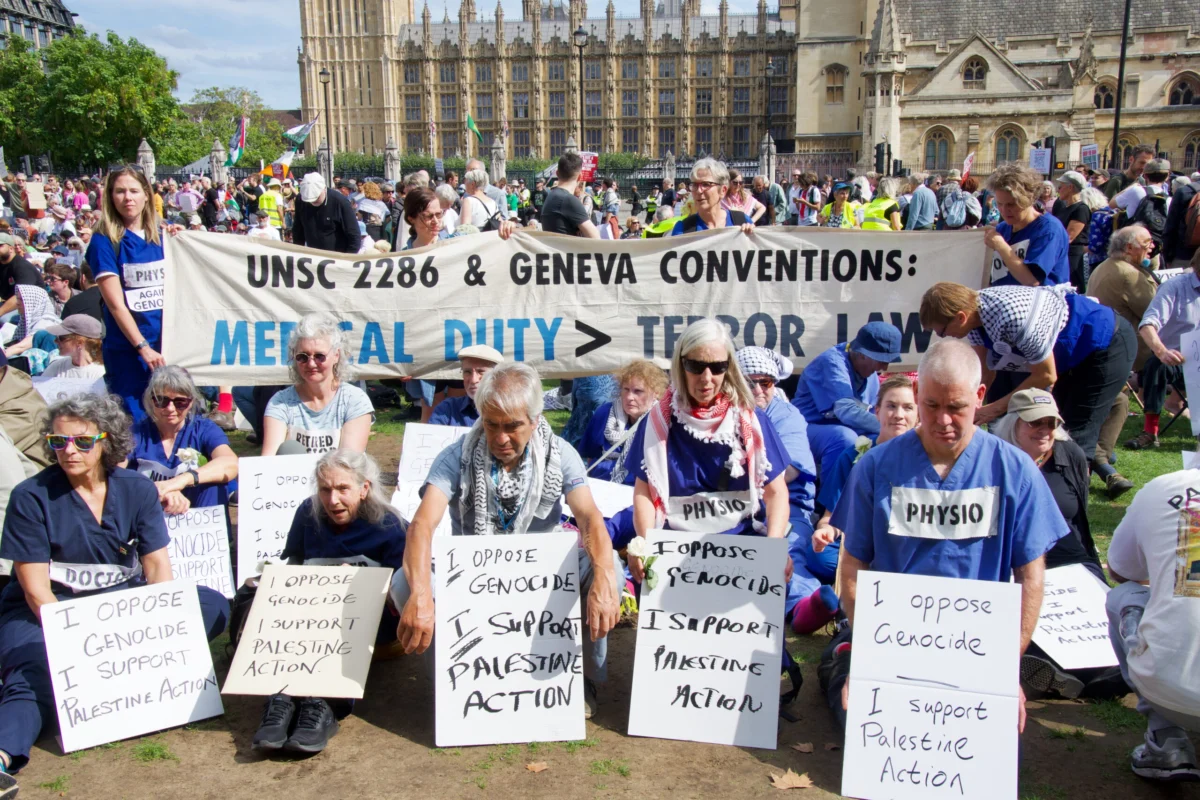
The ruling, which has drawn sharp rebukes from human rights organizations, was immediately followed by a robust police response. Outside the courtroom, the Metropolitan Police arrested 117 protesters who had gathered to demonstrate their support for the group, signaling a new era of heightened enforcement against those associated with the organization.
The Legal Foundation: Proportionality and Public Order
At the heart of the Court of Appeal’s judgment was the “proportionality test.” This legal standard requires the government to demonstrate that any infringement on the right to peaceful protest is justified by a legitimate, overriding public interest. The appellants had argued that the designation was an overreach that effectively criminalized political dissent.
The court, however, took a different view. It concluded that the actions of Palestine Action—which have frequently involved the targeting of facilities owned by Elbit Systems UK, a subsidiary of the Israel-based international military technology firm—transcended the bounds of protected protest. The court highlighted the group’s systematic use of an “Underground Manual,” a guide designed to help activists avoid detection while executing break-ins and sabotage.
The justices ruled that such tactics, which resulted in significant property damage and the disruption of business operations, fall outside the scope of constitutional protection. While acknowledging that the “terrorist” designation might have a “chilling effect” on legitimate activism, the court maintained that the necessity of protecting third-party property and the safety of personnel outweighs the individual’s right to assemble in this specific context.
Furthermore, the ruling clarified the latitude granted to the Home Secretary. The court held that the government is entitled to consider the practical consequences for police operations when deciding whether to proscribe an organization. This decision empowers the executive branch to use the effectiveness of law enforcement as a “highly significant factor” in the balancing exercise of proscription, overturning a lower court’s previous skepticism toward this criterion.
Chronology of Conflict: From Activism to Proscription
The legal battle is the culmination of years of escalating tension between the state and the activist network.
- 2022: Palestine Action gains prominence through a series of high-profile, disruptive actions, including the targeting of the Thales defense factory in Glasgow. These actions were framed by the group as necessary interventions to halt the production of military hardware used by Israel.
- 2024: The group intensifies its campaign, successfully breaching facilities associated with Elbit Systems and Instro Precision. A notable break-in at an Elbit facility resulted in approximately $1.6 million in property damage, triggering a massive police investigation.
- July 5, 2025: The UK Home Secretary officially designates Palestine Action as a terrorist organization. This move is met with immediate opposition from civil liberties groups, including Amnesty International, who warned that the legislation was overly broad.
- June 2026: Justice Jeremy Johnson at Woolwich Crown Court sentences the “Filton 4”—four activists involved in the 2024 Elbit break-in—to prison terms, explicitly citing a “terrorist connection” despite the charges being rooted in criminal damage.
- June 2026 (Monday): The Court of Appeal upholds the proscription, confirming that the government’s use of terrorism law against the group is lawful.
The "Filton 4" Precedent: Terrorism Labels for Criminal Damage
Perhaps the most controversial aspect of this saga is the sentencing of the "Filton 4." In an unprecedented move, Justice Jeremy Johnson concluded that the activists’ actions were intended to "intimidate the UK government to advance a political cause."
This interpretation of the law—that criminal damage conducted with a political motive can be classified as terrorism—has sent shockwaves through the UK’s legal and activist communities. Kerry Moscogiuri, the UK chief executive of Amnesty International, expressed deep concern, noting that this is the first time a standard criminal damage conviction has been tied to a terrorism penalty.
"It is completely disproportionate to punish protesters for criminal damage as if they were terrorists," Moscogiuri stated. "A sentence of this nature will stay with these individuals for the rest of their lives, essentially branding them as enemies of the state for activities that were previously handled as civil or criminal trespass issues."
Supporting Data and Policy Implications
The government’s rationale for the proscription rests on the cumulative impact of Palestine Action’s activities. The Home Office has argued that the group does not merely protest; it engages in "calculated sabotage" that places employees at risk and costs taxpayers and private businesses millions of pounds annually.
Legal scholars note that the Court of Appeal’s endorsement of the Home Secretary’s ability to consider "police operational efficiency" as a basis for proscription is a significant expansion of executive power. Previously, proscription was reserved for groups involved in violence against persons or the incitement of extremist ideologies. By including organizations that primarily cause economic disruption and property damage, the UK government has effectively lowered the threshold for the use of its most severe counter-terrorism tools.
Critics argue that this creates a slippery slope. If "intimidating the government to advance a political cause" becomes the litmus test for terrorism, concerns have been raised that other protest movements—such as climate change activists or those advocating for economic reform—could find themselves under the same legal scrutiny if their methods prove too disruptive to the status quo.
Official Responses and the Road Ahead
The reaction to the Court of Appeal’s ruling has been sharply polarized. Supporters of the government’s position argue that the rule of law must be upheld and that businesses, regardless of their political controversy, have a right to operate without being subjected to illegal incursions.
Conversely, human rights organizations are calling for an urgent review of the Terrorism Act. Amnesty International has described the ban as "a grave misuse of counter-terrorism powers," arguing that the current trajectory will inevitably suppress legitimate, non-violent democratic debate.
The concern is not just about the group itself, but the symbolism of the logo and the act of association. As Amnesty noted during the initial consultation phase in 2025, the breadth of the law could lead to situations where even wearing a Palestine Action logo or sharing the group’s content on social media could theoretically result in an investigation for supporting a "terrorist" organization.
As the legal dust settles, the implications for the future of protest in the UK remain uncertain. While the Court of Appeal has signaled that "peaceful protest" remains a protected right, the definition of what constitutes "peaceful" has been drastically narrowed. By prioritizing the protection of third-party property and the efficiency of state operations over the traditional protections afforded to civil disobedience, the judiciary has provided the government with a powerful, if controversial, tool for managing dissent in the 21st century.
For now, the 117 individuals arrested outside the court face a uncertain legal future, and the activists within Palestine Action are left to navigate a landscape where their chosen methods have officially been classified as a threat to national security. The debate over whether the UK is sacrificing its democratic traditions for the sake of order is only just beginning.